Los Angeles, CA — Since its high-profile debut earlier this year, the Violet Audio dMix 128 has quickly established itself as a disruptive force in the digital mixing console market. Today, the company looks to solidify that standing with the release of Firmware V2. This substantial update is far more than a routine patch; it is a comprehensive overhaul that fundamentally alters how audio engineers interact with, share, and configure the dMix 128 ecosystem. By introducing advanced logical partitioning and sophisticated multi-user management, Violet Audio is aiming squarely at the high-stakes demands of modern concert touring, broadcast production, and multi-room venue management.
The Evolution of the dMix 128: A Chronology of Innovation
The journey of the dMix 128 began with a clear design philosophy: high-density processing power packed into a flexible, scalable architecture. When it first launched, the console was praised for its raw sonic performance and intuitive interface. However, early feedback from power users in the field highlighted a demand for greater flexibility in collaborative environments.
- Q1 2026: The dMix 128 enters the market, gaining immediate traction for its robust input/output capabilities and low-latency processing engine.
- Q2 2026: Violet Audio launches an aggressive feedback program, collecting data from front-of-house (FOH) engineers, monitor mixers, and broadcast technicians.
- Q3 2026: Development cycles for Firmware V2 begin, focusing on the "Mixer Split" technology and enhanced networking security.
- October 13, 2026: Violet Audio officially rolls out the Firmware V2 update, marking the most significant expansion of the dMix platform since its inception.
Core Features: Unpacking the V2 Update
The V2 update is defined by a shift toward "logical independence," allowing the physical hardware to serve multiple masters without compromising the integrity of the individual mix.
Mixer Split: The Engine of Versatility
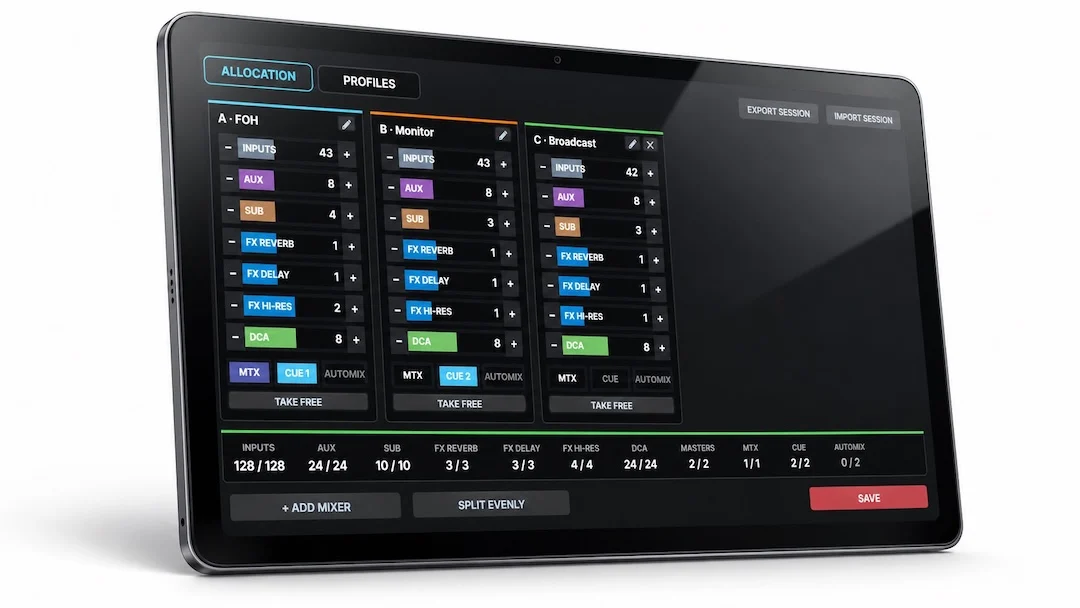
The crown jewel of the V2 update is undoubtedly the "Mixer Split" feature. In a traditional digital mixing environment, a single console is often dedicated to a single task—FOH or monitors. The V2 update shatters this paradigm by allowing the dMix 128 to be sliced into as many as four independent, logical mixer instances.
Each of these four instances functions as its own ecosystem. Users can allocate unique inputs, buses, effects racks, DCA groups, and even separate "Shows and Scenes" to each instance. This means that a single dMix 128 can simultaneously handle the FOH mix for a main stage, monitor mixes for the band, a broadcast feed for a live stream, and an auxiliary mix for a side stage—all within one integrated, redundant system.
Shared-Preamp Gain Tracking
One of the most persistent headaches for collaborative mixing teams is the "preamp war." When two engineers share the same physical input, adjusting the gain on one desk often ruins the level on the other. Violet Audio’s new Shared-Preamp Gain Tracking mitigates this by providing a unified view of the hardware gain. Operators can maintain their desired gain relationships while seeing the active hardware gain in real-time. Crucially, the system allows for authorized users to take direct control, ensuring that "gain staging" remains a coordinated effort rather than a chaotic struggle.
Offline Editor and Network Manager
Recognizing that time is the most valuable currency in live production, the V2 update introduces a powerful Offline Editor. Engineers can now build complex show files, route inputs, and configure signal processing in the comfort of a hotel room or office, then transfer the data to the dMix 128 upon arrival.
Complementing this is the new Network Manager, a utility that automatically discovers all dMix 128 devices on a network, regardless of complex IP address or subnet configurations. This "plug-and-play" capability for pro-audio hardware significantly reduces setup times and simplifies the integration of multiple consoles in large-scale venue infrastructures.
Supporting Data: Enhancing the Workflow
Beyond the marquee features, Firmware V2 introduces a suite of refinements that address the granular needs of the professional engineer:
- Matrix Expansion: The Matrix has been expanded to a 12×12 configuration, providing greater flexibility for complex routing requirements.
- Workflow Enhancements: The addition of a "Cut and Paste" function for Aux mixes allows engineers to quickly replicate settings across different outputs, saving critical minutes during soundcheck.
- Equipment Match Wizard: A new automated tool that helps engineers synchronize external hardware and peripheral equipment to the dMix 128’s internal routing, ensuring that digital and analog paths are perfectly aligned.
- Interface Refinements: The Personal Mix interface has been overhauled to prioritize visibility and tactile response, ensuring that musicians on stage have a clearer view of their individual monitoring needs.
Security and Governance: The New Profile-Based Access System
As the dMix 128 gains the ability to support multiple operators, the need for security has become paramount. The V2 firmware introduces a sophisticated profile-based access system. Administrators can now define specific permission levels:
- Admin: Full access to all system settings, routing, and user management.
- Mixer Operator: Access to assigned channels, faders, and processing, with limited administrative overrides.
- Personal Mix: A restricted mode designed for performers or junior operators, providing access only to the specific sends and levels they need to manage.
To ensure stability, these profiles can be locked behind four-digit PINs, preventing unauthorized adjustments during a live performance. This level of granularity is rarely seen in mid-to-large-format consoles and demonstrates Violet Audio’s commitment to institutional and touring reliability.
Official Perspective and Industry Implications
"The release of V2 is a direct response to the way modern productions are evolving," says a representative for Violet Audio. "Our users aren’t just mixing audio; they are managing complex networks of data and people. By providing the tools to partition the system, we are essentially giving our customers four consoles for the price of one. We believe this will fundamentally change how venues approach their infrastructure budget and how touring acts handle their FOH and monitor requirements."
The Industry Shift
The implications of this update are significant for several sectors:
- Concert Touring: By allowing FOH and monitors to reside on the same engine, touring companies can reduce the physical footprint of their tech packages, leading to lower freight costs and faster setup times.
- Broadcast/Streaming: The ability to pull a clean, independent feed directly from the FOH engine—without requiring a secondary split or stage box—will likely become a preferred workflow for live-streamed concerts.
- Houses of Worship: With the new profile-based access, volunteers can be given limited access to the board, ensuring that they can manage their own personal mixes without the risk of accidentally altering the main sanctuary mix.
Conclusion: A New Standard
The V2 update for the Violet Audio dMix 128 is a testament to the power of iterative design. By listening to the pain points of the end-user, the company has successfully bridged the gap between raw processing power and practical, real-world utility. As the industry continues to push for higher efficiency and lower overhead, the dMix 128, now bolstered by its newfound versatility, is positioned to remain a dominant player in the digital audio landscape for years to come.
For current owners, the update is available immediately via the Violet Audio website, providing an instant upgrade to the capability of their existing hardware—a rare and welcome value proposition in the high-end audio market.