SCOTTS VALLEY, CA — October 13, 2026 — For over two decades, the Empirical Labs Fatso has occupied a hallowed space in the world of professional audio. Whether tucked into the racks of a high-end recording studio in Los Angeles or serving as the "secret sauce" on a touring front-of-house rig, the Fatso Jr. and Sr. units have defined the sound of modern saturation. Today, Universal Audio (UA) and Empirical Labs have officially bridged the gap between the physical and the digital, announcing the release of the UAD Empirical Labs FATSO Tape Simulator plug-ins for macOS and Windows.
This collaboration, developed in direct partnership with Empirical Labs founder and legendary audio designer Dave Derr, promises to deliver the exact harmonic complexity, non-linear distortion, and compression "glue" that have made the hardware a modern classic.
The Main Facts: What is the Fatso?
At its core, the Empirical Labs Fatso (an acronym for "Full Analog Tape Saturation and Optimizer") was designed to solve a specific problem in the digital age: the clinical, sterile nature of early digital recording. By using a series of diode-based clipping circuits and transformer-emulating filters, the hardware mimics the musical degradation of magnetic tape.
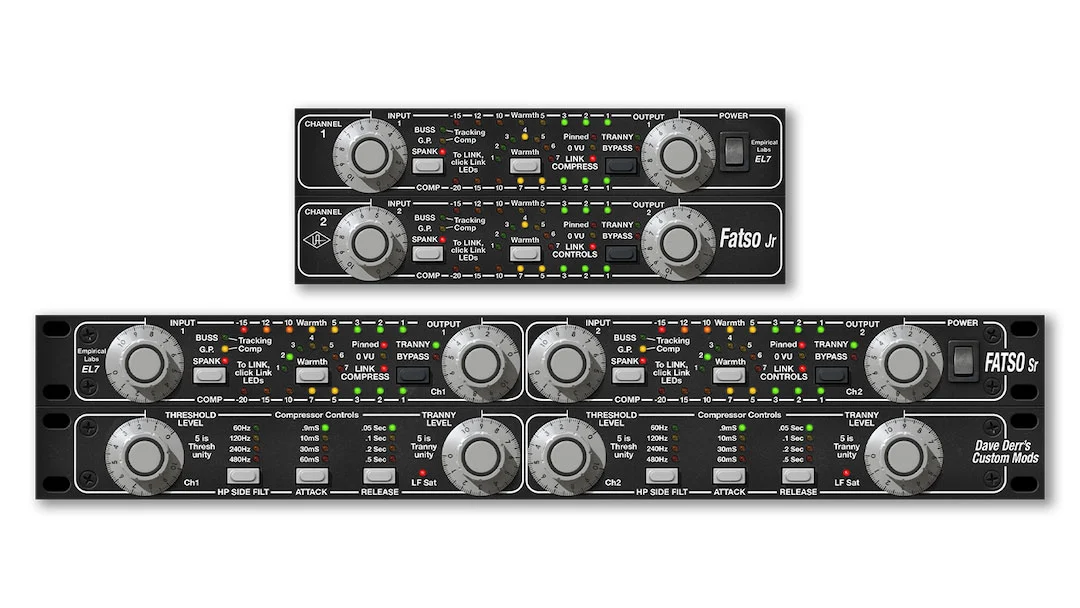
The new UAD release arrives as a dual-plug-in suite, mirroring the hardware lineup:
- The FATSO Jr.: Designed for ease of use and classic, "set-it-and-forget-it" saturation. It provides the essential, musical tape-like character that made the original a staple on drum buses and vocal chains.
- The FATSO Sr.: An expanded version of the Jr., offering granular control over compression parameters and saturation modes, tailored for engineers who require precision in their mix-bus processing.
Both versions feature the signature "Buss," "G.P.," "Tracking," and "Spank" compression modes. These modes have been meticulously modeled to recreate the unit’s unique ability to "glue" a mix together, turning disjointed tracks into a cohesive, finished record.
Chronology: A Legacy of Saturation
To understand the weight of this release, one must look at the history of the hardware itself.
The Mid-90s: The Analog Counter-Revolution
In the mid-1990s, as the industry began its migration toward digital audio workstations (DAWs), producers found themselves missing the "color" of tape. Dave Derr, building on his experience at Eventide, founded Empirical Labs and introduced the Fatso. It wasn’t just a compressor; it was a character box. It allowed engineers to hit the input hard, generating second and third-order harmonics that "thickened" thin digital signals.
The 2010s: The DSP Era
As Universal Audio expanded its UAD-2 platform, the need for an authentic Fatso emulation became the number one request from the professional community. UA released early iterations of the Fatso for their Apollo DSP hardware, which became instant best-sellers. These versions proved that digital algorithms could indeed capture the essence of Derr’s proprietary circuits.
2026: The Native Renaissance
With the transition of UAD’s ecosystem to "Native" (CPU-based) processing, the company faced a new challenge: re-engineering their most beloved legacy plug-ins to run on any audio interface, without the need for proprietary DSP cards. The release today marks the culmination of this transition, bringing the Fatso to a broader audience than ever before.
Supporting Data: Under the Hood
The technical achievement behind this release lies in the modeling of "Transformer Saturation." Unlike digital distortion, which often creates harsh, jagged clipping, the Fatso hardware relies on transformers that soften the signal as it reaches high input levels.
Key Features of the New Suite:
- Transformer Emulation: The plug-in recreates the subtle low-end roll-off and the high-end rounding that occurs when driving a high-quality audio transformer.
- Compression Modes:
- Tracking: A subtle mode designed for individual instruments.
- G.P. (General Purpose): A versatile setting that handles a wide range of source material.
- Buss: Designed specifically for the mix bus, providing that famous "glue."
- Spank: An aggressive, limiter-style mode that can make a room mic explode or a vocal track cut through a dense mix.
- Sidechain Filtering: An essential modern requirement, the new plug-in allows engineers to keep the low end of a kick drum or bass from triggering unwanted compression artifacts, ensuring the "warmth" doesn’t turn into "muddiness."
Official Responses: Dave Derr and Universal Audio
In an exclusive statement accompanying the launch, Dave Derr expressed his satisfaction with the final result. "The goal has always been to make digital sound less like a calculator and more like a musical instrument," Derr said. "Working with the team at Universal Audio, we spent months obsessing over the behavior of the diodes and the way the transformer saturation reacts to transient peaks. This isn’t just an approximation; it’s the Fatso, translated for the modern workflow."
Universal Audio’s engineering team noted that the move to native architecture allowed them to utilize higher oversampling rates than were possible in the original hardware-DSP days. "Because we aren’t limited by the fixed-point constraints of early DSP chips, we were able to push the fidelity of the saturation circuits to a new level," a lead developer stated. "The result is a plug-in that feels ‘expensive’ in the same way the hardware rack unit does."
Implications: The Changing Landscape of In-the-Box Mixing
The release of the UAD Fatso Native suite signals a broader shift in the music industry. As more producers work exclusively "in the box," the distinction between "analog" and "digital" continues to blur.
1. The Death of the "Clinical" Mix
For years, the "in-the-box" sound was criticized for being too clean. With tools like the Fatso now widely accessible via UAD Spark subscriptions and native plug-ins, the average bedroom producer has access to the same sonic textures as top-tier engineers. This will likely lead to a resurgence of "vibe-heavy" production, where harmonic saturation is used as a creative instrument rather than a corrective utility.
2. Pricing and Accessibility
The introduction of an introductory $79 price point is a strategic move by Universal Audio. By lowering the barrier to entry, they are ensuring that the Fatso becomes the industry standard for saturation, competing directly with third-party developers like FabFilter or Softube. The inclusion in the UAD Spark subscription also suggests that UA is moving toward a service-based model, prioritizing recurring access over one-off sales.
3. The End-of-Life for DSP-Only Workflows?
While many professional studios still rely on Apollo DSP for low-latency monitoring, the migration of the Fatso to native code suggests that the industry is moving toward a hybrid future. Engineers will likely use DSP for tracking (latency-free monitoring) and native plug-ins for mixing, effectively doubling their processing power.
Final Thoughts: A New Standard
The UAD Empirical Labs Fatso is more than just another saturation plug-in; it is the realization of a decades-long effort to codify "vibe." For the modern producer, it provides a shortcut to the warmth and depth that previously required thousands of dollars in hardware racks.
As we look toward the future of audio production, the Fatso stands as a reminder that the best technology doesn’t just process sound—it imparts a personality. Whether you are looking to "spank" a drum kit or gently warm up a digital synth, the Fatso remains the gold standard for adding character to a mix.
Availability:
The UAD Empirical Labs Fatso plug-ins are available now. Users can purchase the suite for an introductory price of $79 USD through December 31, 2026, after which the price will increase to $149 USD. Existing Apollo DSP owners can upgrade to the native version for a nominal fee of $2.99 USD, and the plug-ins are immediately included for all UAD Spark Studio subscribers.