Main Facts: The Return of a Legend
The landscape of high-end audiophile equipment has just shifted. Japanese audio pioneer Luxman—one of the remarkably few high-fidelity firms to achieve a centennial anniversary—is continuing its grand 100th-birthday celebration with the official release of the B-100 Centennial (affectionately known as the B-100C).
Breaking a twenty-year hiatus since the company last engineered a dedicated mono power amplifier (a milestone originally launched to commemorate Luxman’s 80th anniversary), the B-100C represents the absolute zenith of the brand’s century-long engineering journey and acoustic craftsmanship. Initially teased over the summer at the prestigious High End Vienna exhibition, the B-100C has now transitioned from prototype buzz to full commercial reality, with units officially shipping in the UK via distribution partner IAG.
Positioned firmly in the ultra-luxury tier, the B-100C carries a price tag of £22,000 individually (approximately $22,000 / AU$42,000), meaning a stereo pair will set dedicated enthusiasts back a cool £44,000 (roughly $58,000 / AU$83,000). For this substantial investment, buyers are treated to a masterclass in hybrid amplification engineering, custom-tailored component selection, and uncompromising industrial design.
Chronology: From Vienna Prototype to Global Shipping
To understand the weight of the B-100C’s arrival, one must look back at the timeline of Luxman’s historic milestone:
- The Centenary Kickoff (Last Year): Luxman officially marked its 100th year in operation by introducing an exclusive suite of Centennial products, establishing a high-water mark for the brand and setting high expectations for future legacy releases.
- Summer Preview in Vienna: The hi-fi community caught its first glimpse of the B-100 Centennial at the High End Vienna show. The mono amplifier immediately drew crowds and critical praise for its bold design and ambitious technical claims.
- The Production Phase and Final Specifications: Following the summer exhibition, Luxman fine-tuned the internal architecture—particularly its proprietary feedback and differential-detection circuitry—to ensure zero compromises in signal fidelity.
- Present Day: The B-100 Centennial is officially ready for global release, with distribution commencing across the UK. Audiophiles worldwide can now place orders for what promises to be one of the most defining amplifiers of the decade.
Supporting Data & Technical Architecture: Bridging Class A and Class AB
At the heart of the B-100 Centennial is a fierce dedication to solving one of audio engineering’s oldest compromises: the choice between the pure, unadulterated musicality of Class A amplification and the efficiency and raw power of Class AB.
The Hybrid Power Paradigm
Continuous Class A amplification is universally praised for its elimination of crossover distortion and its exceptional linearity, but it traditionally suffers from notoriously low efficiency, excessive power consumption, and massive heat generation. Conversely, Class AB provides the muscle needed to drive demanding speakers without melting component racks, but often introduces switching distortion.
Luxman’s solution for the B-100C is a uniquely refined hybrid architecture:
- Pure Class A Operation: The amplifier operates in continuous Class A up to 25 watts into an 8-ohm load. This ensures that delicate low-level details, micro-dynamics, and rich harmonic textures are rendered with absolute purity.
- Seamless Class AB Transition: Beyond 25 watts, the amplifier automatically and seamlessly transitions into Class AB operation. This allows the B-100 Centennial to scale effortlessly, delivering a robust 125 watts into 8 ohms and a massive 250 watts into 4 ohms.
- Speaker Load Handling: Luxman asserts that this architecture enables the amplifier to command "even the most demanding loudspeaker loads with authority," maintaining vice-like control over unruly woofer cones while retaining an open, natural soundstage.
Inside the Chassis: Precision Engineering
Luxman’s design philosophy for the B-100 Centennial leaves nothing to chance. Every millimeter of the signal path and power delivery system has been scrutinized:
- Output Stage Configuration: The amplifier features an advanced $4times4$ configuration, utilizing four quadruple-paralleled, triple-stage Darlington push-pull modules per amplifier.
- Power Supply Mastery: Energy delivery is managed by a highly stable EI-core transformer equipped with flat copper windings designed to minimize transmission losses, ensuring abundant energy reserves on demand.
- Refined Feedback Circuitry: Utilizing Luxman’s proprietary feedback system, the amplifier compares input and output signals to isolate and feed back only the distortion components, rather than tampering with the original music signal. For the B-100C, this circuit has been upgraded with parallel differential-detection circuitry to drastically lower distortion and enhance precision.
- Signal Integrity Measures: Luxman intentionally removed solder masks and residual flux from signal paths to preserve high-frequency integrity. The layout is optimized for ultra-low impedance, featuring large-gauge output conductors, a heavy-duty output coil, and low-resistance speaker relays.
Mechanical and Exterior Design
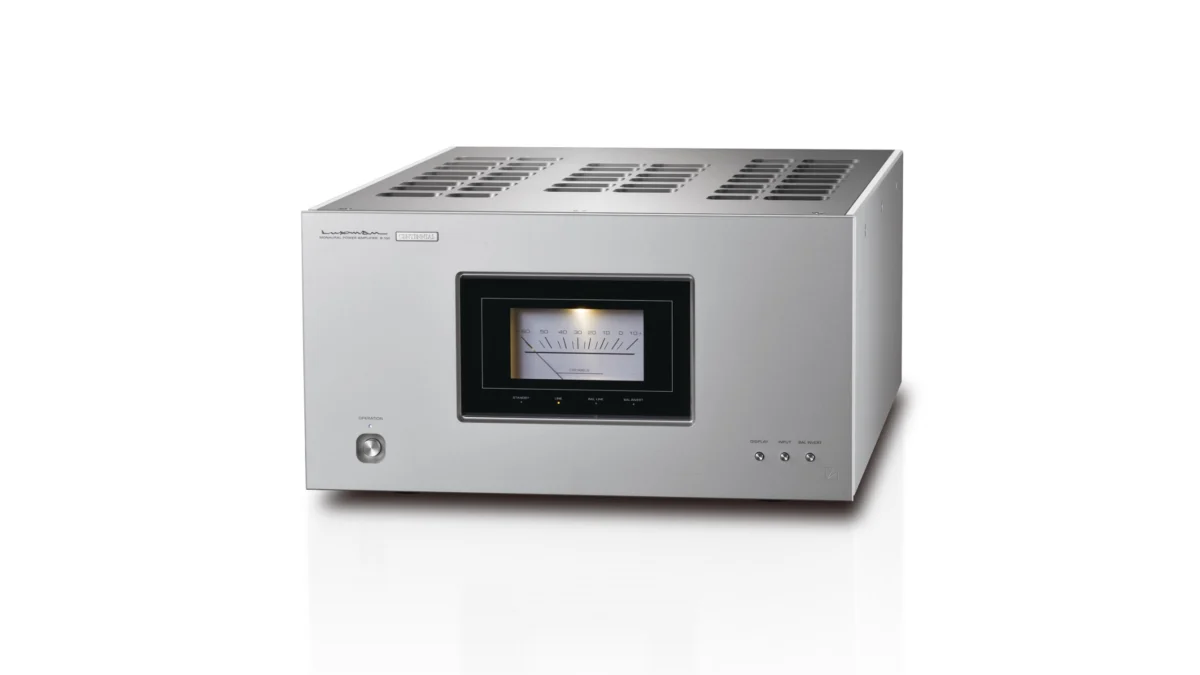
The physical build of the B-100 Centennial is as formidable as its electrical performance. Encased in Luxman’s signature ‘Blasted White’ silver finish, the chassis utilizes a loop-less construction to minimize ground impedance.
To combat airborne and mechanical interference, the amplifier rests securely on custom cast-iron density-gradient isolation feet. These feet serve a dual purpose: they block external vibrations from entering the chassis while actively dissipating internal resonances generated by the transformer and circuitry.
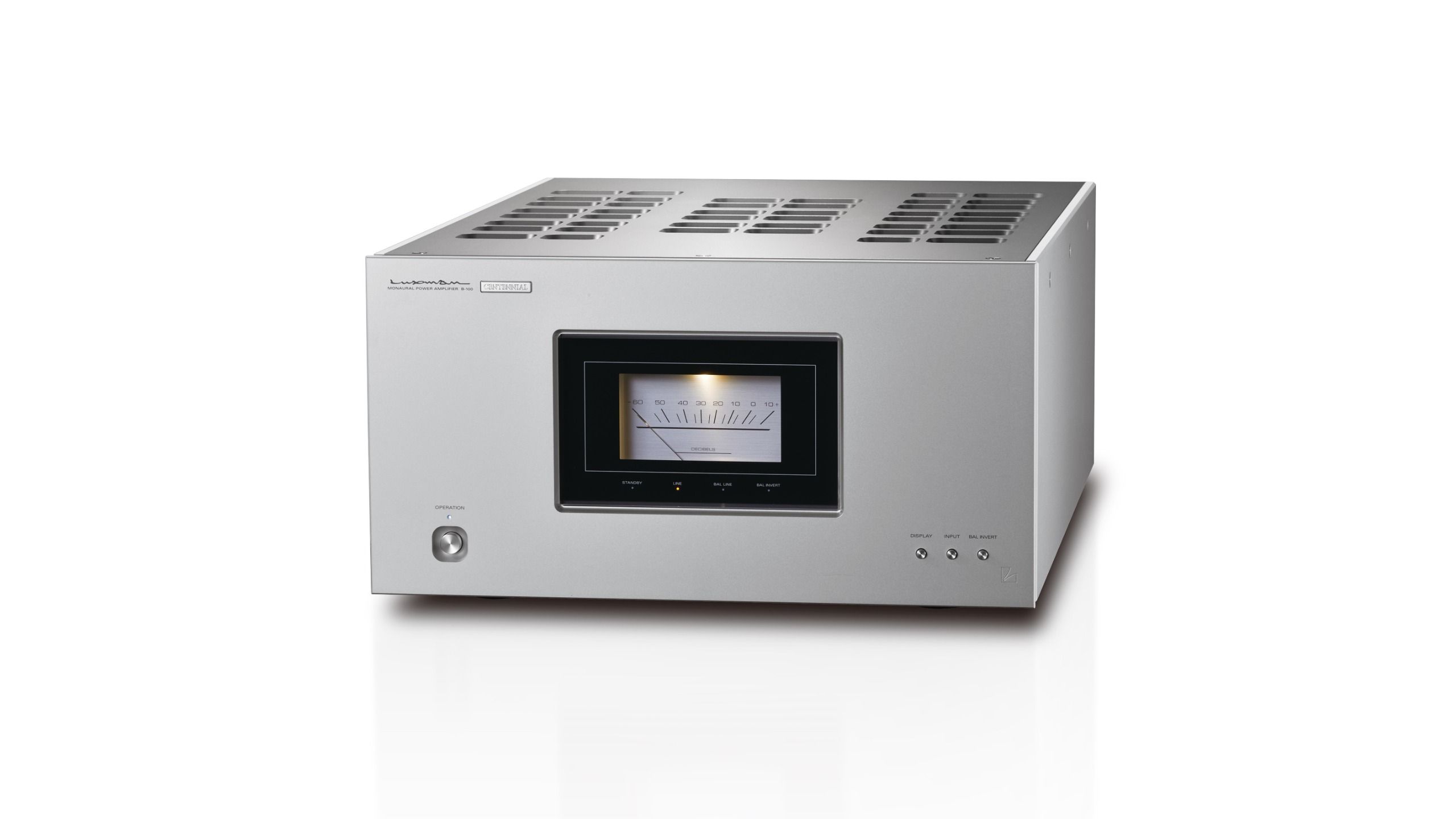
On the front fascia sits a classic, beautifully lit analogue meter illuminated by soft white LEDs, offering real-time visual feedback of signal output. Around back, the high-end treatment continues with rigid Luxman RCA terminals, Neutrik XLR connectors, heavy-duty binding posts, and an upgraded AC inlet engineered for long-term mechanical stability.
Official Responses and Industry Context
While official PR statements from luxury audio manufacturers naturally lean into superlatives, industry insiders and reviewers who experienced the B-100C during its European debut have noted that Luxman’s performance claims are firmly backed by the hardware.
"It combines the best of Class A and Class AB amplification without the typical pitfalls," noted early reviewers at high-end audio panels. The consensus within the professional audio community is that Luxman has successfully bridged the gap between raw, stadium-level power delivery and the intimate, micro-detailed presentation typically reserved for low-wattage single-ended tube or pure Class A designs.
The launch also underscores a broader industry trend: heritage audio brands with century-old legacies are increasingly willing to pull out all the stops, utilizing modern metallurgy, computer-aided circuit optimization, and no-expense-spared parts sourcing to appeal to ultra-high-net-worth audiophiles who demand both aesthetic timelessness and state-of-the-art performance.
Implications: What the B-100C Means for the Ultra-High-End Market
The release of the Luxman B-100 Centennial carries several important implications for the high-end hi-fi ecosystem:
1. A Statement of Longevity
Reaching 100 years in business is a vanishingly rare feat in consumer electronics. By releasing a dedicated mono power amplifier—a format that requires maximum R&D investment and caters to a niche, highly discerning subset of the market—Luxman is loudly declaring its independence, technical dominance, and commitment to traditional, analogue-centric high fidelity in a digital-first world.
2. Redefining Benchmarks in Hybrid Amplification
By claiming to eradicate the traditional artifacts that plague the handoff between Class A and Class AB, Luxman is setting a new technical benchmark. If the B-100C performs as seamlessly in consumer listening rooms as it did on the exhibition floor, it could influence how future high-end power amplifiers are engineered across the industry.
3. Exclusive Accessibility
At £44,000 for a stereo pair, the B-100 Centennial is definitively out of reach for the mainstream consumer. Instead, it serves as a "halo product"—a device that elevates the brand prestige of Luxman as a whole, trickling down engineering prestige and brand equity to their more accessible integrated amplifiers, preamps, and digital source components.
For the fortunate few who can afford to anchor their reference systems with a pair of B-100Cs, Luxman has delivered a fitting centurion: a monument to sound, style, and a century of uncompromising dedication to music.