NEW YORK, NY — As the broadcast industry pivots toward increasingly decentralized, software-defined workflows, Calrec Audio has positioned itself at the vanguard of this transformation. At the 2026 NAB Show New York, the company is demonstrating a comprehensive, IP-native ecosystem designed to bridge the gap between traditional hardware reliability and the agility of virtualized production.
Central to this demonstration is the Argo console range, bolstered by the debut of the Type RT compact console and the versatile Apex M6 I/O platform. These technologies collectively represent Calrec’s vision for the future of broadcast: a modular, interconnected environment where processing power is decoupled from physical surfaces and integrated via open-source standards.
Main Facts: The New IP Ecosystem
The centerpiece of Calrec’s showcase in New York is the seamless integration of its hardware portfolio through its ImPulse IP processing core. By utilizing True Control 2.0—a sophisticated software layer that harmonizes disparate hardware—Calrec is addressing one of the most persistent challenges in modern broadcasting: the management of complex, multi-operator, multi-location audio environments.
The Hardware Lineup:
- The Argo S and M Consoles: Calrec is showcasing a 36-fader Argo S console functioning as the primary controller, tethered to a 24-fader Argo M. This configuration highlights the flexibility of the Argo range, which allows operators to scale their control surfaces based on the requirements of a specific production without sacrificing the depth of the mix.
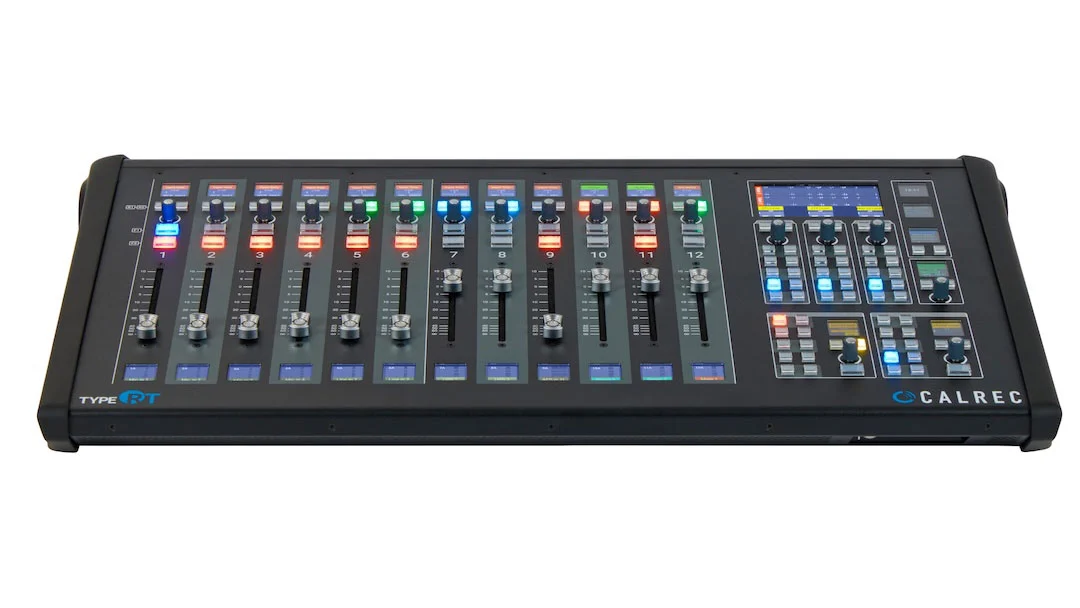
- The Type RT Compact Console: Launched in September, the Type RT is a breakthrough for space-constrained environments. Available in 6-, 12-, and 18-fader configurations, this all-in-one unit packs DSP, control processing, I/O, monitoring, and USB audio into a single chassis. Crucially, it supports native ST 2110 AoIP, with optional Dante and MADI support, ensuring it remains future-proofed for diverse facility requirements.
- The Apex M6 I/O Platform: This 1U modular platform is designed for the network edge. Featuring six configurable slots, a 512 x 512 internal router, and NMOS-native operation, the M6 acts as a vital bridge between legacy hardware and modern IP infrastructures.
Chronology: From Proprietary Hardware to Virtualized Future
Calrec’s trajectory over the past decade mirrors the wider industry shift from dedicated, hard-wired DSP engines to software-defined architectures.
- The Shift to AoIP: Following the widespread industry adoption of AES67 and SMPTE ST 2110, Calrec began transitioning its product lines to IP-native architectures, starting with the development of the ImPulse core.
- The Introduction of Argo (2023-2024): Calrec debuted the Argo surface, moving away from fixed console designs toward a more flexible, surface-agnostic control philosophy. This allowed users to define the layout of their consoles to match the specific needs of the production.
- The ImPulseV Era: By virtualizing the audio mixing engine, Calrec enabled broadcasters to run high-fidelity audio processing on off-the-shelf server hardware, reducing the need for massive, proprietary machine rooms.
- September 2026 (The Type RT Launch): Calrec identified a gap in the market for a high-performance, compact console that didn’t compromise on connectivity, leading to the development of the Type RT.
- October 2026 (NAB New York): The current showcase represents the culmination of this modular strategy, proving that multiple consoles of varying sizes and types can coexist under the "True Control" umbrella.
Supporting Data: Understanding True Control 2.0 and MXL
The technical prowess of this ecosystem relies on two key pillars: the True Control 2.0 software and the commitment to the EBU’s Dynamic Media Facility (DMF) project.
True Control 2.0: Unified Management
True Control 2.0 allows a single operator to manage up to five distinct Calrec consoles or processing cores simultaneously. The beauty of this system lies in its transparency; the operator is provided with full access to EQ, dynamics, routing, direct outputs, and delay, regardless of where the physical processing resides. This effectively makes the physical location of the DSP core irrelevant, allowing for "follow-me" audio workflows where an operator can move between control rooms while maintaining a consistent user experience.
The DMF and MXL Initiative
Perhaps the most significant long-term development is Calrec’s backing of the EBU’s Dynamic Media Facility (DMF). The DMF project envisions a future where production software—from mixing engines to graphics and automation—is hosted on a shared server stack.
The Media eXchange Layer (MXL), an open-source initiative developed by the EBU and the North American Broadcasters Association (NABA) under the Linux Foundation, is the "glue" that makes this possible. By allowing containerized software from different vendors to exchange metadata and audio/video signals via shared memory, it eliminates the "silo effect." Calrec has officially committed to adding MXL support to its ImPulseV virtualized engine, signaling an industry-wide move toward interoperability.
Official Responses and Strategic Vision
Industry analysts and Calrec leadership view the current demonstration as a definitive response to the "black box" era of broadcast audio.
"The goal is to ensure that the operator’s experience remains seamless, whether they are in a massive OB van or a compact remote studio," says a spokesperson for Calrec. "By standardizing our I/O through the Apex M6 and virtualizing our mixing core through ImPulseV, we are giving broadcasters the keys to their own infrastructure. They are no longer tethered to proprietary hardware lifecycles."
The decision to lean into the Linux Foundation’s MXL project is a strategic move to future-proof their clients. By supporting open standards, Calrec is positioning itself as a collaborative partner rather than a vendor of closed systems. This is a critical distinction for large-scale media organizations that prioritize long-term asset management and flexibility over immediate, short-term deployment.
Implications: The Future of Remote and Cloud Production
The implications of this ecosystem for the broadcast industry are profound.
1. Resource Optimization
With the ability to spin up virtualized mixing engines on demand, media companies can significantly reduce their hardware footprint. Instead of having dedicated DSP cards idling in racks, they can allocate server resources based on current production schedules.
2. Geographically Distributed Production
The True Control 2.0 architecture effectively makes the physical distance between the control surface and the processing core negligible. This enables "remote production" where the control surface could be in one city, the processing core in a data center in another, and the I/O at the event venue.
3. Vendor Interoperability
The commitment to the MXL standard is a direct challenge to the proprietary nature of broadcast gear. If a facility can exchange audio and metadata between a Calrec console, a third-party video switcher, and an automated playout system via a shared server memory, the "best-of-breed" production model becomes much easier to implement.
4. Scalability for Emerging Formats
As the industry moves toward immersive audio (such as Dolby Atmos) and high-density ST 2110 streams, the bandwidth and processing demands will continue to rise. The modular nature of the Apex M6 and the scalability of the ImPulseV architecture provide a clear upgrade path for broadcasters as their requirements evolve.
Conclusion
Calrec’s presence at NAB Show New York 2026 is more than a standard product demonstration; it is a declaration of the new rules of broadcast engineering. By synthesizing high-performance hardware like the Type RT and Apex M6 with the open-source philosophy of the Media eXchange Layer, Calrec is enabling a transition toward a truly fluid production environment.
As broadcasters continue to navigate the complexities of IP adoption, the focus is shifting away from the specifications of individual components toward the robustness and agility of the system as a whole. In this new landscape, Calrec’s ecosystem provides the stability, control, and, most importantly, the interoperability required to survive and thrive in the future of media production.