Four and a half millennia ago, the ancient Egyptians achieved the impossible by stacking 2.3 million limestone and granite blocks to form the Great Pyramid of Giza. When Hemiunu, the vizier and chief architect to Pharaoh Khufu, first proposed the structure’s dimensions, history suggests the Pharaoh likely responded with a bewildered, "You want to do what?" That monument remained the tallest human-made structure on Earth for nearly 4,000 years—a testament to the enduring Egyptian spirit for monumental engineering.
Fast-forward to the present day, and it appears the spirit of architectural audacity has migrated from the construction of stone tombs to the invisible architecture of radio waves. Egyptian engineer Moamen Mohamed, the founder and CEO of RFOXiA, is currently making waves in the wireless industry with a proposition that triggers the same incredulous reaction as Hemiunu’s pyramid plans: he claims he can push Bluetooth communication, a technology famously restricted to the "garden fence" range, to distances of 50 kilometers and beyond.
The Evolution of Short-Range Connectivity
To understand why this claim forces engineers to raise their eyebrows, one must look at the origin of Bluetooth. Conceived in the mid-1990s by Ericsson in Sweden, the technology was designed to solve a mundane but ubiquitous problem: the "spaghetti" of cables connecting mobile phones, headsets, and computers. The mandate was low-cost, low-power, and short-range.
For three decades, this "short-range" paradigm has held firm. As the Internet of Things (IoT) exploded, Bluetooth became the invisible glue of modern life, connecting billions of devices—smartwatches, medical sensors, automotive infotainment systems, and home peripherals. Its success relies entirely on its unobtrusive nature and its strict operational limits. If you stray more than a few tens of meters from your source device, the link drops. It was never intended for long-range telemetry; for that, industry turned to LoRa (which suffers from agonizingly low data rates) or cellular/Wi-Fi (which demand expensive, heavy infrastructure).

Enter Moamen Mohamed, whose professional journey has been as unconventional as his engineering goals. A 2016 graduate from Alexandria, Egypt, Mohamed cut his teeth in Bangalore, India, mastering advanced embedded systems, before spending three years in China navigating the complexities of large-scale electronic manufacturing. By combining RF expertise with a deep understanding of hardware production and a stint collaborating with veteran engineers in Austria and Germany, Mohamed developed a "maker mentality"—a drive to move beyond "that’s handy" to "how can I put this in everyone’s hands?"
The Technical Alchemy: How It Works
The secret to RFOXiA’s long-range breakthrough isn’t magic; it is a meticulous optimization of signal physics. The module is anchored by the STMicroelectronics STM32WB07 wireless microcontroller, which supports the Bluetooth Low Energy (BLE) "LE Coded PHY" standard.
"There are two ways to communicate over a long distance," Mohamed explains. "You can shout louder, or you can listen better."
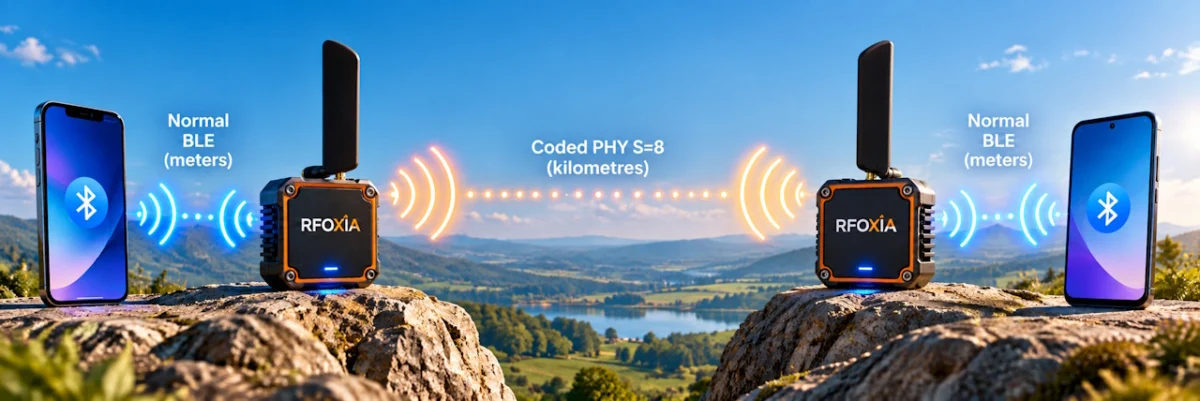
The RFOXiA team does both. They have designed a custom RF front end that pairs a power amplifier (to increase transmission strength) with a high-sensitivity low-noise amplifier (LNA) to extract signals from the background noise floor. When combined with impedance matching and a high-gain omnidirectional antenna, the module gains a pair of "ears" capable of hearing signals that standard consumer hardware would discard as static.

The real heavy lifting, however, occurs in the firmware. Bluetooth LE’s Coded PHY, specifically the S=8 mode, trades bandwidth for robustness. By using forward-error correction and pattern mapping, the system sends eight symbols for every single data bit. The resulting data rate of 125kbps is insufficient for streaming 4K video, but it is more than enough for high-fidelity sensor telemetry, command-and-control protocols, text messaging, and—in upcoming iterations—voice communication.
Solving the "Connection" Problem
Standard Bluetooth stacks are designed for short-range handshake protocols. If a device at 4km range loses its connection, a standard device would fail to reconnect because the "handshake" requires proximity. The RFOXiA team developed a proprietary layer that sits within the Bluetooth stack, allowing modules to initiate and maintain connections directly via the long-range Coded PHY. This "dual-role" stack effectively allows the module to hold two conversations at once: one with the local smartphone and one with the distant remote node.
Empirical Validation and Future Targets
The proof, as they say, is in the testing. In a recent ground-to-ground demonstration, a RFOXiA module mounted on an antenna mast communicated seamlessly with a second unit attached to a moving vehicle. The link remained fully operational at a distance of 4.6 kilometers (2.86 miles).
While 4.6km is a significant achievement for a technology designed for a 10-meter room, the RFOXiA team is looking much higher. By elevating one node—for example, mounting a module on a drone—the company anticipates ranges exceeding 20 kilometers. When both ends are airborne (drone-to-drone), the design target extends beyond 50 kilometers.

These figures represent a paradigm shift for industries that currently rely on satellite links or cellular coverage. For large-scale agriculture, forestry management, or disaster relief, the ability to deploy a low-power, long-range mesh network without needing a centralized tower or a recurring subscription fee is a massive value proposition.
The RFOXiA Ecosystem: Beyond Hardware
Mohamed is quick to note that RFOXiA is not merely a piece of hardware; it is an ecosystem. The "RFOXiA Club" serves as a nexus for developers and makers, offering tools like My Console, a browser-based environment for monitoring and recording live data from deployed nodes.
Perhaps most intriguing is the AI Develop initiative. Recognizing that firmware development can be a steep barrier for non-experts, the company is leveraging its open-source codebase to create an AI-assisted environment. Users can describe their desired functionality in natural language, and the AI generates the necessary code to implement it on the RFOXiA module. This democratization of high-end RF engineering is consistent with Mohamed’s mission: to move technology out of the lab and into the field.
Implications for the Future of Connectivity
The implications for this technology are profound. In disaster zones where cell towers are destroyed, RFOXiA modules could establish an immediate, localized communication network for first responders. In remote industrial sites—such as wind farms or oil pipelines—sensors could report status updates directly to a central gateway over dozens of kilometers without the need for expensive satellite hardware.

However, the path forward is not without its challenges. Spectrum management and regulatory compliance for unlicensed frequency usage remain hurdles. Yet, Mohamed is undeterred. He is currently shipping modules to universities and makerspaces in Japan, South Korea, and elsewhere. He knows the standard engineering response to his claims—"That’s impossible"—and he is opting for the most effective rebuttal: giving skeptics the hardware and letting them prove themselves wrong.
As we look toward the future, the RFOXiA project serves as a reminder that the most significant technological leaps often occur not by discovering new laws of physics, but by daring to re-apply existing ones in ways that "experts" deemed impractical. When Moamen Mohamed talks about hitting that 50km target, he isn’t just dreaming; he is following in the footsteps of the builders of the pyramids. If history has taught us anything about Egyptian engineering, it is that when they set out to do the impossible, it is usually wise to stop questioning if they can do it and start asking how it will change the world.