In the high-stakes world of professional audio, few names command the reverence of Neumann. For nearly a century, the brand has been synonymous with the gold standard of recording—the microphone that captured history’s most iconic performances. Yet, as the industry pivots toward AI, spatial audio, and decentralized production, the challenge for legacy brands is no longer just maintaining quality; it is maintaining relevance.
Under the leadership of Yasmine Riechers, who assumed the role of CEO of Georg Neumann GmbH in March 2024, the brand is undergoing a strategic metamorphosis. By blending the precision of traditional German engineering with a modern, agile approach to global business, Riechers is positioning Neumann not merely as a hardware manufacturer, but as an indispensable architect of the modern creative workflow.
The Architect of Evolution: A Professional Chronology
Yasmine Riechers’ ascent to the helm of Neumann was neither accidental nor overnight. Her career trajectory is marked by a deliberate synthesis of international business strategy and deep-seated technical acumen.
Riechers joined the Sennheiser Group in 2015, an entry point that was both a professional milestone and a homecoming of sorts. Having grown up near Hanover, Germany, the Sennheiser brand was a fixture of her environment. Her initial remit involved developing the Sennheiser Greater China division, a crucible that would define her leadership philosophy. Starting as Director of Operations and rising to Country Manager, she gained granular, hands-on experience in manufacturing, global supply chains, and market scaling.
Following her successful tenure in Asia, Riechers returned to Germany in the early 2020s to head the Sennheiser Group’s Corporate Development Office. There, she played a pivotal role in refining the group’s overarching strategy before being appointed CEO of Georg Neumann GmbH in 2024. Her transition into the top role at Neumann marked a shift in the company’s internal culture—one that prioritizes rapid, data-informed decision-making without sacrificing the brand’s century-old reputation for craftsmanship.
Global Strategy: Lessons from the East
When asked how her time in China fundamentally altered her approach to leadership, Riechers points to the concept of "dynamic adaptability."

"In Europe, we often approach strategy with long, linear planning cycles," Riechers explains. "In China, market dynamics can shift within months. That experience taught me the importance of speed, local relevance, and the necessity of building integrated ecosystems."
For a company like Neumann, which has historically operated on long-term product lifecycles, this insight has been transformative. Riechers argues that global strategies cannot be "exported" from a headquarters in a vacuum; they must be localized. This means understanding that a producer in Nashville, a post-production engineer in London, and a creator in Shanghai have vastly different workflow requirements. By embedding this agility into the Neumann business model, she is ensuring the brand can pivot as quickly as the technology it serves.
The Nashville Shift: Proximity to the Creative Heart
Perhaps the most visible sign of Neumann’s strategic evolution is the intentional focus on the United States market, signaled by the relocation of Sennheiser USA’s headquarters to Nashville, Tennessee.
Riechers views this not as a mere logistical change, but as a "deliberate step toward being closer to the creative heart" of the industry. Nashville serves as a nexus for global talent, and for Neumann, proximity is the new currency.
"Being present where music and content are created every day allows us to listen more closely," she says. "Our ambition goes beyond showcasing individual products; it is about being part of the creative community. You will see us placing greater emphasis on education, partnerships, and direct engagement with creators."
By embedding themselves in the Nashville ecosystem, Neumann is transitioning from a distant "standard-bearer" to an active participant in the daily creative lives of engineers and producers. This move underscores a broader shift: moving away from the "ivory tower" approach of premium audio and toward a collaborative, user-centric model.

Redefining the Legacy: Hardware, Software, and AI
One of the most pressing questions facing heritage brands today is how to remain relevant in a world increasingly dominated by software-as-a-service (SaaS) and artificial intelligence.
Riechers views this not as a threat, but as a natural extension of the company’s original mission. "Georg Neumann’s vision was broader than just microphones," she notes. "He wanted to make sound last. At the time, that required microphones, cutting lathes, and mixing desks. Today, the tools have evolved, but the mission remains exactly the same."
The "Full Ecosystem" Concept
Neumann’s current strategy centers on the idea of a "connected workflow." The modern creator is no longer tethered to a fixed studio environment. They move fluidly between high-end professional facilities, home studios, and mobile setups. Neumann’s response has been to provide a cohesive ecosystem—from the MT 48 interface and NDH headphones to RIME software—that allows a seamless transition between these environments.
The "Concept Car" Approach
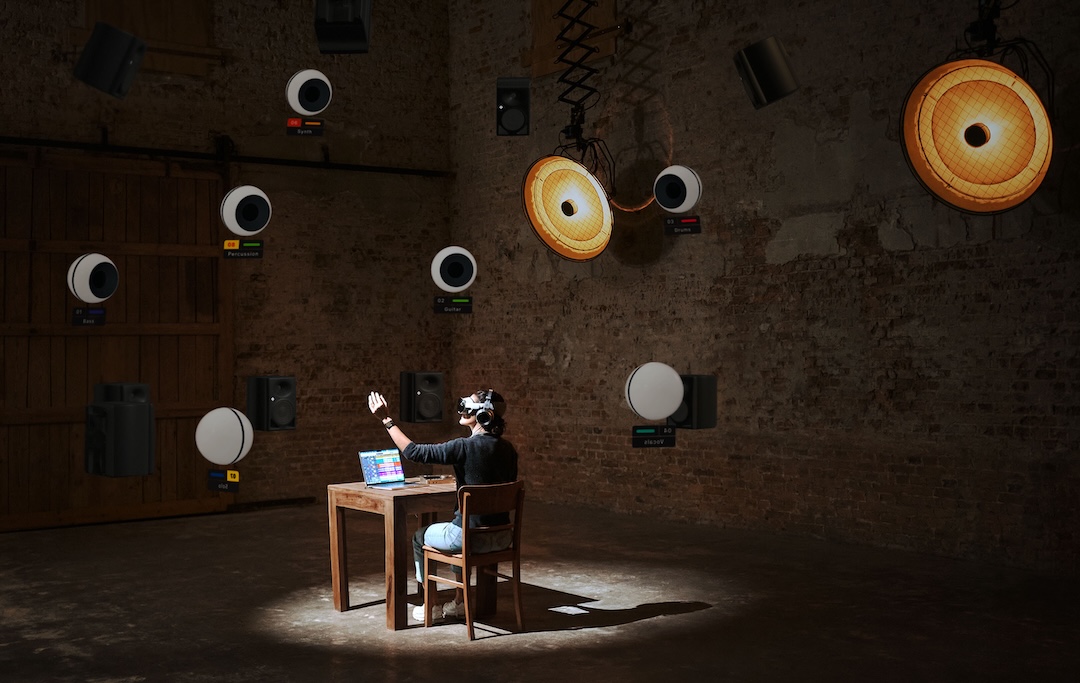
The debut of the Virtual Immersive Studio (VIS), an audio spatial positioning app developed for Apple Vision Pro, serves as a testament to this new direction. Riechers refers to the app as the company’s "concept car." It demonstrates that while Neumann’s soul is in hardware, its future is in the software-defined creative process. It serves as a testing ground for how spatial audio can become intuitive, proving that technology should disappear into the background, leaving only the sound.
Balancing Heritage with Disruption
Despite this push toward digitalization, Neumann’s commitment to its roots remains unshakable. The early 2026 reissue of the classic M 50 V tube microphone, originally introduced in 1951, proves that the company understands the value of its own legacy.
This duality—simultaneously launching cutting-edge spatial audio apps and re-releasing 75-year-old microphone technology—is the hallmark of Riechers’ tenure. It is a strategy of "innovating from a position of authenticity." By carrying forward the precision and trust associated with the Neumann name, the company ensures that its modern digital offerings are treated with the same reverence as its classic hardware.
Future Implications: The Next 100 Years
Looking toward the next decade, the roadmap for Neumann is clear. The goal is to evolve from a "product brand" into a "workflow standard."
Key Pillars of Growth:
- Integrated Ecosystems: Moving away from standalone product sales toward interconnected hardware/software solutions.
- Emerging Markets: Leveraging the growth potential in Asia while solidifying presence in the U.K. and U.S. creative hubs.
- The "Fluid Creator": Designing for the next generation of professionals who require portability, simplicity, and uncompromising quality.
- AoIP and Immersive Audio: Prioritizing technologies that facilitate the next wave of audio production standards.
As Yasmine Riechers approaches her three-year mark as CEO, her successes are already evident. She has provided the organization with a renewed sense of clarity, successfully navigating the transition from a traditional hardware manufacturer to an agile, modern audio powerhouse.
"What I have learned most is how powerful the combination of strong heritage and a genuine willingness to evolve can be," Riechers reflects. Under her stewardship, Neumann is not just surviving the digital transition; it is defining the terms of the next century of audio production. By staying "close to the creator," she ensures that the name on the front of the microphone will remain a symbol of excellence, regardless of how the industry evolves.