Santa Cruz, CA (September 25, 2026) — In the world of professional audio production, few names carry as much weight—or spark as much debate—as Antares Audio Technologies. Since its inception, the company’s flagship pitch-correction software has become an indelible part of the modern musical lexicon, shaping the sound of pop, hip-hop, and R&B for nearly three decades. Today, Antares marks a significant milestone in its history with the global release of Auto-Tune Advanced, a complete, ground-up rebuild of its legendary pitch-correction suite.
This release is more than a mere incremental update; it represents the largest engineering investment in the core Auto-Tune algorithm since the software’s commercial debut. By pivoting to a modern architecture, Antares aims to bridge the gap between transparent, natural-sounding vocal correction and the creative, transformative potential that made the brand a household name.
The Core Innovation: The DVA Engine and Next-Gen Algorithms
At the heart of the Auto-Tune Advanced release is the patent-pending DVA (Dynamic Vibrato Analysis) engine. For years, the "Achilles’ heel" of automatic pitch correction has been the flattening of natural vocal inflections, particularly vibrato, which often resulted in a sterile or "robotic" sound when over-processed.
The DVA engine addresses this by utilizing a sophisticated, real-time recognition system that identifies natural vibrato as it occurs. Rather than treating a vocal line as a static stream of notes, the engine differentiates between intentional performance characteristics and unwanted pitch deviation. By intelligently preserving these nuances, the software maintains the singer’s original emotional intent while simultaneously correcting pitch.
Complementing this is the overhauled Auto-Mode pitch algorithm. Antares has invested heavily in low-level signal processing to improve tracking accuracy, even in challenging recording environments where bleed, breathiness, or high-velocity vocal performances might typically confuse traditional pitch detectors.
Chronology of a Revolution: From "The Effect" to "The Standard"
To understand the magnitude of the Auto-Tune Advanced release, one must look back at the trajectory of the technology.
- 1997: Antares introduces the original Auto-Tune as a rack-mount unit, initially intended to subtly fix minor pitch errors in professional recording sessions.
- 1998: The release of Cher’s "Believe" inadvertently showcases the "Auto-Tune Effect," turning a corrective tool into a stylistic instrument.
- 2000s: Auto-Tune becomes a staple in the DAW (Digital Audio Workstation) environment, evolving through various iterations like Auto-Tune Pro and EFX.
- 2020: Antares pivots to the "Auto-Tune Unlimited" subscription model, moving toward a service-based ecosystem.
- 2026: The launch of Auto-Tune Advanced signals a "rebuild from the ground up" strategy, prioritizing speed, latency management, and artistic creative control.
This evolution tracks the changing demands of the recording industry. Where the 1990s demanded "invisible" correction, the 2020s require a hybrid approach: the ability to toggle seamlessly between clinical correction and heavy-handed creative manipulation.
Technical Specifications and Workflow Enhancements
Auto-Tune Advanced is designed to be a high-performance tool that fits into the modern, high-pressure studio environment. Several key technical improvements highlight the company’s focus on professional utility.
Ultra-Low Latency for Real-Time Monitoring
One of the most requested features from the pro-audio community has been a more robust "Live" mode. The new Live mode in Auto-Tune Advanced achieves a remarkably low latency of 0.84 ms at 44.1 kHz. This allows artists to record while monitoring the processed signal in real-time without the distracting delay that often plagues lesser plugins. This is critical for vocalists who rely on hearing their own processed pitch to maintain their performance confidence in the booth.
The Vibrato Visualizer and Creative FX
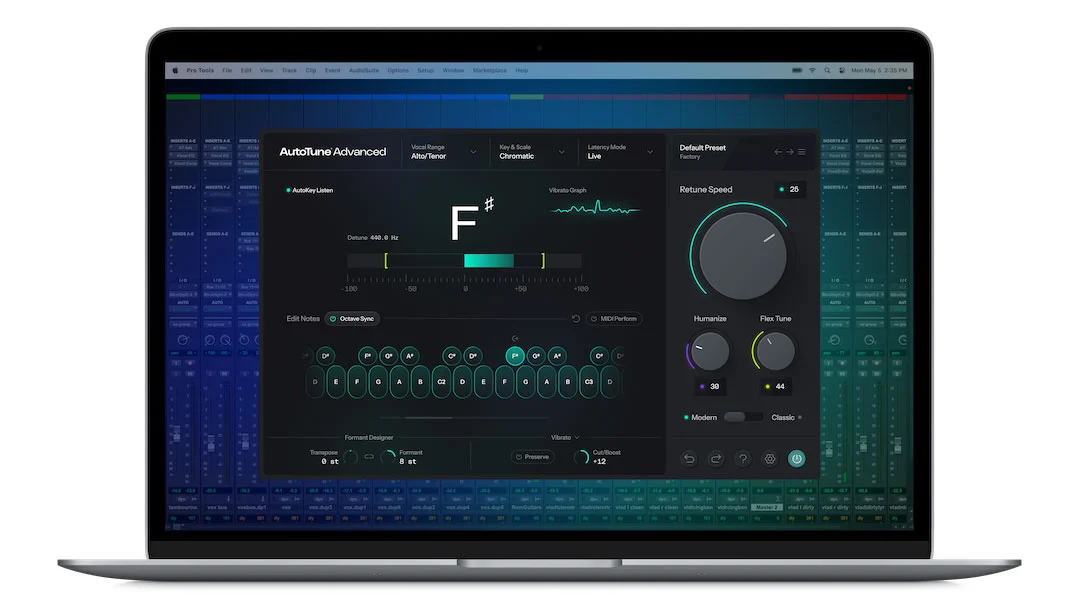
The DVA engine doesn’t just work behind the scenes; it provides a real-time vibrato visualizer. This GUI element offers engineers immediate feedback on how the plugin is interpreting a performance.
Beyond correction, Antares has introduced Creative Vibrato FX. For tracks that lack the necessary energy, this feature allows users to inject artificial vibrato into a dry vocal. Users can select from various wave shapes—sine, square, saw, or triangle—and adjust the rate and cut/boost controls to achieve a naturalistic or heavily stylized sound.
Advanced Sculpting: Formant and Workflow
The Formant Designer has been significantly updated, allowing for more precise manipulation of the vocal timbre. This is crucial for maintaining the "human" quality of a voice when shifting pitch, preventing the "chipmunk" effect often associated with extreme transposition.
The introduction of a 78-note Visual Keyboard and a custom scale workflow empowers producers to work within non-traditional musical contexts, such as microtonal scales or experimental jazz, with ease. Furthermore, the new MIDI Perform feature turns any MIDI controller into a tactile surface for the plugin, allowing for "performance-based" automation that can be recorded directly into a DAW’s automation lanes.
Official Industry Responses and Artist Integration
The rollout of Auto-Tune Advanced has been accompanied by a significant endorsement campaign, featuring presets and workflow templates from a "who’s who" of the music industry. Producers and engineers such as Julian Marley, Ann Mincieli, Tom Norris, and Benjamin Thomas have contributed custom presets to the library, providing users with a "starting point" modeled after real-world professional sessions.
"The goal with Advanced wasn’t just to make the tuning better; it was to make the plugin feel like an instrument," said a spokesperson from the Antares engineering team during the launch event. "When we looked at the feedback from top-tier producers, the consensus was clear: they wanted more control over the performance and less time spent fighting the algorithm."
Implications for the Future of Music Production
The launch of Auto-Tune Advanced arrives at a pivotal moment in the audio industry, where the lines between "human performance" and "machine-assisted production" are increasingly blurred.
The Democratization of Professional Polish
By including a vast library of industry-standard presets and simplifying the workflow for complex tasks like formant shifting and vibrato management, Antares is effectively lowering the barrier to entry for high-end vocal production. Producers working in home studios can now access the same tools and sonic character as those working in multi-million dollar facilities.
The "Hybrid" Future
The emphasis on "Low Latency" and "High Quality" modes suggests a future where the distinction between "tracking" and "mixing" plugins disappears. Antares is pushing toward a world where a single plugin can handle the entire lifecycle of a vocal, from the initial tracking session to the final mix-down.
Addressing the "Uncanny Valley"
As AI and machine learning continue to permeate the audio landscape, the DVA engine represents a strategic response to the "uncanny valley" of pitch correction. By focusing on the preservation of natural vibrato rather than its complete removal, Antares is aligning itself with the current aesthetic trend in pop music, which favors "perfectly imperfect" performances. Listeners are increasingly gravitating toward vocal sounds that feel human yet polished, and Auto-Tune Advanced is explicitly engineered to serve this aesthetic.
How to Access Auto-Tune Advanced
Antares has opted for a flexible licensing model to accommodate the varied needs of its user base. Auto-Tune Advanced is available for purchase as a perpetual license for those who prefer to own their software outright. Alternatively, it is included as part of the Auto-Tune Unlimited subscription service.
For those interested in exploring the new features, Antares is offering a free trial of the Auto-Tune Unlimited bundle, which includes the entire suite of vocal processing tools. As the industry moves forward, the release of this software serves as a reminder that even in an age of automation, the human ear remains the final, and most important, arbiter of quality.
Whether used to subtly nudge a flat note or to completely redefine the texture of a vocal performance, Auto-Tune Advanced stands as a testament to the enduring influence of Antares in the creative landscape of 2026.