KNOXVILLE, TN – September 22, 2026 – In an industry where time is the most valuable currency, the gap between a high-stakes live performance and a polished multitrack recording has long been a source of logistical friction for audio engineers. Today, Waves Audio has sought to collapse that distance with the official release of Tracks Live 2.0. This major update to their flagship recording software not only expands its technical ceiling to 128 channels but, more importantly, introduces a level of deep, intelligent integration with the Waves eMotion LV1 live mixing console that promises to automate the most tedious aspects of the recording and virtual soundcheck process.
The Core Evolution: Main Facts and Technical Prowess
At its most fundamental level, Tracks Live 2.0 is designed as a robust, high-fidelity multitrack capture engine built specifically for the unforgiving environment of live sound. With support for up to 128 channels of simultaneous recording, the software is equipped to handle everything from intimate club gigs to massive, multi-stage festival productions.
The architecture remains platform-agnostic in its core, offering native support for both macOS—including full optimization for Apple Silicon processors—and Windows environments. This ensures that engineers can deploy the software using virtually any industry-standard Core Audio or ASIO I/O hardware. However, while the software functions as a versatile "any-interface" recorder, it is when paired with the Waves eMotion LV1 ecosystem that Tracks Live 2.0 transforms from a utility into a comprehensive production hub.
The key features of the V2.0 update include:
- 128-Channel Capacity: Scalable recording depth for complex, large-format shows.
- LV1 Sync Protocol: Real-time data mirroring between the mixer and the recorder.
- Automated Session Mapping: Automatic importation of track names, patching, and channel color-coding.
- Scene-Linked Timeline Markers: Intelligent marker placement based on console scene recalls.
- Dynamic Virtual Soundcheck: Synchronized playback that mirrors the original performance’s scene structure.
A Chronology of the Live Recording Workflow
To understand the significance of this release, one must look at the evolution of the "virtual soundcheck"—a concept that transformed live audio in the early 2000s but remained fraught with manual labor.
In the early years of digital multitrack recording, engineers spent hours before a show manually labeling tracks, assigning colors, and mapping I/O paths in their DAW to match their console settings. A 64-channel show could easily take an hour of "prep time" before the first microphone was even checked.
By the mid-2010s, the introduction of Tracks Live provided a specialized, stripped-down alternative to traditional DAWs like Pro Tools or Nuendo, focusing solely on stability and record-arm efficiency. However, the data link between the console and the recorder remained unidirectional.
With the 2026 release of V2.0, Waves has bridged this final divide. The chronology of the modern engineer’s workflow has now shifted from Manual Preparation (pre-2010s) to Software-Aided Capture (2015–2025) and, finally, to the Synchronized Ecosystem model represented by this update. The software no longer waits for the engineer to tell it what the session looks like; the console now "informs" the software of its entire topography.
Deep Integration: The eMotion LV1 Symbiosis
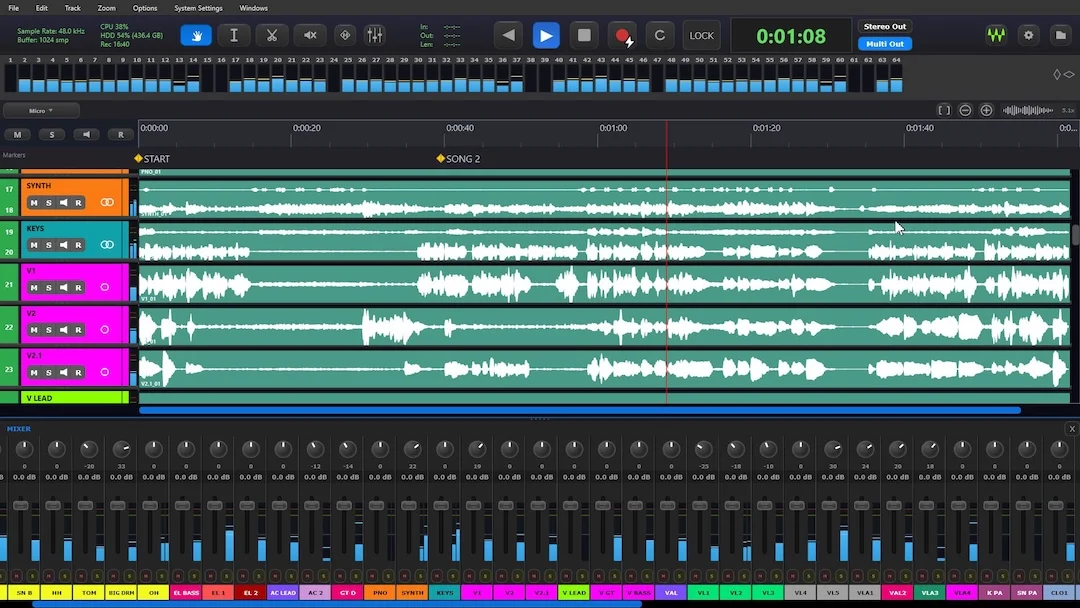
The standout feature of Tracks Live 2.0 is its "Sync" capability. When connected to an eMotion LV1 system, the software acts as an extension of the console’s own brain. Upon launching a session, the software imports the routed LV1 channels directly.
This is not merely a file import; it is a live synchronization. All channel names, mono/stereo assignments, and custom color-coding defined on the console surface are reflected instantly in the Tracks Live project window. For a touring engineer, this eliminates the "paperwork" of the digital world. If a band adds a percussionist or renames a guitar input mid-tour, the sync protocol ensures that the recording environment stays in lock-step with the console without the need for manual edits.
Perhaps most impressive is the handling of scene changes. In traditional setups, if an engineer wanted to recall a mix during a virtual soundcheck, they had to manually sync their DAW markers to the scene changes on the console—a process prone to human error. In Tracks Live 2.0, LV1 scene recalls are automatically captured as timeline markers. During a virtual soundcheck, the software follows the console’s scene recalls. As the engineer cycles through the show on the LV1, the recording software automatically follows suit, ensuring that the playback processing mirrors the specific parameters of the original live performance.
Supporting Data and Production Utility
The utility of Tracks Live 2.0 extends beyond the show itself. Recognizing that the modern live engineer is often also the post-production engineer, Waves has included comprehensive editing tools within the software.
Once a performance is captured, users can perform quick, non-destructive edits directly within the Tracks Live interface. For those who require deeper processing, the software allows for an easy "bounce" of the finished mix or an export of the entire session into a standard DAW project format. This facilitates a seamless handoff to professional studio software, where further mixing, overdubbing, or mastering can take place.
From a performance stability standpoint, the software’s optimization for Apple Silicon and updated Windows ASIO drivers suggests a significant reduction in CPU overhead. In a live environment, where the DAW must compete for resources with console plugins, low-latency, high-stability recording is non-negotiable. Waves claims that the V2.0 engine has been "rebuilt for the rigors of modern tour production," prioritizing a low-footprint operation that prevents buffer underruns—the dreaded "clicks and pops" that can ruin a professional live recording.
Industry Implications and Future Outlook
The release of Tracks Live 2.0 signals a larger trend in the pro-audio industry: the consolidation of the "Recording" and "Mixing" paradigms. As live productions become increasingly complex—incorporating massive playback tracks, intricate automation, and high-channel-count input lists—the barrier to entry for a clean, error-free recording session has reached an all-time high.
By automating the mundane aspects of session management, Waves is effectively allowing the engineer to focus on the art of the mix rather than the science of the file system.
Industry analysts suggest that this integration could set a new standard for console manufacturers. As Waves continues to push the boundaries of the "software-defined console," competitors will likely be forced to improve their own DAW integration protocols. We are moving toward an era where the console and the recorder are treated as a single, unified instrument.
Furthermore, the focus on "virtual soundcheck" as a core pillar of the software underscores the importance of the practice in modern touring. With travel costs rising and rehearsal time becoming a luxury, the ability to walk into a venue, plug in, and have a fully-labeled, perfectly-routed recording session ready for soundcheck is not just a convenience—it is a significant operational advantage.
Conclusion
Waves Tracks Live 2.0 is more than just a software update; it is a refinement of the live engineer’s daily life. By stripping away the administrative burden of multitrack capture, Waves has provided a tool that respects the tempo and intensity of the modern live stage. Whether it is the 128-channel capability, the seamless macOS and Windows performance, or the deep, scene-aware integration with the eMotion LV1, the software is positioned to become a mainstay in the professional live sound rig.
For engineers who have spent years manually typing track names and fighting with session templates, Tracks Live 2.0 arrives as a long-awaited solution. As the software becomes available globally, it will undoubtedly change how production teams approach the preservation of live performances, ensuring that the magic of the show is captured as accurately and efficiently as it is mixed.
Waves Audio has made it clear: in the race to capture the perfect live sound, they are no longer just keeping pace—they are setting the markers.