BACKNANG, Germany (September 22, 2026) — For decades, the professional audio industry has relied on the mantra of "measure twice, cut once." In the high-stakes world of large-scale live sound reinforcement, this has traditionally meant rigorous software modeling—using complex algorithms to predict SPL (Sound Pressure Level) distribution, frequency response, and coverage patterns before a single loudspeaker is flown. However, these visualizations have always been limited to two-dimensional plots and heat maps.
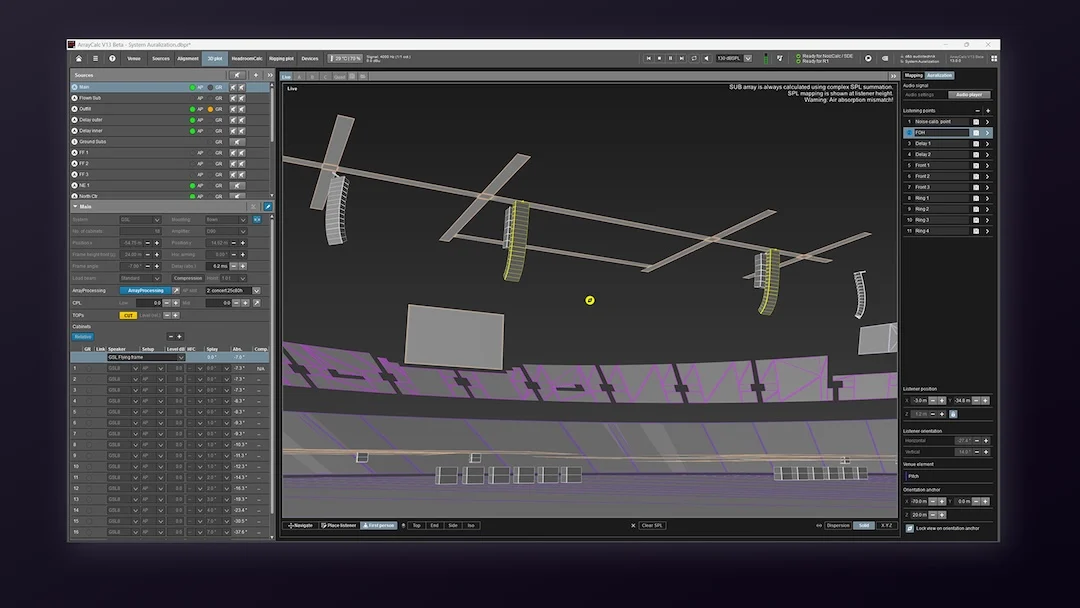
Today, d&b audiotechnik has fundamentally shifted that paradigm. With the launch of the System Auralization feature within its industry-standard ArrayCalc software, the German audio powerhouse is moving beyond the visual, allowing sound engineers and system designers to listen to their loudspeaker configurations in a high-fidelity virtual environment long before the rigging motors are engaged.
The Evolution of Prediction: From Heat Maps to High Fidelity
The Traditional Approach to System Design
To understand the significance of this development, one must appreciate the history of P.A. system design. Since the late 1990s, software like ArrayCalc has served as the backbone for touring sound professionals. By inputting venue dimensions and loudspeaker technical data, engineers could generate a "prediction"—a digital twin of the performance space.
These predictions provided invaluable data: Where would the system fall short? Where would it be too loud? Which seating sections might suffer from comb filtering? Yet, despite the sophistication of these tools, there remained a "translation gap." An engineer could see a dip at 2kHz on a screen, but they had to rely on years of field experience to intuit exactly how that dip would manifest in the actual acoustic experience of an audience member.
The Auralization Breakthrough
System Auralization closes that gap. By generating a real-time binaural rendering of the loudspeaker configuration, d&b audiotechnik is effectively turning a design workspace into an immersive listening laboratory. The technology simulates the interaction between the loudspeakers and the venue’s geometry, processing the audio signal through a complex series of room acoustic algorithms and HRTF (Head-Related Transfer Function) filters.
"We are moving from looking at sound to experiencing sound," says a lead developer at d&b audiotechnik. "By integrating binaural rendering directly into the design workflow, we are giving engineers the ability to audit the ‘soul’ of a design rather than just its metrics."
A Chronology of Innovation: Building the Virtual Venue
The path to System Auralization was not instantaneous. It represents the culmination of nearly a decade of research into acoustic modeling and DSP (Digital Signal Processing) efficiency.
- 2018–2020: The Foundation of Virtual Acoustic Modeling. d&b began integrating more sophisticated venue modeling capabilities, moving from simple boxes to complex, multi-tiered stadium representations.
- 2022: The Arrival of ArrayProcessing. The industry saw a massive shift when d&b introduced ArrayProcessing, which allowed for individual control over the frequency response of every box in an array. This necessitated more granular prediction data, setting the stage for more advanced simulation tools.
- 2024: Development of High-Density Real-Time DSP. The primary barrier to auralization was processing power. Auralization requires calculating reflections, late reverberation, and direct sound simultaneously. With the advancements in modern silicon, d&b finally had the overhead to run these calculations in real-time.
- September 2026: Official Launch. Following an extensive closed-beta phase, the feature is now integrated into the public-facing ArrayCalc software, marking a new era for system design professionals globally.
Supporting Data: Why "Hearing Before Hanging" Matters
The implications of System Auralization are not merely aesthetic; they are grounded in the harsh economic and technical realities of touring.
Efficiency and Cost Mitigation
In the touring world, time is the most expensive commodity. Every hour spent adjusting an array in the air is an hour of lost rehearsal time or labor cost. By identifying phase issues, tonal imbalances, or coverage gaps during the design phase, engineers can iterate through dozens of variations in minutes.
The "Snapshot" Advantage
The introduction of snapshot recall functionality within ArrayCalc is a game-changer. An engineer can create a "Base Design," then create a "Secondary Design" with a different splay angle or sub-array configuration. With a single click, they can switch between the two while listening to the same source material, allowing for an A/B comparison that was previously impossible. This allows for evidence-based decision-making rather than relying on gut instinct or trial and error on-site.
User Interface and "First-Person" Navigation
The software features a first-person virtual mode. Users can "walk" through the venue, positioning their virtual head at the back row, the VIP section, or the front-of-house mix position. As they move, the binaural engine updates the audio playback, simulating the arrival time, frequency absorption, and spatial cues of the room.
Official Responses and Industry Reception
Early testers of the System Auralization beta have been quick to praise the tool’s impact on workflow.
"I used to spend half the morning on-site doing minor tweaks to the array angles to ensure the high-end was consistent across the mezzanine," says one veteran FOH (Front of House) engineer. "With the new Auralization tool, I could hear the transition between the main array and the out-fills before I even left the production office. It changes the way we negotiate with riggers and venue managers about what is actually necessary for a show."
Industry experts suggest that this tool will also become an invaluable educational resource. For junior system techs, the ability to hear the cause-and-effect relationship between design changes and audio output will drastically shorten the learning curve required to master line array physics.
Implications: The Future of Live Sound
The introduction of System Auralization signals a broader trend in the pro-audio industry: the "gamification" and "virtualization" of the live event space.
The Shift Toward Immersive Design
As audiences demand increasingly immersive audio experiences—such as object-based audio and spatial sound—designers can no longer afford to think in terms of simple stereo left-right arrays. System Auralization provides the necessary environment to prototype complex spatial setups, ensuring that the "sweet spot" is not just a single point in the center, but a coherent experience for every seat in the house.
Environmental and Logistical Impact
While the environmental impact of touring is a growing concern, better software leads to smarter logistics. Accurate prediction means smaller, more efficient systems. If an engineer can prove that a specific loudspeaker configuration provides 98% coverage efficiency, they may be able to reduce the total weight of the rig, leading to lower fuel consumption and fewer trucks on the road.
A New Standard for Professionals
d&b audiotechnik has set a high bar. As this technology matures, it is likely that other manufacturers will be forced to follow suit, leading to an industry-wide transition where auralization becomes as standard as the frequency plot.
For now, the beta version is available for download on the official d&b website. For the sound professional, the message is clear: the era of static prediction is over. The era of the "Virtual Mix" has arrived, and it sounds remarkably like the real thing.
How to Get Started
- Download: Visit the d&b ArrayCalc download page.
- Setup: Ensure your computer meets the recommended RAM and processing specifications to handle real-time binaural rendering.
- Calibrate: Import your venue’s CAD data into ArrayCalc to ensure the Auralization engine has an accurate acoustic model to reference.
- Listen: Load your high-resolution audio files into the software and begin navigating your virtual space.
As the industry continues to push the boundaries of what is possible, d&b audiotechnik remains at the forefront, proving that while technology should be invisible in a finished performance, it is the most powerful tool in the hands of those who shape the sound of our world.