In the high-stakes world of high-end audio, the debate between passive and active speaker systems has raged for decades. Proponents of active designs have long argued that the marriage of dedicated amplification, custom-tailored crossovers, and precise DSP (Digital Signal Processing) offers a level of performance that passive systems—regardless of their pedigree—simply cannot match. While this philosophy has become the industry standard in recording and mastering studios, it has struggled to gain the same traction in the luxury home audio market.

Enter the Sigberg Audio Manta, a 2.2-channel active system hailing from Norway that aims to dismantle the wall between professional accuracy and home-listening musicality. By combining a coaxial driver, a sophisticated cardioid dispersion design, and a fully integrated, DSP-managed subwoofer foundation, Sigberg Audio has created one of the most compelling, high-performance systems to hit the market in recent years.

The Genesis of the Manta: From Viking Lands to Global AudioStages
Sigberg Audio, founded by Thorbjørn Sigberg, is a boutique manufacturer based in Ås, Norway—a location that places it in the geographic orbit of legendary driver manufacturers like SEAS. The company’s approach is refreshing in its humility and engineering-first focus. During the 2025 Capital AudioFest, Sigberg demonstrated the Manta system, leaving a lasting impression on attendees through a performance that favored technical transparency and dynamic headroom over the "warm" coloration often found in high-end home gear.

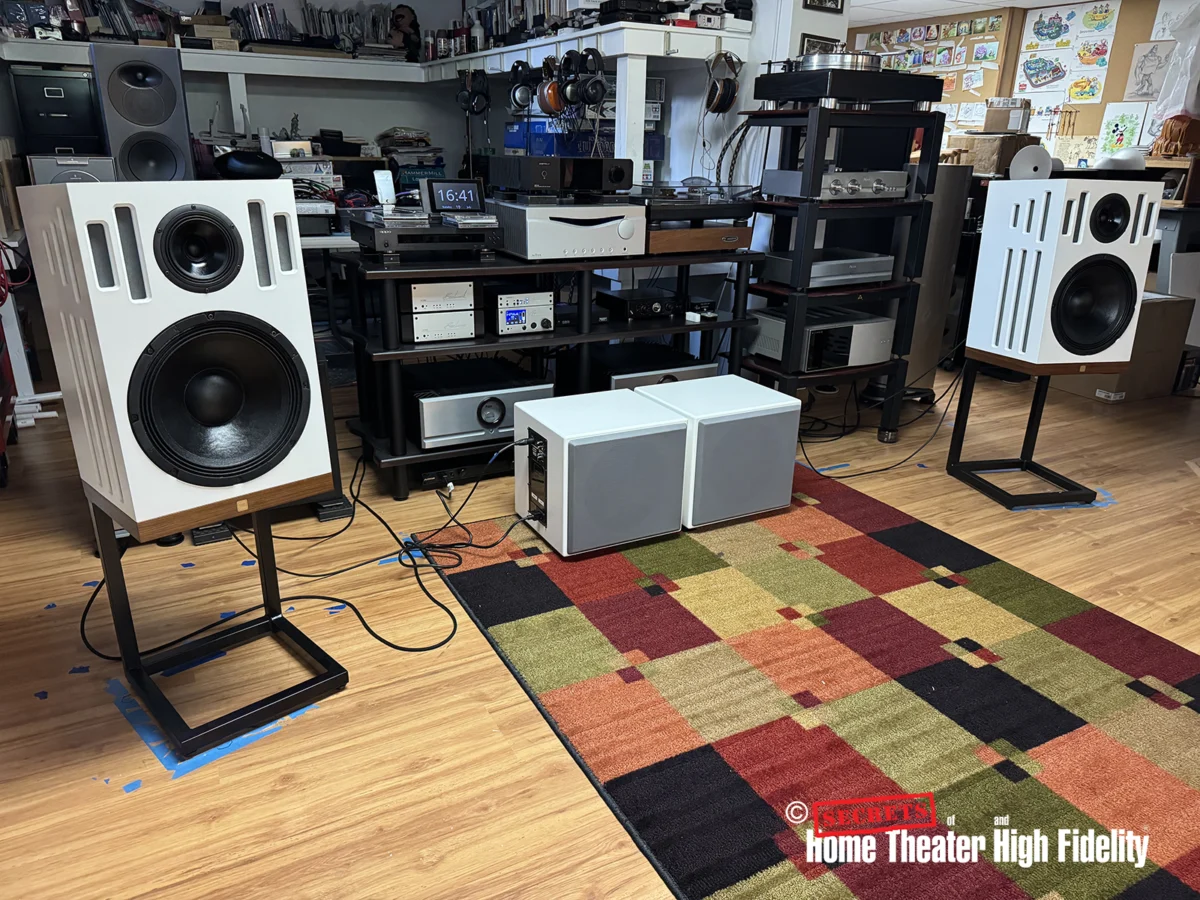
The Manta system is not merely a pair of speakers paired with subwoofers; it is an integrated, end-to-end audio ecosystem. The Manta monitors are designed to roll off at 90 Hz, explicitly offloading the heavy lifting of bass reproduction to the accompanying dual 10D active sealed subwoofers. This design choice is rooted in a specific philosophy: to maximize the dynamic capability of the midrange and treble by liberating the main drivers from the physical excursion demands of low-frequency reproduction.

Technical Architecture: A Study in Controlled Dispersion
The Manta’s most striking feature is its utilization of "cardioid" dispersion. By employing strategically placed vents (slats) on the front baffle and the sides of the cabinet, the speaker channels out-of-phase sound waves to cancel out energy that would otherwise reflect off side walls. This reduces the "muddying" effect caused by room reflections, allowing for a cleaner, more precise soundstage at the listening position.

Driver Complement and Engineering
- High/Mid Frequencies: A 5.5-inch coaxial driver (featuring a treated paper cone and a 1-inch silk dome tweeter) sourced from SICA.
- Mid-Bass: A 12-inch woofer, also from SICA, which features a 3-inch voice coil to ensure high excursion and low distortion.
- Subwoofers: Each 10D subwoofer utilizes two horizontally opposed 10-inch aluminum-cone drivers from Scan-Speak, providing a vibration-neutralized, high-output foundation that extends down to 18 Hz in-room.
The cabinets, constructed from high-grade MDF with a 1.5-inch thick front baffle, are braced internally to remain inert even at high sound pressure levels (SPL). The entire ensemble is driven by Hypex nCore Class D amplification, which provides 600 watts per monitor and 500 watts per subwoofer, ensuring that the system never runs out of "headroom."

The Listening Experience: Scale, Precision, and Immersion
When evaluating the Manta in a real-world, non-idealized listening room, the results are nothing short of transformative. Unlike many high-end systems that require a perfectly treated acoustic environment to shine, the Manta’s cardioid dispersion provides a degree of placement flexibility that is rare in this class.

The immediate impression is one of sheer scale. The coaxial driver arrangement produces a soundstage that is not only wide but remarkably deep, with a sense of verticality that makes performers feel present in the room. In tracks like Taeko Onuki’s "4:00 AM," the Manta renders every layer of the 70s jazz-pop production with surgical precision, yet retains the fluidity of the instrumentation. The double-bass lines in Adam Ben Ezra’s "Cosmic Nomad" showcase the seamless integration between the monitors and the 10D subwoofers; the bass is tight, textured, and punchy, devoid of the "one-note" bloom that plagues many home theater-oriented subwoofers.

Furthermore, the system’s performance on orchestral works, such as Joe Hisaishi’s "A Town With an Ocean View," demonstrates an ability to maintain composure during complex dynamic shifts. The Royal Philharmonic Orchestra is presented with full-scale grandeur, where each section is delineated in space, proving that the Manta is as adept at reproducing the delicate texture of a flute solo as it is the thunderous impact of a full percussion section.

Supporting Data: The Bench Perspective
The objective measurement data, gathered using a calibrated UMIK-2 microphone and analyzed by both Carlo Lo Raso and Technical Editor David A. Rich, confirms the subjective findings. The in-room spatial average reveals that the system tracks the predicted target curve with impressive consistency. While the room-dominated region below 300 Hz shows minor fluctuations, these are not inherent to the speakers but are characteristic of the acoustic environment.

Thorbjørn Sigberg himself emphasizes that the goal of the Manta is not "iron-flat" anechoic response at the expense of naturalness. He argues that aggressive, over-corrected DSP can lead to ringing and a "clinical" sound. Instead, the Manta is tuned for a balance that prioritizes the listener’s perception of direct sound, ensuring that the speaker remains musical and non-fatiguing over long sessions.

Official Designer Insights
When queried about the design of the slot-loading vents, Thorbjørn Sigberg explained:
"I find the use of passive resistive ports to work just as well as active drivers and to be the more elegant and interesting engineering solution. The off-axis response bunches up a bit around 1.5 kHz, and these ports help soften that, reducing the need for aggressive digital correction while helping to reduce hardness in the sound."

Regarding the potential for EQ, Sigberg cautions against over-processing:
"I generally do not recommend EQing above 100–200 Hz with our systems. I would suggest only EQing peaks, not dips. If you flatten the response to the point of being artificial, you lose the natural character of the soundstage."

Implications for the Future of Hi-Fi
The $30,000 price point for the full Manta system places it in a competitive bracket, but it also highlights a shift in the high-end landscape. You are not just paying for a cabinet and a driver; you are paying for an integrated, programmable solution that includes state-of-the-art amplification and a bespoke room-correction consultancy.

For the audiophile who wants to bypass the endless cycle of swapping amplifiers and DACs, the Manta offers a "final destination" product. It is a system that bridges the gap between the professional studio and the home, proving that active architecture is not just a trend, but a superior path for sound reproduction.

Summary of Strengths and Considerations
- The Pros: Unmatched imaging, exceptional bass integration, placement flexibility thanks to the cardioid design, and a high-performance active architecture that removes the need for external power amps.
- The Wishlist: While the current system is world-class, a more user-friendly interface for DSP adjustments—perhaps via a tablet or smartphone app—would be a welcome evolution for the less technically inclined user.
In conclusion, the Sigberg Audio Manta system is a triumph of Scandinavian engineering. It is an ensemble that respects the listener’s intelligence and the music’s complexity in equal measure. Whether you are a recording professional looking for an honest reference or a high-end enthusiast seeking the ultimate in-room realism, the Manta warrants serious consideration. It is, quite simply, one of the best examples of what the future of high-performance audio looks like: integrated, active, and uncompromising.