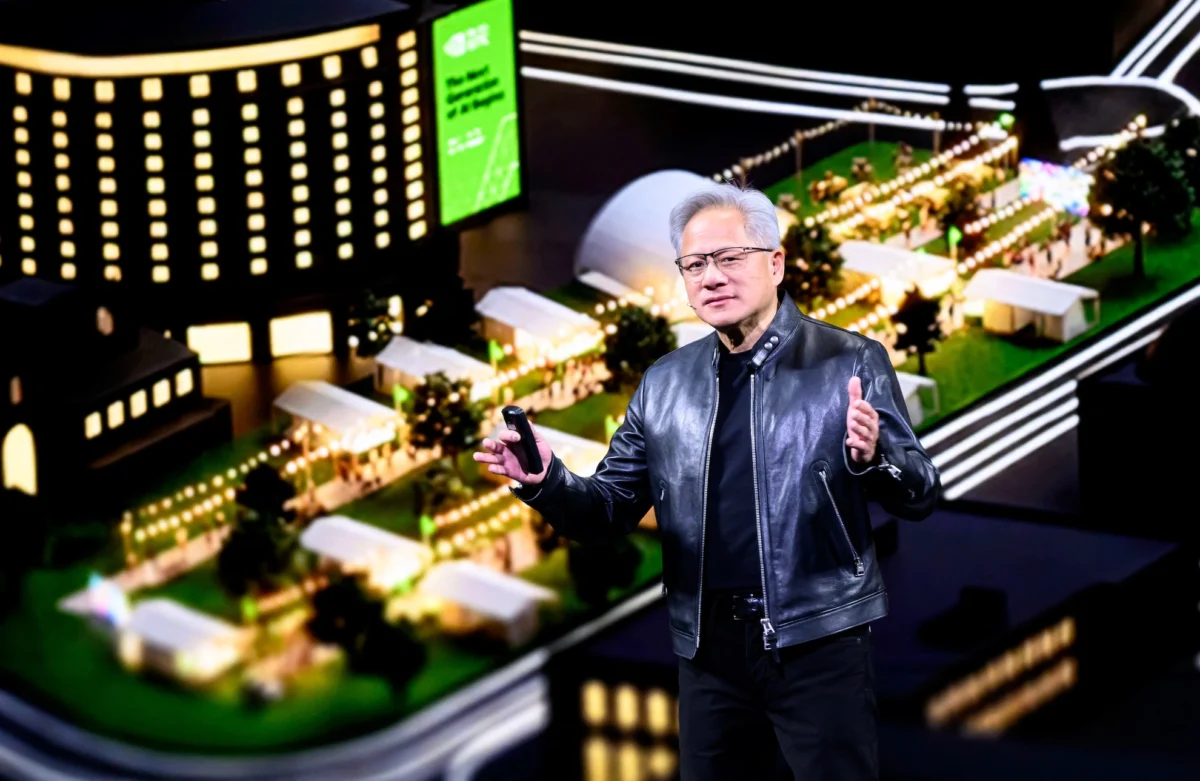
At the Goldman Sachs Communacopia + Technology conference held this past Thursday, Nvidia founder and CEO Jensen Huang did more than just present a corporate update; he delivered a manifesto on the future of the global economy. As the central nervous system of the artificial intelligence revolution, Nvidia currently sits at the pinnacle of the tech industry, a position that many skeptics argue is precarious. Yet, standing before investors and analysts, Huang projected a level of confidence that suggests the company’s record-breaking growth streak is far from hitting its ceiling.
Main Facts: Defying the Gravity of Expectation
The core of Huang’s message was a defiant rebuttal to the "Nvidia bubble" narrative. Despite a landscape increasingly crowded with competitors—ranging from hyperscale cloud giants like Amazon, Microsoft, and Google, to specialized hardware challengers like Cerebras and Etched—Huang maintains that Nvidia is not merely a component manufacturer; it is the foundational architecture of the modern intelligence age.
The most startling revelation from the conference was the sheer scale of Nvidia’s hardware. Huang pivoted away from the company’s historical identity as a purveyor of $399 gaming graphics cards, emphasizing the industrial complexity of modern AI infrastructure. He described a single, unified "GPU" system as an $8.5 million behemoth—a massive orchestration of two million parts connected by proprietary NVLink technology, consuming 250,000 kilowatts of power. By redefining the "unit" of sale from a chip to a city-sized data center system, Huang signaled that Nvidia is playing a game that its competitors, who are still focused on individual silicon dies, are not yet equipped to replicate.
Chronology: A Trajectory of Unprecedented Growth
To understand the current fervor surrounding Nvidia, one must look at the timeline of its transformation. The company’s meteoric rise was not an overnight phenomenon but the culmination of decades spent refining parallel computing.
- The Gaming Origins: In its early years, Nvidia was synonymous with PC gaming. The GPU was a tool for rendering pixels, a consumer-facing product that made the company a household name among enthusiasts.
- The CUDA Revolution: Long before the current AI boom, Nvidia invested heavily in CUDA, a software platform that allowed developers to use GPUs for general-purpose computing. This was the silent turning point that enabled AI researchers to harness Nvidia hardware for deep learning.
- The Generative AI Inflection Point: With the launch of LLMs (Large Language Models), the demand for high-performance compute became insatiable. Nvidia’s H100 and subsequent Blackwell architectures became the "gold standard," leading to consecutive quarters of revenue growth that shattered Wall Street projections.
- The Current Guidance: Just last month, during its Q2 earnings call, Nvidia provided guidance that stunned the market. Huang reaffirmed on Thursday that he anticipates a 70% year-over-year revenue growth for the coming year. Given that analysts project the current fiscal year to close at approximately $400 billion, a 70% expansion would catapult the company toward a staggering $680 billion annual revenue target.
Supporting Data: The Logistics of a Global Powerhouse
Huang’s confidence is rooted in a proprietary intelligence network that few companies in history have ever possessed. He described Nvidia’s operational reach as "tracking every single gigawatt of land, power, and shell around the world."
The data backing this confidence is not merely anecdotal. The company’s flagship GB200 NVL72—a system combining 36 Grace CPUs with 72 Blackwell GPUs—is currently seeing a 27% month-to-month sales growth rate. This is not just a high-demand product; it is a fundamental building block for the next generation of data centers.
Furthermore, Huang’s "visibility" into the market is unparalleled. Because Nvidia supplies the foundational hardware for Anthropic, OpenAI, Google, and a vast ecosystem of open-weight model developers, the company sees the order flow of the entire industry. By working directly with original equipment manufacturers (OEMs), neocloud providers, and hyperscalers, Nvidia has effectively built a real-time dashboard of where global capital is being spent on AI infrastructure.
Official Responses: Addressing the "Circular Deal" Allegations
One of the most pressing questions directed at Huang involved the phenomenon of "circular financing." Critics have pointed to instances where Nvidia invests in AI startups—such as those developing new models or infrastructure—only for those startups to turn around and spend their funding on Nvidia hardware. Similar arrangements were notoriously blamed for the collapse of telecommunications giant Lucent Technologies during the dot-com bubble.
Huang’s response was characteristically blunt and, at times, cheeky. Dismissing the "circular" label, he framed these investments as high-yield returns. "I look at the spreadsheet, we put in $1 and $100 comes back in," Huang remarked, suggesting that the logic of the investment is sound because the capital is being recycled into a productive asset—a GPU—that immediately generates revenue for the client.
He further clarified that Nvidia is not acting as a venture capital firm in the traditional sense. Before any investment is finalized, the company conducts rigorous due diligence to ensure the startup has "real contracts" and a path to commercial viability. Huang noted that he has personally reviewed over $100 billion worth of these contracts, asserting, "I’m not taking any risks… I need a sure thing."
Implications: The Long-Term Horizon
The implications of Huang’s vision are profound. If Nvidia achieves its projected growth, it will become the most significant industrial force since the dawn of the internet. However, the tech industry is governed by the iron law of disruption.
As the AI industry matures, there will inevitably be a push toward efficiency. Startups that are currently burning through venture capital to buy massive amounts of compute will eventually need to justify their existence through profitable business models. If the market shifts from "growth at all costs" to "optimized inference," the demand for Nvidia’s raw power might stabilize or change in nature.
Moreover, the hyperscalers are not sitting idle. Amazon, Microsoft, and Google are all actively developing internal silicon to reduce their reliance on Nvidia. While these efforts have yet to dislodge Nvidia from its dominant position, they represent a long-term strategic threat that could compress margins or limit market share in the years to come.
Despite these headwinds, Huang remains unfazed. He views Nvidia as the "foundational platform" of the next industrial revolution. Whether that dominance lasts for another decade or eventually gives way to a new paradigm, one thing is certain: for the next 18 months, the world of AI will continue to revolve around the architecture designed by Jensen Huang.
As the industry moves from the experimental phase to the era of massive, physical-world deployment, Nvidia has successfully positioned itself not just as a supplier, but as the indispensable backbone of the modern economy. For now, Huang is not just watching the future; he is shipping it, one crate of GPUs at a time.