
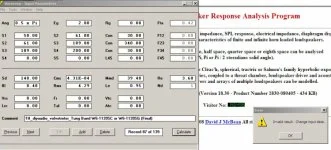
In the specialized field of loudspeaker enclosure design, few software tools have achieved the legendary status of Hornresp. Developed by David McBean, this application has served as the backbone for countless DIY audio enthusiasts and professional acousticians for years. In the spring of 2008, a rapid series of updates transformed the software from a static calculation tool into a highly dynamic, interactive environment, specifically regarding the simulation of "Tapped Horn" (TH) designs.
This article examines the intense, two-week period in March and April 2008 when McBean’s iterative development cycle—marked by direct collaboration with the user community—redefined the capabilities of tapped horn modeling.
Main Facts: The 2008 Tapped Horn Revolution
In March 2008, the state of the art in loudspeaker simulation underwent a significant shift. The release of Hornresp Version 18.00 marked the introduction of a vastly improved "Tapped Horn Wizard." Prior to this, users were often forced to manually input complex variables to approximate the performance of a tapped horn, a process that was both time-consuming and prone to human error.
The central innovation of the 18.x series was the introduction of real-time interactivity. Rather than requiring users to manually trigger a "calculate" command after every adjustment, the new Wizard allowed users to manipulate parameters—such as horn length, flare rate, and driver positioning—and witness the resulting frequency response shift instantaneously. This shift from "compute-on-demand" to "real-time visualization" represented a paradigm shift in acoustic engineering software, leveraging growing CPU capabilities to provide a more intuitive design experience.
Chronology of Development: March–April 2008
The rapid-fire release schedule during this period highlights an unprecedented level of developer responsiveness.
The Launch of Version 18.00 (March 22, 2008)
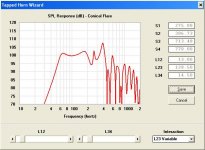
The release of version 18.00 provided users with three distinct "Interaction" options for the Tapped Horn Wizard. The most significant addition was the "L12 & L34 Linked" setting. This feature allowed users to effectively "slide" the driver along the mounting baffle—the acoustic equivalent of altering the path length of a slide trombone. This allowed for precise tuning of the driver’s position relative to the 180-degree bend in the horn path.
Iterative Polishing: 18.10 and 18.20 (March 28 – March 31, 2008)
Less than a week after the initial rollout, McBean released Version 18.10, which added the ability for tapped horns to incorporate a "throat chamber." This was a critical addition for those looking to model the physical reality of a driver mounted behind a chamber, as it allowed for a more accurate representation of the two sides of the driver diaphragm.
By March 31, Version 18.20 was released, enabling users to define two separate segments between the driver entry points. This allowed for more complex horn geometries, such as a slow-flare section leading into a faster flare, a design technique famously associated with specific high-performance audio patents.
The 18.30 Milestone (April 5, 2008)
The culmination of this development sprint was version 18.30. Despite encountering minor stability bugs following the 18.30 release—which prompted rapid feedback from the user community—the update successfully integrated the Wizard’s functionality with four-segment systems. This allowed for a high degree of complexity, enabling designers to balance acoustic output with the physical constraints of their enclosures.
Supporting Data: Engineering Insights from the Field
The success of these updates was validated by the DIY audio community, specifically on platforms like diyaudio.com. Experienced builders, such as William Cowan, noted that these updates revealed phenomena previously obscured by the difficulty of the simulation process.

The L1-2 Notch Effect
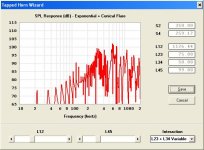
Cowan discovered that a large "L1-2" (the distance from the start of the horn to the driver position) could produce a significant notch in the frequency response. By utilizing this notch to cancel out the first major peak, builders found it significantly easier to integrate a tapped horn with their existing crossover designs. This discovery demonstrated that the Wizard was not just a tool for optimization, but also a tool for discovery, allowing users to find creative solutions to common acoustic problems that might otherwise be overlooked.
Sensitivity to Parameters
Ken Strain, another early adopter, noted that the Wizard served as a "relief" for builders. By sliding the parameters, he could observe the sensitivity of the response to specific dimensions (L12 and L34). Knowing that his physical build would inherently be an approximation of the simulation, the ability to see that small variations in those parameters had minimal impact on the overall response provided him with the confidence to proceed with his project.
Official Responses and Developer Philosophy
David McBean’s approach during this period set a gold standard for software maintenance in the niche engineering sector. His responses to the community were characterized by transparency and a genuine willingness to iterate based on user bug reports.
When users like Ian "iand" asked why the Wizard didn’t initially support four-segment systems, McBean provided a detailed engineering explanation regarding the logic of how tap points are defined by segment lengths. Rather than dismissing the suggestion, he acknowledged the utility of such a feature and began working on it immediately.
This collaborative environment fostered a sense of partnership between the developer and the users. When users reported an "Invalid result" error in version 18.30, McBean did not retreat; he remained active in the forum threads, analyzing input data and working to rectify the logic flow that caused the crash. This level of engagement ensured that the software remained both robust and relevant to the evolving needs of its user base.
Implications: The Legacy of Interactive Modeling
The updates to Hornresp in the spring of 2008 had profound implications for the world of loudspeaker design.
Lowering the Barrier to Entry
Before these enhancements, designing a tapped horn required significant mathematical expertise and the patience to navigate rigid software interfaces. By introducing a visual, interactive Wizard, McBean lowered the barrier to entry, allowing a new generation of hobbyists to experiment with advanced horn geometry. The "fun factor" mentioned by several users is not to be underestimated—it shifted the design process from a chore to a creative, explorative exercise.
Increasing Precision
While the software became easier to use, it did not sacrifice precision. By allowing for more segments, throat chambers, and flexible driver positioning, the 18.x series actually increased the accuracy of the simulations. This allowed for a tighter correlation between the simulated response and the real-world measurements taken in the workshop.
The "Software as a Living Organism" Model
The 2008 development cycle serves as a case study in effective software evolution. By releasing incremental updates (18.00, 18.10, 18.20, 18.30), McBean was able to collect real-world data from a wide range of user setups. This rapid-feedback loop allowed him to identify and patch issues quickly, ensuring that the software evolved in the direction most useful to its end users.
Future-Proofing Acoustic Design
The move toward real-time computation—where changing a variable instantly updates the frequency response curve—anticipated the way modern engineering software would function. By leveraging the increase in CPU power available to the average user, Hornresp transitioned from a tool that felt like a legacy DOS application to one that felt like a modern, interactive design suite.

Conclusion
The story of Hornresp in March and April 2008 is more than just a history of software updates; it is a narrative of community-driven innovation. David McBean’s commitment to refining his software in response to the specific, practical needs of the audio community transformed the way loudspeaker designers approach the challenge of the tapped horn.
By prioritizing interactivity, precision, and user feedback, McBean ensured that Hornresp remained the gold standard for acoustic modeling. For those who were there to witness the rapid-fire release of the 18.x series, it was a rare moment where development speed, engineering necessity, and user experience perfectly aligned, leaving a lasting impact on the field of DIY audio design that continues to resonate today.


