In the heart of the Cincinnati region lies Liberty Collective, an expansive 18,000-square-foot entertainment destination that redefines the modern "food hall" experience. Housing five distinct culinary concepts, a vibrant coffee and breakfast bar, an artisanal ice cream shop, and three separate bars spanning both indoor and outdoor environments, the venue is a triumph of hospitality design. However, beneath its polished aesthetics and bustling atmosphere lay a daunting technical hurdle: how to deliver pristine, intelligible audio across a massive, highly reverberant open-floor plan.
The solution arrived through a sophisticated integration of the AtlasIED Atmosphere processing and control platform, executed by the Cincinnati-based firm iCOMM Communications. By leveraging cutting-edge signal processing and a strategic loudspeaker deployment, the project serves as a masterclass in overcoming the inherent acoustic limitations of industrial-style architecture.
The Genesis of a Technical Challenge
The journey to an optimized audio environment began when Liberty Collective’s owners enlisted Tom Kaper of TECServices to spearhead the deployment of extensive video display systems. As the venue’s layout—a sprawling 160-by-100-foot footprint with soaring ceilings—began to take shape, it became clear that the architectural ambition of the building was at odds with traditional audio distribution.
The sheer volume of the space, combined with the presence of massive, operable garage-style doors intended to bridge the gap between indoor and outdoor dining, created a "perfect storm" for acoustic reflections and wind interference. Ken Sargent, owner of iCOMM Communications, recognized immediately that the project required more than a standard distributed audio system; it required an intelligent, adaptive solution.
"I’ve been a fan of AtlasIED for about 15 years," Sargent says. "Given that Liberty Collective’s audio system is primarily utilized for background music and atmosphere management, the Atmosphere platform was the immediate front-runner. It provides the granular control necessary for a multi-zone environment of this complexity."
Chronology of the Integration
The project moved through several distinct phases, starting with the design consultation and concluding with the final calibration of the Atmosphere system.
Phase 1: Consultation and Design
Once iCOMM was brought on board, they collaborated with Andy Black, territory sales manager for McFadden Sales, to conduct a site assessment. Black noted that while the Cincinnati market features various food court-style venues, Liberty Collective’s scope and architectural design were unprecedented. "The inside design was gorgeous, but it was incredibly challenging from an acoustic standpoint," Black notes. "We spent a significant portion of the design phase ensuring that the audio solution wouldn’t just be ‘loud enough,’ but would provide high-fidelity coverage without causing listener fatigue."
Phase 2: System Infrastructure
The core of the installation rests on the AtlasIED AZM8, an eight-zone digital signal processor. This unit serves as the nerve center for the venue, managing audio distribution across the east and west zones of both floors, as well as distinct outdoor zones for the building’s exterior spaces. Installation was completed by integrating a robust lineup of amplifiers, including the DPA804, DPA1202, DPA2402, and HPA4202, ensuring that every speaker—from the interior dining areas to the perimeter volleyball courts—received clean, consistent power.
Phase 3: Calibration and Commissioning
The final stage involved fine-tuning the Atmosphere system using its on-board web interface. Because the venue features operable walls, the system had to account for changing environmental conditions. iCOMM’s engineers programmed the system to handle varied acoustic profiles, ensuring that the transition from a quiet Tuesday morning breakfast service to a high-energy weekend evening was seamless and automated.
The Technical Backbone: Atmosphere and Hardware
The success of the Liberty Collective audio environment is largely attributed to the versatility of the AtlasIED hardware ecosystem.
The AZM8 Processor: The Heart of the System
The AZM8 is not merely a router; it is a comprehensive management tool. It features built-in ambient noise sensing, which allows the system to automatically adjust volume levels based on the crowd density. This "learning" capability is essential for a space that oscillates between calm coffee service and bustling nightlife. Additionally, the inclusion of the "Tilter Filter" and auto-gain functions allows for precise frequency response management, helping to mitigate the echo created by the building’s high, exposed ceilings.
Strategic Loudspeaker Placement
One of the most critical decisions made by iCOMM was to abandon the use of pendant-style loudspeakers. Because the building’s garage doors allow for significant airflow, pendant speakers would have been subject to wind-induced sway and inconsistent coverage.
Instead, the team opted for a surface-mount strategy. The AtlasIED SM82T 2-way loudspeakers were selected for their durability and superior sonic performance. By mounting these closer to the listeners, iCOMM effectively "shortened" the distance sound had to travel, drastically reducing the impact of the room’s natural reverb.
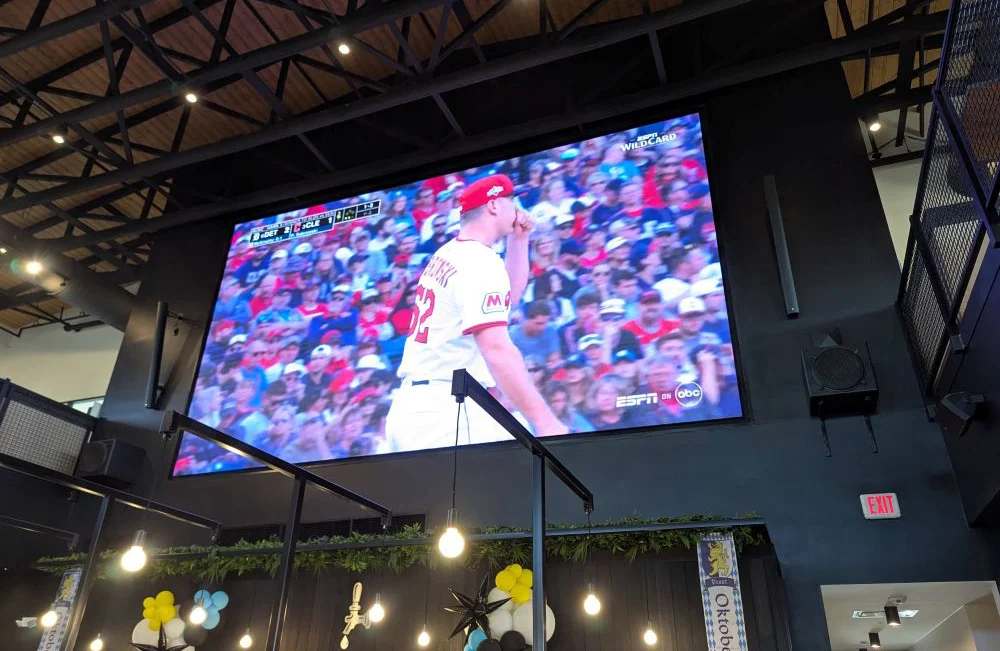
For the outdoor area, the team deployed 12 AS-8T loudspeakers around the volleyball courts, providing even, weather-resistant coverage. The visual centerpiece of the venue—a 25-foot-wide LED screen—is flanked by AtlasIED ALA20T column line-array loudspeakers. These units, which combine 20 three-inch full-range drivers and six high-frequency tweeters, offer exceptional pattern control. This allows the audio to be focused squarely on the audience rather than reflecting off the vast, open wall surfaces.
Official Perspectives: The Integrator and the Partner
The collaboration between iCOMM Communications and AtlasIED is a testament to the importance of manufacturer-integrator relationships in large-scale commercial projects.
"The coverage feels really even as you walk through the space," says Andy Black of McFadden Sales. "In a large, reverberant space like this, you usually end up with ‘hot spots’ and ‘dead zones.’ To achieve such uniform sound pressure levels is genuinely impressive. It’s a testament to the design, not just the hardware."
Ken Sargent echoes this sentiment, highlighting the reliability of the support system behind the gear. "With a product catalog as extensive as AtlasIED’s, it is fantastic to have a wide selection of high-quality indoor and outdoor loudspeakers," Sargent says. "Beyond the hardware, their team is incredibly knowledgeable. When you’re dealing with a project of this scale, knowing that you have technical support that can find answers quickly is a game-changer."
Implications for Future Hospitality Design
The Liberty Collective project sets a new benchmark for how large-scale, open-concept venues should approach audio infrastructure.
Prioritizing Intelligibility
The project demonstrates that high-end commercial audio is not about volume, but about intelligibility. By using column arrays and surface-mount speakers rather than relying on high-ceiling-mounted hardware, iCOMM ensured that background music and announcements remain clear, even when the venue is at capacity.
The Power of Device-Agnostic Control
The use of the Atmosphere platform’s device-agnostic, responsive web interface highlights a growing trend in AV integration: the move away from proprietary, fixed hardware controllers. By allowing managers to control the audio via tablets and mobile devices with rights-based access, the venue staff can adjust zones on the fly without needing to be physically present at a server rack.
Adapting to the "Indoor-Outdoor" Hybrid
As modern entertainment venues increasingly blur the lines between indoor and outdoor spaces, the integration of weather-resistant, high-fidelity audio becomes a necessity. The success at Liberty Collective proves that with the right DSP processing and the correct selection of IP-rated hardware, venues can maintain a consistent brand experience across any environment, regardless of the season or the weather.
In conclusion, the Liberty Collective installation is more than just a list of hardware specifications; it is a successful reconciliation of architecture and acoustics. Through the expertise of iCOMM Communications and the flexibility of the AtlasIED Atmosphere platform, the venue has created a sonic landscape that is as inviting as its culinary offerings, proving that the right technology can turn even the most challenging acoustic environment into a harmonious, high-performance space.