In the heart of East Texas, the First Baptist Church in Carthage has long served as a spiritual cornerstone for its community. However, as the musical landscape of modern worship evolved over the past two decades, the church’s audio infrastructure struggled to keep pace. Facing the limitations of a system that had remained largely untouched since the building’s construction in 2003, church leadership recently embarked on a comprehensive audio overhaul. By partnering with the integration firm RP AVL and deploying Martin Audio’s advanced TORUS constant coverage array technology, the church has successfully bridged the gap between its traditional architecture and the high-fidelity demands of contemporary worship.
The Catalyst for Change: Addressing Two Decades of Acoustic Drift
The decision to modernize was not born of mere desire, but of necessity. Since 2003, the worship style at First Baptist Carthage had transitioned from traditional acoustic-led services to more dynamic, multi-instrumental programs. The aging PA system, which featured deteriorating loudspeakers and underpowered amplification, was no longer capable of providing the clarity required for speech intelligibility or the musical depth demanded by a modern band.
Congregants and staff had grown accustomed to uneven coverage—where some areas of the sanctuary suffered from muddy low-end build-up while others lacked the high-frequency presence necessary for vocal clarity. As components failed and the technology became obsolete, the need for a professional-grade, future-proof solution became the church’s primary technical priority.
A Partnership Rooted in Purpose: Enter RP AVL
To spearhead this transformation, the church turned to RP AVL, a boutique integration firm founded by industry veteran Ray Priszner. Priszner’s background is unique; he spent years serving as a technical director at a major Houston-area mega-church before launching his own firm in 2022.
"I stepped away from a technical director role at a mega-church in the Houston area to found RP AVL," Priszner explains. "I missed helping churches and working alongside volunteer teams to increase their skill set in serving their local church. This project started because of a relationship with a pastor who felt called back to his home church in Texas. In his prior church, I had installed a smaller Martin Audio system, which he really loved."
Priszner’s approach is deeply collaborative, focusing not just on the hardware, but on empowering the church’s volunteer teams—the people who operate the system week-in and week-out. His previous success with Martin Audio products made the brand a natural choice for the Carthage project.
Overcoming Architectural Challenges: The Design Phase
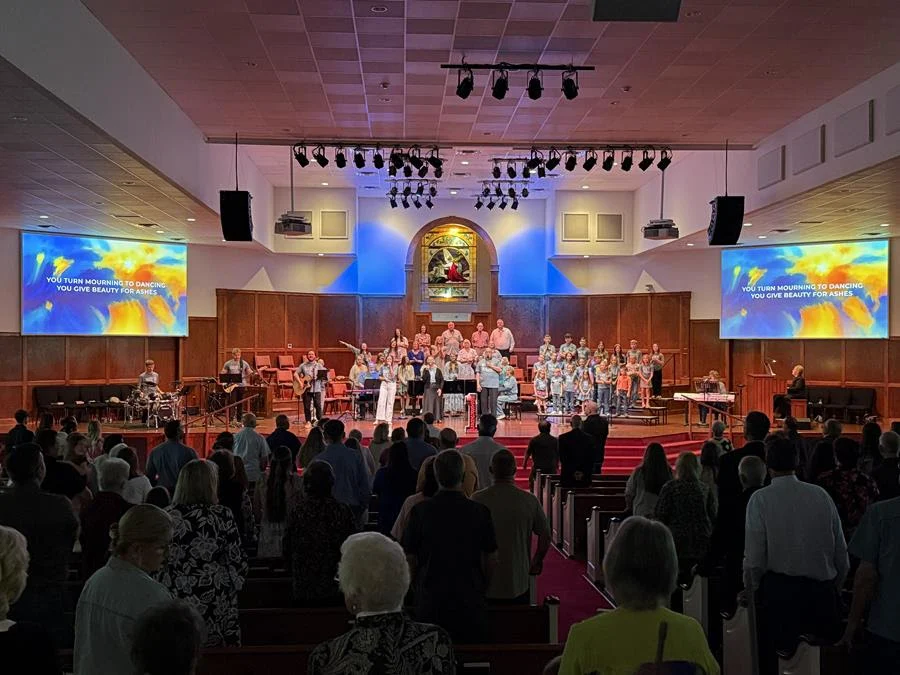
The sanctuary at First Baptist Church presented a challenging acoustic environment. The room is significantly wider than it is deep, a configuration that often results in poor stereo imaging and coverage gaps. Furthermore, the space features a stepped ceiling, which introduces complex frequency anomalies and reflections that can wreak havoc on a standard point-source speaker system.
To mitigate these issues, the design process relied heavily on Martin Audio’s proprietary DISPLAY software. This tool allowed Priszner to create a virtual 3D rendering of the sanctuary, testing different loudspeaker configurations before a single piece of rigging was mounted.
"Importing the room rendering and modeling with different Martin boxes made the process seamless," Priszner notes. "Ultimately, we chose the TORUS T820 and CDD6 to be the optimal boxes for the space."
The accuracy of this software proved to be a revelation. During the commissioning phase, Priszner used SMAART measurement software to verify the system’s performance. The results were startlingly close to the digital projections. "I’m very impressed how accurate the DISPLAY modeling was compared to the physical deployment of the system," he says. "Using SMAART, I measured numerous positions within 0.2 dB of DISPLAY’s predictions. This alone has given me additional confidence when designing and implementing Martin Audio solutions."
The Technical Deployment: Precision Engineering
The final installation is a testament to the versatility of the TORUS series. The system is anchored by two main hangs of four TORUS T820 constant coverage array elements per side. These are supported by two SX218 dual-18-inch subwoofers, which provide the foundational low-end punch necessary for a modern worship band. To ensure that the far edges and specific seating areas received consistent high-frequency coverage, a pair of Martin Audio CDD6 loudspeakers were deployed as out-fills.
Powering the entire array is a pair of Martin Audio iKON IK41 amplifiers, which provide the DSP and headroom required to drive the system to its full potential without compromising signal integrity.
One of the most significant wins for the project was the constant curvature design of the TORUS arrays. By optimizing the "single box resolution" of the system, Priszner was able to achieve even coverage from the front rows to the back of the room without the need for additional front-fill speakers. This not only reduced the complexity of the installation but also maintained a cleaner visual aesthetic, ensuring the technology remained unobtrusive to the worship environment.
Chronology of the Project
- 2003: Original audio system installed during the construction of the sanctuary.
- Early 2022: Ray Priszner founds RP AVL with a mission to serve local congregations.
- Late 2023: Consultations begin between the church leadership and RP AVL to address the deteriorating sound system.
- Q1 2024: System design phase using Martin Audio DISPLAY software; final selection of TORUS T820 and CDD6 components.
- Q2 2024: Physical installation and calibration using SMAART analysis; training of volunteer staff.
- Q3 2024: Full system deployment and formal debut to the congregation.
The "Jaw-Drop" Moment: Proof in Performance
The effectiveness of the new system was perhaps best demonstrated during the final tuning sessions. Priszner was working on the out-fills when the worship pastor walked into the room.
"I had just finished tuning the CDD6s when the worship pastor walked in and was amazed at the sound," Priszner recounts. "I turned and looked at him to inform him that the only thing on was the out-fills. His jaw dropped. He said, ‘No way. That can’t be.’ But I said yes, only the small guys!"
This anecdote highlights the fundamental shift in the church’s audio quality. The CDD series—known for its natural, open sound and compact form factor—paired seamlessly with the TORUS line, providing a smooth, high-fidelity experience that the church had previously lacked.
Implications and Reflections
The success of the First Baptist Church project serves as a case study for modernizing aging houses of worship. By prioritizing high-precision modeling and choosing modular, scalable technology like the TORUS array, the church has not only solved its immediate acoustic problems but has also created a platform that can grow with the congregation’s needs for years to come.
The feedback from the congregation has been overwhelmingly positive. During the first few weeks of operation, long-term members—some of whom had attended for over 15 years—remarked that they could finally hear individual instruments and the choir with absolute clarity. The system, once a source of distraction, has now faded into the background, allowing the congregation to focus entirely on the service.
For RP AVL, the project reinforces the value of specialized audio integration. By combining technical expertise with a genuine desire to serve the church community, Priszner has helped set a new standard for sound reinforcement in the region. The project proves that even in complex acoustic environments, a thoughtful design process combined with the right technology can turn a sonic challenge into an inspiring, worship-enhancing asset.