In an era where digital audio workstations (DAWs) are becoming increasingly complex, managing massive orchestral templates and sprawling instrument libraries has become a significant bottleneck for modern composers. Addressing this friction, Forma Labs Audio has officially unveiled Filament, a groundbreaking real-time MIDI orchestration engine designed to fundamentally change how producers and composers interact with their virtual instrument (VST/AU) collections.
Launching on June 30, 2026, Filament is positioned not as another sample library or a replacement for creative judgment, but as a "control layer" that streamlines the technical overhead of large-scale production. By allowing users to host and manipulate up to 64 virtual instruments within a single DAW track, Filament promises to transform chaotic project files into highly performable, streamlined environments.
The Core Concept: Simplifying Complexity
For many professional composers, the "template" is a double-edged sword. While massive templates containing hundreds of instrument instances offer instant inspiration, they often tax CPU resources, clutter session windows, and make navigation a nightmare.
Filament disrupts this paradigm by acting as a centralized hub. Instead of spreading dozens of plugins across multiple tracks and auxiliary channels, a user can load the Filament plugin onto a single track and host up to 64 AU/VST3 instruments within it. This architecture allows for a more cohesive workflow, where routing, sequencing, mixing, and triggering are managed through a unified interface.
The Philosophy Behind the Engine
According to the development team at Forma Labs Audio, the goal of the project was simple: "To provide musicians with a faster and more performable way to control the sounds already in their workflow." By abstracting the technical routing away from the DAW’s native environment, Filament allows composers to focus on the performance and the arrangement rather than the underlying signal chain.

Feature Deep-Dive: A Toolkit for Modern Producers
At launch, Filament arrives with a suite of features that cater to both studio composers and live performers. The software is designed to be highly flexible, offering deep integration without forcing a specific creative workflow upon the user.
1. Multi-Instrument Hosting
The centerpiece of the engine is its ability to host 64 instances of AU or VST3 instruments. This is particularly useful for orchestral composition, where layering multiple string patches or brass libraries is common practice. By hosting these within Filament, users can perform complex orchestrations—such as triggering a full string ensemble and a percussion section simultaneously—from a single MIDI input.
2. Real-Time MIDI Orchestration and Arpeggiation
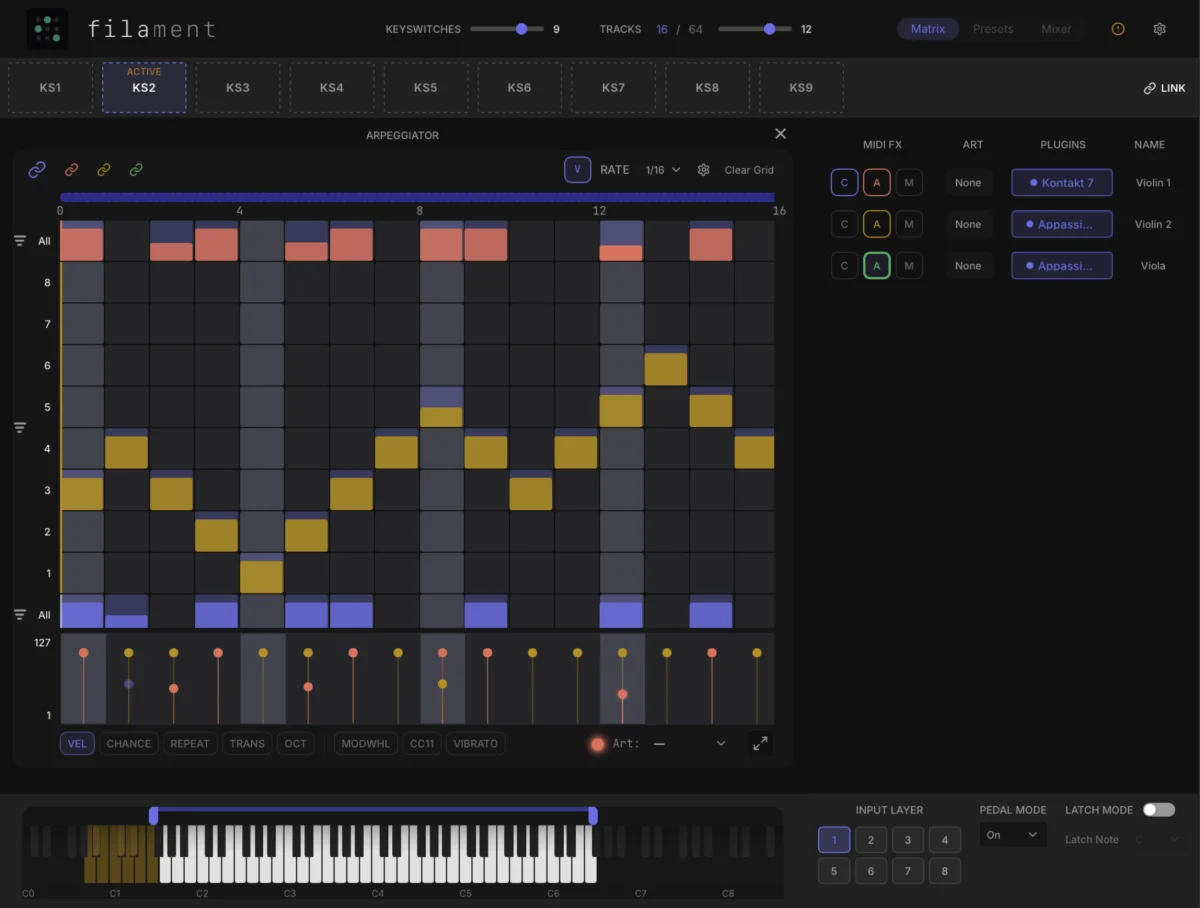
Filament includes a robust, multi-mode arpeggiator that goes beyond traditional patterns. It is designed to work in tandem with the engine’s MIDI routing, allowing for complex, dynamic musical textures to be generated on the fly. Whether a user is composing a cinematic score or designing a synth-heavy soundscape, these tools provide a level of control that would be cumbersome to replicate manually in a standard DAW piano roll.
3. Key-Switching and Performance Management
One of the most tedious aspects of working with virtual instruments is the management of key-switches (the MIDI notes used to change articulation). Filament introduces a dedicated system for handling these, allowing users to build bespoke orchestration systems that bridge the gap between different instrument libraries from various developers. This creates a unified "language" for the composer’s entire sample collection.
4. Per-Instrument Clip Launching
Mirroring the functionality found in live-performance software, Filament allows for per-instrument MIDI clip launching. This enables composers to trigger specific sequences or patterns for individual instruments within the engine, effectively turning a single DAW track into a multi-layered, interactive performance machine.

Chronology: From Concept to Release
The development of Filament represents a significant milestone for Forma Labs Audio. While the company has maintained a relatively low profile, the industry buzz surrounding the beta-testing phase of Filament has been substantial.
- Q3 2025: Initial concept development begins, focusing on the limitation of current DAW MIDI routing.
- Q1 2026: Alpha testing commences with a select group of cinematic composers and MIDI programmers. Feedback focuses heavily on the need for stable CPU management when running 64+ instances of high-end orchestral libraries.
- May 2026: Forma Labs Audio initiates a "soft-launch" teaser campaign, showcasing the UI and the flexibility of the routing engine.
- June 30, 2026: Official global release for Windows 10+ and macOS. The software enters the market at a competitive price point, with a special launch-window promotion.
Technical Specifications and Compatibility
Forma Labs Audio has prioritized cross-platform stability. Filament is fully compatible with both Windows 10 (and later) and macOS environments. It supports VST3 and AU formats, ensuring that it integrates seamlessly into the vast majority of industry-standard DAWs, including Logic Pro, Cubase, Ableton Live, and Studio One.
Furthermore, the inclusion of a "Standalone" mode is a notable feature. This allows users to utilize Filament outside of their DAW, which is an ideal solution for live stage setups where a laptop might be used to trigger virtual instruments without the overhead of a full recording session.
Launch Pricing:
- MSRP: GBP 149
- Launch-Window Price: GBP 99
Implications for the Industry
The introduction of Filament arrives at a pivotal time for the music production industry. As sample libraries become increasingly heavy (often requiring massive RAM and high CPU overhead), the ability to manage these resources efficiently is a primary concern.

Improving Workflow Efficiency
For the independent composer working on tight deadlines, the "time-to-first-note" metric is crucial. Filament’s ability to recall complex, multi-instrument setups from a single preset means that the time spent on "template building" can be drastically reduced. This shift toward modular, engine-based production is likely to influence how other software developers approach MIDI management in the coming years.
A Shift Toward "Engine-Centric" Production
For years, the DAW has been the final word in production. However, with the rise of dedicated plugins like Filament, we are seeing the emergence of "engines within engines." This modular approach allows users to carry their custom instrument hierarchies from project to project, regardless of the DAW being used. It effectively creates a layer of abstraction that makes the composer’s setup more portable and resilient against software updates or DAW migrations.
Official Perspective and Future Outlook
While Forma Labs Audio has been clear that Filament is a utility, the implications of its usage are deeply creative. By lowering the technical barriers, they are enabling users to push their arrangements further.
When asked about the future of the platform, a representative from the company hinted at potential updates to the orchestration engine, including deeper integration with AI-assisted MIDI generation and more advanced macro-control surfaces. As the software matures, it is expected that the library of 100+ included presets will expand, offering users more templates for common orchestration tasks.
For those interested in exploring the engine, the official website provides a comprehensive manual and a series of video tutorials that demonstrate how to integrate Filament into existing workflows. As of the June 30, 2026, release, users can download the software directly and begin testing its capacity to handle their most demanding orchestral templates.

Conclusion
Forma Labs Audio’s Filament is a bold step forward in the realm of virtual instrument management. By focusing on the "performability" of the studio environment, they have addressed a silent but pervasive issue in modern music production: the sheer logistical weight of high-end sample libraries.
Whether it is through its innovative multi-instrument hosting, its intuitive arpeggiation tools, or its ability to act as a bridge between disparate sample libraries, Filament provides a cohesive solution for the modern producer. As the industry continues to evolve, tools that simplify, consolidate, and streamline the creative process will undoubtedly define the next generation of professional music creation. For the composer who feels bogged down by the technical limitations of their current DAW setup, Filament may well be the missing piece of the puzzle.