Main Facts: A New Standard in Compact Processing
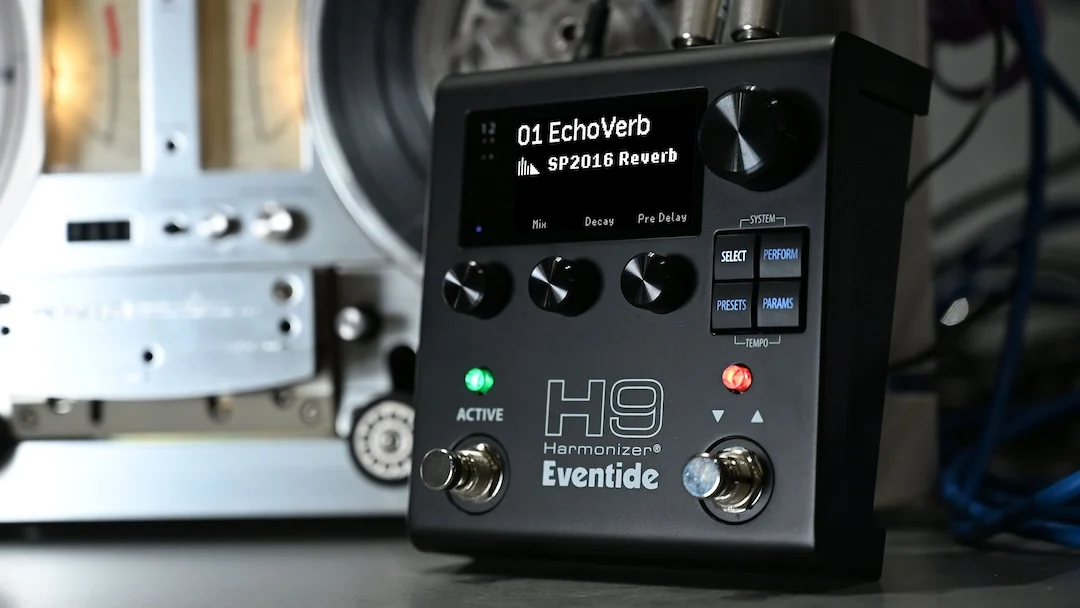
The H9 Harmonizer Gen 2 is not merely a software update but a comprehensive hardware evolution. At its core lies a modern ARM-based processing engine, a radical departure from the architecture used in the original H9 (first released in 2013). This new internal "brain" allows the pedal to run the full suite of 74 algorithms previously exclusive to the H90, Eventide’s dual-engine powerhouse.
Key features of the H9 Gen 2 include:
- The Full Algorithm Library: Users now have access to all 74 algorithms from the H90, encompassing the complete H9 Max library plus newly developed granular, synth, and pitch-shifting effects.
- Enhanced UI: Moving away from the minimalist single-knob design of the original, the Gen 2 introduces three "Quick Knobs" and a dedicated button pad for instant parameter manipulation without requiring an external device.
- Professional Connectivity: The unit features dual instrument and line-level I/O, supporting everything from high-impedance guitar signals to balanced studio levels.
- Advanced Routing: New internal routing options allow for Pre/Post and Wet/Dry configurations, facilitating complex signal paths such as the "four-cable method" or parallel studio processing.
- Legacy Continuity: Despite the hardware jump, the Gen 2 remains fully compatible with legacy H9 presets, ensuring that a decade’s worth of user-created sounds can be migrated seamlessly.
The H9 Harmonizer Gen 2 is priced at $599 MSRP and is available immediately through global retailers.
Chronology: From the H910 to Gen 2
To understand the significance of the H9 Gen 2, one must look at the half-century of innovation that preceded it. Eventide’s "Harmonizer" trademark is one of the most storied in pro audio history.
- 1975 – The H910: Eventide released the H910, the world’s first commercially available digital effects processor. It introduced the concept of pitch-shifting to the masses and became a staple in studios like Abbey Road.
- 1980s – The H3000 Era: The H3000 series cemented Eventide’s reputation for "unearthly" delays and lush pitch-shifted reverbs, sounds that defined the records of the era.
- 2013 – The Original H9: Eventide condensed its studio algorithms into a single-pedal format. The H9 became a global phenomenon, winning multiple awards for its "one-pedal-to-rule-them-all" philosophy, though it relied heavily on a Bluetooth-connected app for deep editing.
- 2022 – The H90 Harmonizer: Eventide launched the H90, a larger-format pedal featuring a high-resolution screen and the ability to run two algorithms simultaneously. This introduced the modern ARM architecture that defines the current "Gen 2" era.
- June 24, 2026 – The Gen 2 Launch: Recognizing that many players prefer the smaller footprint of the H9 but crave the sonic fidelity and "no-app-required" workflow of the H90, Eventide officially releases the H9 Gen 2.
Supporting Data: Technical Specifications and Sonic Fidelity
The shift to ARM-based processing is the most critical technical data point for the Gen 2. The original H9 utilized a DSP architecture that, while revolutionary for its time, eventually reached its "ceiling" in terms of computational complexity.
Processing Power and Fidelity
The new ARM architecture provides significantly more "headroom" for complex calculations. This manifests in two ways: lower latency and higher fidelity. The updated AD/DA converters in the Gen 2 offer a wider dynamic range and a lower noise floor, making the pedal equally at home on a professional studio console as it is on a stage floor.
The 74-Algorithm Powerhouse
The Gen 2 ships with the "Max" library out of the box. This includes:
- Pitch Shifting: Legendary algorithms like MicroPitch, Crystals, and H910/H949.
- Reverbs: The full "Space" series, including Blackhole, Shimmer, and MangledVerb.
- Delays: TimeFactor-derived delays including Vintage Delay and Tape Echo.
- New H90 Exclusives: Granular effects like Ribbons and SP2016 Reverb, alongside polyphonic pitch-shifting algorithms that track with near-zero latency.
Physical Hardware Improvements
The Gen 2 chassis, while maintaining the iconic white aesthetic, features a more robust build. The "Quick Knobs" allow players to map the three most important parameters of any algorithm (e.g., Mix, Decay, and Feedback) to physical controls. This addresses the primary criticism of the original H9: the reliance on an iOS or Android app for real-time adjustments.
Official Responses: The Vision for Gen 2
In a statement accompanying the launch, Eventide emphasized that the H9 Gen 2 was designed as a direct response to user feedback from the pro audio and touring communities.
"The Harmonizer has been a cornerstone of Eventide for ages," a company spokesperson noted during the unveiling. "With the H9 Gen 2, we wanted to ensure that the ‘heat of the creative moment’—whether that’s on a stage or in a high-pressure session—isn’t interrupted by technology. By bringing the H90’s architecture into this smaller format, we are giving musicians the broadest collection of Eventide effects ever housed in a single-algorithm pedal."
Engineers at Eventide also highlighted the "Evolutionary Design" of the product. By integrating the unit with Eventide Control (the updated ecosystem for Mac, PC, and mobile), the Gen 2 is positioned as a "living" platform. The company has committed to regular firmware updates that will introduce new algorithms and features, much as they did with the original H9 over its 13-year lifespan.
Implications: What This Means for the Industry
The release of the H9 Gen 2 has several far-reaching implications for the musical instrument (MI) and pro audio markets.
1. The End of the "App-Dependent" Era
For years, the industry trend was toward "headless" hardware controlled by smartphones. The Gen 2’s focus on physical "Quick Knobs" and on-unit parameter control suggests a market correction. Professional users are increasingly demanding "standalone" capability, where the hardware is fully functional without the need for a secondary device that might lose connection or become obsolete.
2. Studio/Stage Hybridization
With the inclusion of line-level I/O and improved converters, the H9 Gen 2 further blurs the line between a guitar pedal and a rackmount studio processor. At $599, it offers a more affordable entry point into the Eventide ecosystem than the H90 ($899), potentially capturing a larger segment of home studio producers who want "Eventide Reverb" but don’t need the dual-engine complexity of the larger unit.
3. The Competitive Landscape
The H9 Gen 2 enters a crowded market, competing against the likes of the Strymon BigSky MX and the Line 6 HX One. However, Eventide’s "algorithm-first" reputation gives them a unique advantage. While other brands focus on modeling specific vintage gear, Eventide focuses on "computational audio"—creating sounds that are physically impossible in the analog world.
4. Legacy Support as a Brand Pillar
By ensuring that 13-year-old presets from the original H9 work on the Gen 2, Eventide is setting a standard for "digital longevity." In an era of planned obsolescence, the ability for a touring professional to simply "drop" their old sounds into new, more reliable hardware is a significant selling point that builds immense brand loyalty.
Conclusion
The H9 Harmonizer Gen 2 is more than a simple refresh; it is a sophisticated re-imagining of what a compact multi-effects processor can be. By marrying the historic legacy of the Harmonizer name with the most advanced ARM processing available today, Eventide has ensured that its "white box" will remain a fixture on pedalboards and studio desks for another decade to come. As the pro audio world continues to evolve toward higher fidelity and more intuitive workflows, the H9 Gen 2 stands as a testament to the power of listening to the community while pushing the boundaries of what is possible in digital signal processing.