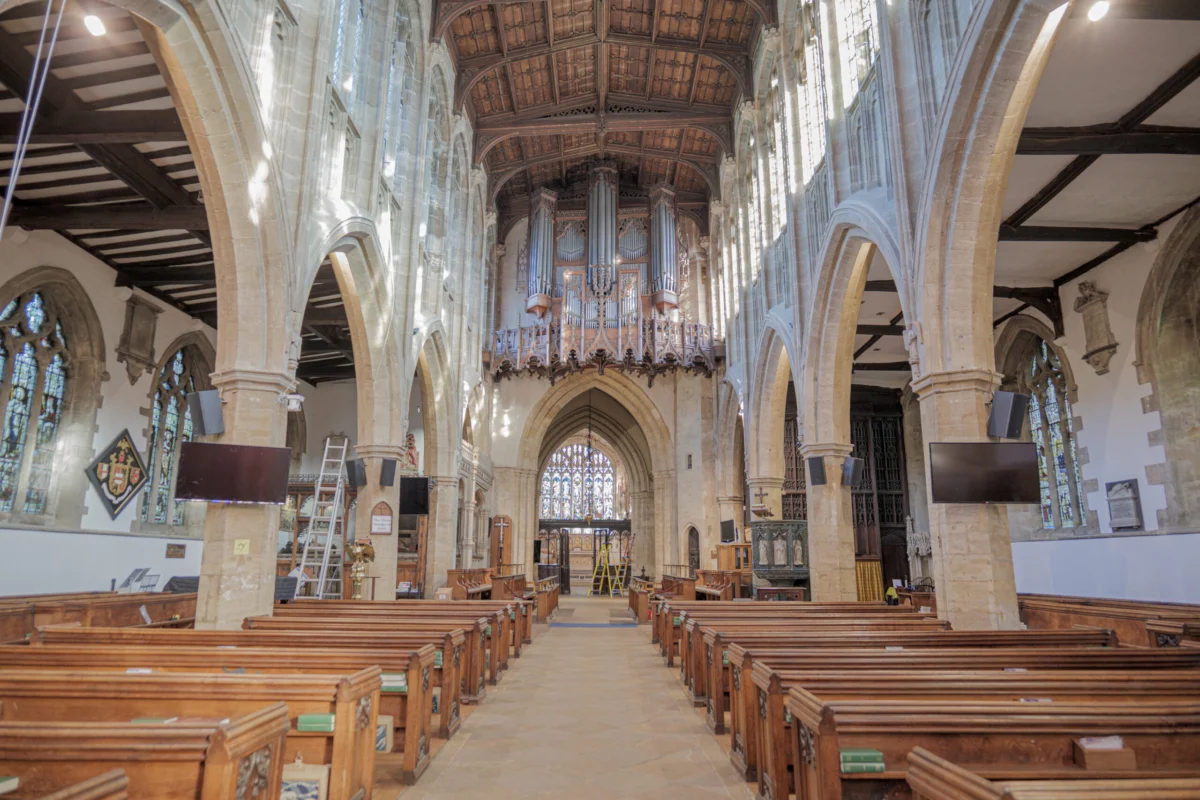
In the heart of Stratford-upon-Avon, where the River Avon winds past the final resting place of the world’s most celebrated playwright, a quiet revolution has taken place. Holy Trinity Church, an architectural crown jewel with over 800 years of history, recently completed a comprehensive overhaul of its audio infrastructure. This project, spearheaded by the UK-based integration firm NoiseBoys Technologies, bridges the gap between centuries-old craftsmanship and 21st-century acoustic precision. By deploying a sophisticated networked system featuring Electro-Voice and Dynacord components, the church has ensured that its diverse program of services, contemporary worship, and special events are heard with clarity that honors its historic surroundings.
Main Facts: A Technical Overhaul for a Living Monument
The installation at Holy Trinity Church was driven by the urgent need to replace an aging, failing 100-volt distributed audio system. As one of the UK’s most visited parish churches—and the site of William Shakespeare’s baptism and burial—the venue faces unique challenges. It is a space defined by immense stone surfaces and intricate woodwork, creating a highly reverberant acoustic environment that is notoriously difficult for traditional sound reinforcement.
The new design centers on a multi-zone configuration powered by Dynacord’s IX series networked DSP amplifiers. These amplifiers act as the engine for a comprehensive speaker array, primarily utilizing Electro-Voice’s EVC series for the main nave and LRC line radiator columns for fill and delay duties in the side aisles, choir stalls, and the chancel. The system is managed via SONICUE Sound System Software, allowing for a bespoke user interface that simplifies complex audio routing for church staff and volunteers.

Chronology: From Legacy Infrastructure to Dante Networking
The journey to the new system began as the legacy 100-volt system approached its terminal decline. For a church that functions not only as a tourist destination but as a vibrant, active house of worship, the degradation of audio quality was no longer sustainable.
- Initial Assessment: NoiseBoys Technologies, led by Director Phill Beynon, performed a detailed acoustic analysis of the church’s nave and historic side aisles. The goal was to move away from the "one-size-fits-all" approach of the previous system toward a granular, zoned solution.
- Design Phase: The integration team prioritized flexibility. They needed a system capable of handling delicate spoken word during traditional liturgy while simultaneously providing the headroom and frequency response required for contemporary worship music.
- Implementation: The deployment utilized Dante audio-over-IP networking, a significant upgrade that allowed for bi-directional signal flow. This allowed the system to integrate both a dedicated mixing desk for complex events and a simplified interface for day-to-day operations.
- Final Tuning: Utilizing SONICUE, the team mapped the church’s floor plan into a custom GUI on TPC-1 touch panels, allowing staff to mute or unmute specific zones with the touch of a button.
Supporting Data: The Architecture of Sound
The selection of hardware was dictated by the dual need for sonic transparency and physical discretion. The church’s aesthetic, particularly in the chancel where Shakespeare’s grave is located, demanded equipment that would vanish into the dark, ornate woodwork.
The Electro-Voice EVC Series
The nave is served by EVC-1082 loudspeakers. The integration team strategically utilized different dispersion angles to combat the church’s natural reverb. In the central nave, models with a 90 x 60-degree dispersion pattern were deployed to provide a focused, long-throw performance. In the wider side aisles, the 100 x 100-degree variants ensure consistent coverage without excessive reflection off the stone walls.

The Dynacord IX Series & Dante Integration
The backbone of the system consists of two Dynacord IX30:8 amplifiers and one IX15:4 amplifier. These units are not merely power sources; they are intelligent network nodes. By leveraging the Dante cards installed in the amplifiers, the system can accept inputs from a front-of-house mixing desk while simultaneously providing the flexibility for staff to input audio directly from local sources. This bi-directional communication ensures that no matter where an audio source is located, it can be routed anywhere in the church with zero latency and minimal signal degradation.
Official Responses and Strategic Insight
Phill Beynon, Director of NoiseBoys Technologies, highlighted the importance of balancing the church’s historic integrity with modern functionality. "Their old 100-volt system was coming to the end of its life," Beynon explained. "They wanted a solution that could handle both speech and music, and extend the coverage into different spaces to create a multi-zone system. Dynacord’s IX series networked DSP amps together with Electro-Voice’s EVC series speakers and LRC columns seemed like a really good fit for the project."
Regarding the visual impact, Beynon noted that the LRC-1100 line radiator columns were essential for the sensitive areas of the church. "For historically significant areas like the chancel where Shakespeare’s grave actually is, being able to use just the LRCs in that room was really good because they blend in with all the old dark woodwork. They’re good for filling in those areas where you need something discreet to do that job."

The user experience was a primary focus for the team. By designing a custom interface for the TPC-1 touch panels, the church staff—who are often volunteers rather than professional audio engineers—can operate the system with confidence. "All they have to do really is turn it on and push one preset button and it’s ready to go during the week," Beynon added.
Implications: A Model for Historic Preservation
The successful implementation at Holy Trinity serves as a template for other historic religious sites across the United Kingdom and beyond. The "Holy Trinity model" demonstrates three key takeaways for future installations in heritage buildings:
- Discretion is Mandatory: In buildings where architecture dates back to the 13th century, visual impact must be minimized. The use of compact, slim-profile speakers like the LRC series proves that high-performance audio does not require massive, unsightly enclosures.
- Networked Flexibility: The transition to Dante-enabled hardware provides a future-proof foundation. As the church’s needs evolve—whether that involves streaming services online or hosting larger musical ensembles—the current infrastructure can be expanded without tearing out cables or replacing the core signal processing chain.
- User-Centric Software Design: The use of SONICUE to create a custom GUI is arguably the most critical factor in the system’s long-term success. By abstracting the complex DSP settings into a simple, floor-plan-based touch interface, the technology becomes an enabler of worship rather than a barrier to entry.
Conclusion: The Future of Worship Audio
As Holy Trinity Church continues to welcome thousands of pilgrims and music lovers each year, the new audio system stands as a silent guardian of the spoken word and the liturgy. By successfully marrying the high-fidelity demands of a modern worship space with the strict conservation requirements of a Grade I listed building, the project sets a new standard for acoustic integration in historical contexts.

The collaboration between Electro-Voice, Dynacord, and NoiseBoys Technologies has ensured that while the stones of the church may whisper of the past, the message delivered within those walls remains crisp, clear, and perfectly articulated for the future. Whether it is a quiet prayer or a choral concert, the technology now serves as a transparent conduit, allowing the history of the space to speak for itself.