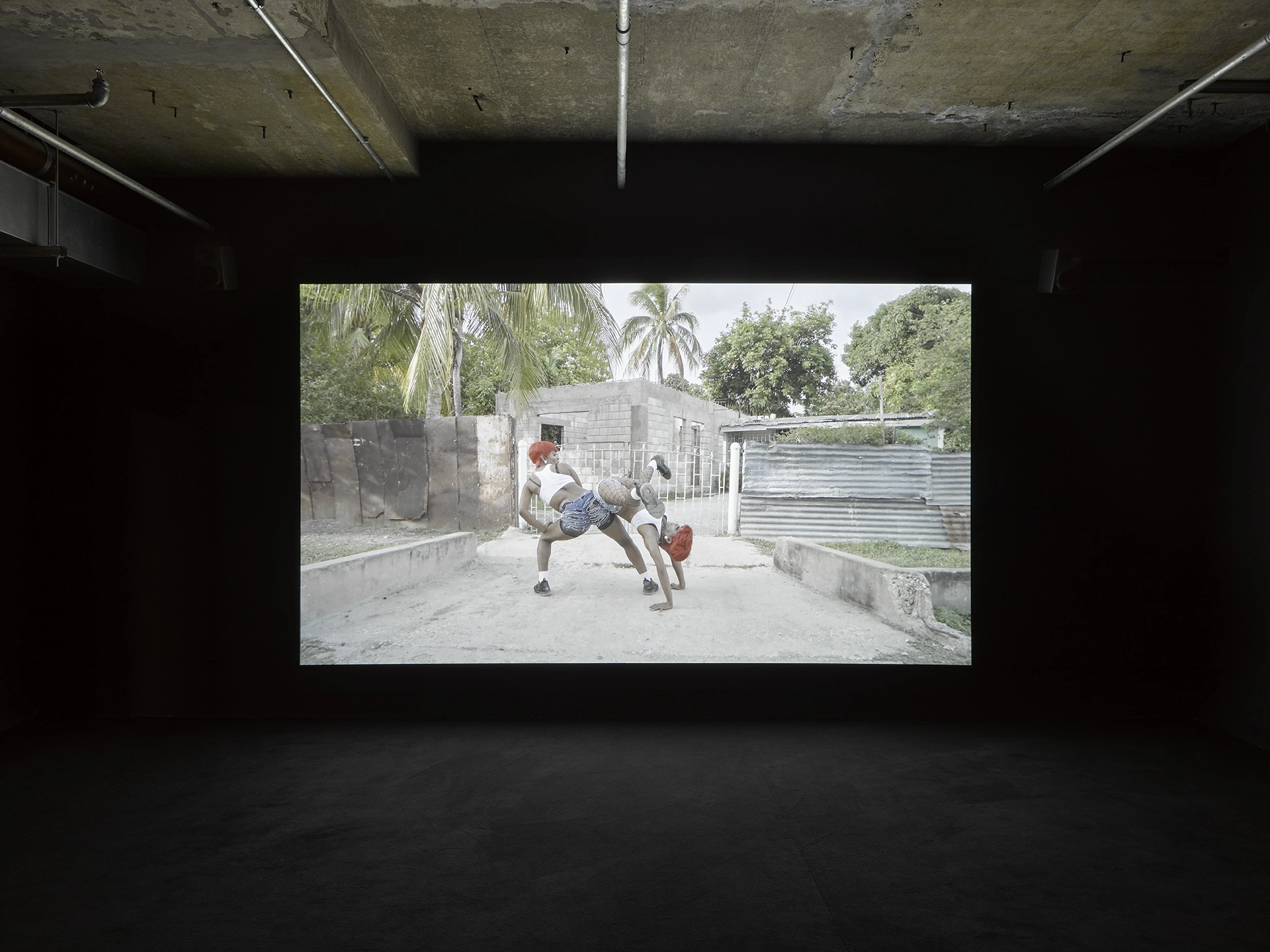
In the subterranean, industrial echoes of 180 Studios, a vibrant, kinetic force is currently commanding the attention of London’s art world. Part of the expansive The Vinyl Factory: Reverb exhibition, the video installation Shelly Belly Inna Real Life by Argentinian-born, Paris-based artist and choreographer Cecilia Bengolea offers more than just a visual record of a subculture; it is a profound, immersive study of movement, resilience, and the socio-political fabric of Jamaica.
Shot on location in Jamaica between 2015 and 2019, the piece centers on the charismatic dancehall icon Shelly Belly. As Bengolea delves into the intricate choreography and the communal spirit of the dancehall scene, she invites viewers into a world that is as misunderstood as it is influential. The exhibition, which runs until March 2, 2025, serves as a testament to the longevity of artistic collaboration and the global reach of Jamaican street culture.
The Genesis of a Creative Obsession
Cecilia Bengolea’s fascination with dancehall is not a recent development, nor is it a superficial engagement. Her work has long operated at the intersection of contemporary art, anthropology, and physical performance. By documenting the street dancers of Jamaica, Bengolea seeks to move beyond the exoticization that often plagues international perspectives on Caribbean culture.
"Dancehall is not just a style; it is a language of survival," Bengolea notes in a recent interview. Her approach to Shelly Belly Inna Real Life was one of deep immersion. Rather than acting as a detached observer, she embedded herself within the circles of Kingston’s dance elite. The resulting footage is raw and unvarnished, capturing the specific tension between the structured choreography of the dance and the unpredictable, often hostile, social environment in which it flourishes.
A Chronology of Collaboration: From Bom Bom to Shelly Belly
The trajectory of Bengolea’s work with The Vinyl Factory provides a fascinating timeline of her evolving relationship with the dancehall medium.
2016: The Infinite Mix
The foundation for her current project was laid nearly a decade ago. In 2016, Bengolea collaborated with renowned British artist Jeremy Deller for the exhibition The Infinite Mix. Their piece, Bom Bom’s Dream, was a surreal, high-energy exploration of the dancehall world, centered on a Japanese dancer known as Bom Bom. The film showcased the global appeal of dancehall, highlighting how the genre had transcended its Jamaican roots to influence dancers in Tokyo and beyond. Shelly Belly, even then, was a pivotal figure, anchoring the work with his effortless command of the genre’s complex steps.
2015–2019: The Fieldwork Period
The four-year span during which Shelly Belly Inna Real Life was filmed represents a maturation of Bengolea’s methodology. During this period, she moved away from the more narrative, dream-like structure of her earlier work toward a more observational, documentary-style approach. She spent months at a time in Jamaica, learning the steps, navigating the social hierarchies of the dance halls, and understanding the specific local context of the dancers’ lives.

2024–2025: Reverb at 180 Studios
The current exhibition at 180 Studios marks the culmination of these efforts. Presented within the context of The Vinyl Factory: Reverb, which celebrates the nexus of music, technology, and art, Shelly Belly Inna Real Life occupies a significant space, forcing the viewer to confront the physicality of the dance—the sweat, the proximity, and the sheer technical prowess required to perform in the heat of a Kingston night.
The Socio-Political Dimensions of Movement
One of the most compelling aspects of Bengolea’s recent commentary is her discussion regarding the relationship between the Jamaican police and the dancehall scene. Dancehall has historically been a site of resistance and regulation. The state’s attempts to control street parties, noise levels, and public gatherings have often placed dancers in a position of conflict with authority.
Bengolea argues that the choreography itself—the way dancers contort, vibrate, and occupy space—is a form of protest. When the police arrive to shut down a dance, the dance does not stop; it moves, evolves, and changes shape. By documenting these interactions, or the threat of them, the film highlights how dancehall functions as an autonomous zone where the marginalized can claim agency.
"The police presence is a shadow over the dance," Bengolea explains. "But the dance is the light. The choreography becomes a way of reclaiming the night, of making the public space yours in the face of institutional pressure."
Supporting Data: The Impact of Dancehall as an Export
While Shelly Belly Inna Real Life focuses on the local, the global impact of the dancehall genre cannot be overstated. Statistics regarding the genre’s reach highlight why an artist like Bengolea is so invested in its documentation:
- Global Influence: Dancehall music and its associated aesthetic have been integrated into mainstream global pop music, from the work of Rihanna and Drake to the explosion of Afrobeats.
- Economic Vitality: In Jamaica, the "dancehall economy"—comprising music production, fashion, event planning, and tourism—is a significant, if often informal, contributor to the nation’s cultural capital.
- Digital Footprint: The evolution of dancehall steps can be traced through social media platforms like TikTok and Instagram, where specific moves are disseminated to millions of users, often divorced from their original social context—a trend that Bengolea’s work serves to correct by providing the necessary historical and cultural anchor.
Artistic Implications and Critical Reception
Critics have lauded Shelly Belly Inna Real Life for its refusal to treat its subjects as mere spectacles. By focusing on the personal narratives of dancers like Shelly Belly, the film elevates the "street dancer" to the status of a fine artist. The installation at 180 Studios is designed to be visceral; the sound design and large-scale projections are intended to replicate the overwhelming sensory experience of being in a dancehall.
The implication for contemporary art is clear: the divide between "high art" and "street culture" is increasingly obsolete. Bengolea’s work proves that the most profound artistic expressions of our time are currently happening on the streets, in the clubs, and in the movement of the human body, not just in the hushed galleries of the West.

Visiting the Exhibition
For those wishing to experience this dialogue between art and dance, The Vinyl Factory: Reverb is currently open to the public at 180 The Strand, London.
Exhibition Details:
- Location: 180 Studios, 180 The Strand, London, WC2R 1EA
- Dates: May 22, 2024 – March 2, 2025
- Note: The exhibition will be closed for the holiday period between December 23, 2024, and January 8, 2025.
- Opening Hours:
- Wednesday – Saturday: 12:00 PM to 7:00 PM
- Sunday: 12:00 PM to 6:00 PM
Tickets can be purchased via the 180 Studios website.
Conclusion: A Living Archive
Cecilia Bengolea has achieved something rare with Shelly Belly Inna Real Life: she has created an archive that breathes. By documenting the sweat, the struggle, and the joy of the dancehall scene, she ensures that these ephemeral moments of brilliance are preserved for a wider audience. As we look at the exhibition, we are reminded that art is not merely about what is left behind in a museum, but about the energy that continues to vibrate in the real world long after the music stops.
Through the lens of her camera, and the movements of Shelly Belly, we are invited to look closer, to listen harder, and to recognize the power of the dance as an act of profound, real-life liberation.