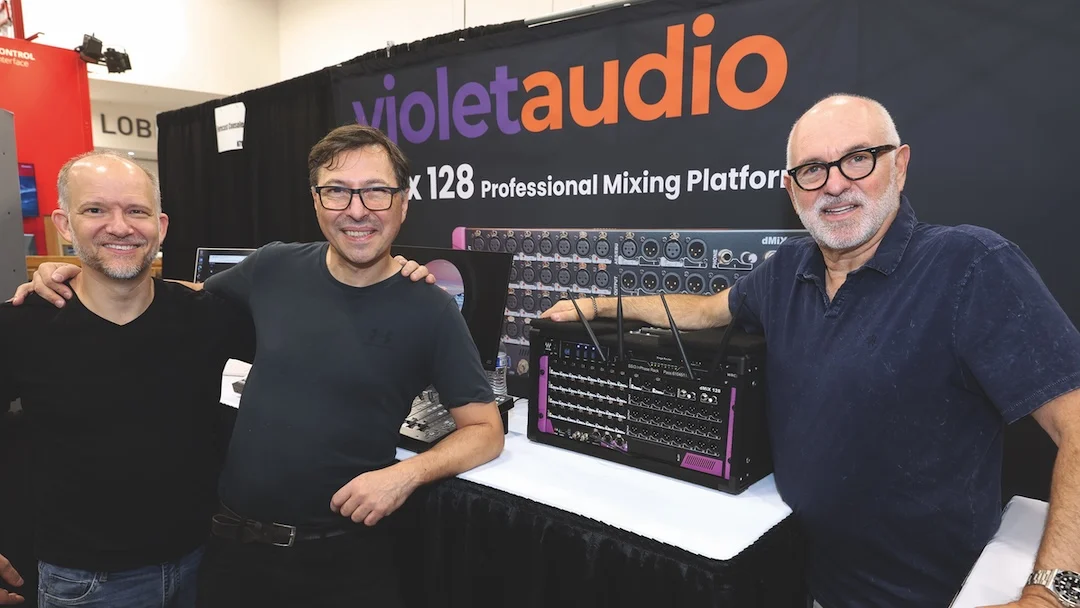
LAS VEGAS, NV — As the professional audiovisual industry converges on the Las Vegas Convention Center for InfoComm 2026, the spotlight has shifted toward a new powerhouse in the live sound and installation market. Violet Audio US, a newly formed distribution and support entity, has officially launched its flagship dMix 128 mixing system. This debut marks a significant strategic expansion for the Melbourne-based Violet Audio, signaling its intent to capture a substantial share of the North American professional audio market by offering high-tier processing power at a competitive price point.
The dMix 128 is not merely another digital console; it is a compact, FPGA-based ecosystem designed to bridge the gap between portable live sound solutions and permanent high-end installations. Led by industry veteran Phil Wagner and founder Danny Olesh, Violet Audio US is positioning itself as a disruptive force, promising to deliver 128 channels of full processing in a form factor that challenges the traditional limitations of compact mixing desks.
I. Main Facts: The dMix 128 and the US Market Entry
The center of the announcement revolves around two primary pillars: the technical prowess of the dMix 128 hardware and the structural launch of Violet Audio US.
The Hardware: dMix 128
The dMix 128 is a digital mixing system built on a Field-Programmable Gate Array (FPGA) architecture. This choice of internal processing allows for extremely low latency and high stability, which are critical in live performance environments. Key specifications include:
- Capacity: 128 input channels and 88 busses, all featuring full processing (EQ, dynamics, and routing).
- Local I/O: A single unit houses 32 microphone/line inputs and 24 analog outputs.
- Scalability: While compact, the system is designed to be scalable via digital networking.
- Networking: Integrated MADI and AES67 I/O come standard, ensuring the unit can sit comfortably in modern AoIP (Audio over IP) workflows.
- Redundancy: To satisfy the demands of mission-critical broadcast and live events, the unit includes redundant power supplies.
The Entity: Violet Audio US
Recognizing that the North American market requires localized expertise, Violet Audio (Australia) has partnered with Phil Wagner to form Violet Audio US. Based in the United States, this new company is responsible for the entire lifecycle of the brand in the US, Canada, and Mexico. This includes:
- Sales and Distribution: Managing a network of select pro audio dealers and system integrators.
- Marketing: Tailoring the brand’s message to the specific needs of the North American live sound and house of worship sectors.
- Training and Support: Providing local technical assistance, which is often the deciding factor for major tour providers and installation firms.
II. Chronology: From Melbourne R&D to the Las Vegas Strip
The journey of the dMix 128 began several years ago in Melbourne, Australia, where Danny Olesh and his engineering team sought to solve a specific market gap: the "mid-tier vacuum." In the early 2020s, engineers often had to choose between affordable but limited digital mixers or prohibitively expensive large-format consoles.
2024–2025: Development and Prototyping
The engineering phase focused on maximizing the efficiency of FPGA chips. By moving away from general-purpose CPUs, the team was able to guarantee "no-compromise" processing, meaning that turning on an effect or a compressor on channel 128 would not degrade the performance of channel 1.
Early 2026: The Strategic Alliance
As the hardware neared production readiness, Danny Olesh tapped Phil Wagner to lead the North American charge. Wagner, whose resume includes leadership roles at some of the industry’s most prestigious audio brands, was tasked with building the infrastructure for Violet Audio US.
June 17, 2026: The InfoComm Launch
The system officially debuted on the first day of InfoComm in Las Vegas. The timing was calculated to coincide with the post-pandemic resurgence of large-scale corporate events and the growing demand for networked audio in educational and government facilities.
Late June 2026: Shipping and Fulfillment
Unlike many "vaporware" announcements seen at trade shows, Violet Audio US confirmed that the dMix 128 will begin shipping immediately in June 2026. This rapid transition from floor-model to shipping-product is intended to build immediate trust with system integrators.
III. Supporting Data: Technical Deep Dive and Integration
To understand why the dMix 128 is generating buzz among technical directors, one must look at the data behind its processing and integration capabilities.
FPGA Architecture vs. Traditional Processing
Most entry-to-mid-level consoles rely on SHARC DSPs or standard ARM processors. While effective, these can hit "walls" when high channel counts and complex effects are used simultaneously. The dMix 128’s FPGA architecture allows for parallel processing. This means the 88 busses—which can be configured as groups, auxiliaries, or matrices—maintain phase coherency and consistent timing across the entire mix.
Connectivity and Standards
In 2026, the "format wars" of digital audio have largely settled into a need for universal compatibility. The dMix 128 addresses this through:
- AES67 Compliance: Ensuring seamless interoperability with Dante, RAVENNA, and Q-LAN networks.
- MADI Support: Providing a legacy-friendly path for existing stage boxes and broadcast trucks.
- Third-Party Control: The system offers native integration with Q-SYS and Crestron. For installers, this means the dMix 128 can be "headless"—controlled via a touch panel in a boardroom or a tablet in a theater—without needing the physical console surface present at all times.
Physical Footprint and Efficiency
Despite its 128-channel capacity, the unit is designed for high-density environments. By consolidating 32 mic pres into a single chassis with the processing engine, Violet Audio has reduced the rack-space requirement for mobile rigs by approximately 40% compared to traditional "brain-and-box" configurations.
IV. Official Responses: Leadership Perspectives
At the InfoComm launch, the leadership team of Violet Audio US articulated a clear vision for the company’s future.
Phil Wagner, US President/CEO:
"Our goal with Violet Audio US is to provide more than just a product; we are providing a support ecosystem. We know that in the North American market, a console is only as good as the person who answers the phone when you have a 5:00 PM soundcheck emergency. By combining Danny Olesh’s brilliant engineering with a dedicated US-based team, we are offering a high-performance alternative to the status quo."
Danny Olesh, Founder:
"The dMix 128 is the culmination of years of listening to what engineers actually need. They want more busses for complex monitor mixes and immersive setups, but they don’t want to carry a six-foot-wide desk. We’ve put the power of a flagship touring console into a package that can fit in a standard rack, without sacrificing the sonic integrity that professionals demand."
Rafael Susin, Technical Director:
"From a technical standpoint, the integration with platforms like Q-SYS and Crestron was a priority from day one. We aren’t just looking at the live sound market; we are looking at the integrated AV market. The ability to deploy 128 channels of high-fidelity audio into a corporate or campus environment, and have it easily managed by existing control systems, is a game-changer for integrators."
V. Implications: The Future of the Mixing Landscape
The introduction of the dMix 128 and the formation of Violet Audio US carry several long-term implications for the professional audio industry.
1. The Democratization of High-Channel Counts
For years, 128-channel mixing was a luxury reserved for top-tier Broadway shows and stadium tours. By bringing this capacity to a more accessible price point, Violet Audio is democratizing complex audio production. Smaller regional theaters, mid-sized houses of worship, and educational institutions will now have the headroom to handle sophisticated productions that were previously out of reach.
2. The "Software-Defined" Hardware Trend
The use of FPGA in the dMix 128 suggests a future where hardware is "evergreen." Because FPGAs can be reprogrammed, Violet Audio can potentially introduce new features, effects, or even entirely new mixing paradigms via firmware updates, extending the lifespan of the hardware investment for the end-user.
3. A New Competitive Era in North America
The entry of Violet Audio US puts established players on notice. With a leadership team that understands the nuances of the American market and a product that hits a "sweet spot" of specs and size, the competitive landscape for digital consoles is set to intensify. This competition is likely to drive innovation across the board, benefiting the end-user through better features and more aggressive pricing.
4. Integration as a Standard, Not an Add-on
By including MADI, AES67, and Crestron/Q-SYS compatibility as standard features rather than expensive expansion cards, Violet Audio is setting a new baseline for what a "professional" console must offer. This move pressures other manufacturers to stop "gatekeeping" connectivity features behind secondary purchases.
As InfoComm 2026 continues, the industry will be watching closely to see how the dMix 128 performs in real-world environments. However, the initial reception in Las Vegas suggests that Violet Audio US has successfully identified a shift in the market—a shift toward power, portability, and total connectivity. With shipping already underway, the dMix 128 is poised to become a staple in the racks of savvy engineers across North America.