LAS VEGAS, NV — As the neon glow of the Las Vegas Strip provided a fitting backdrop, the 2026 InfoComm trade show reached a fever pitch on Wednesday at the Vision Stage. The central theme of the day was clear: the "Experience Economy" is no longer a buzzword—it is the primary driver of the professional audiovisual (AV) industry.
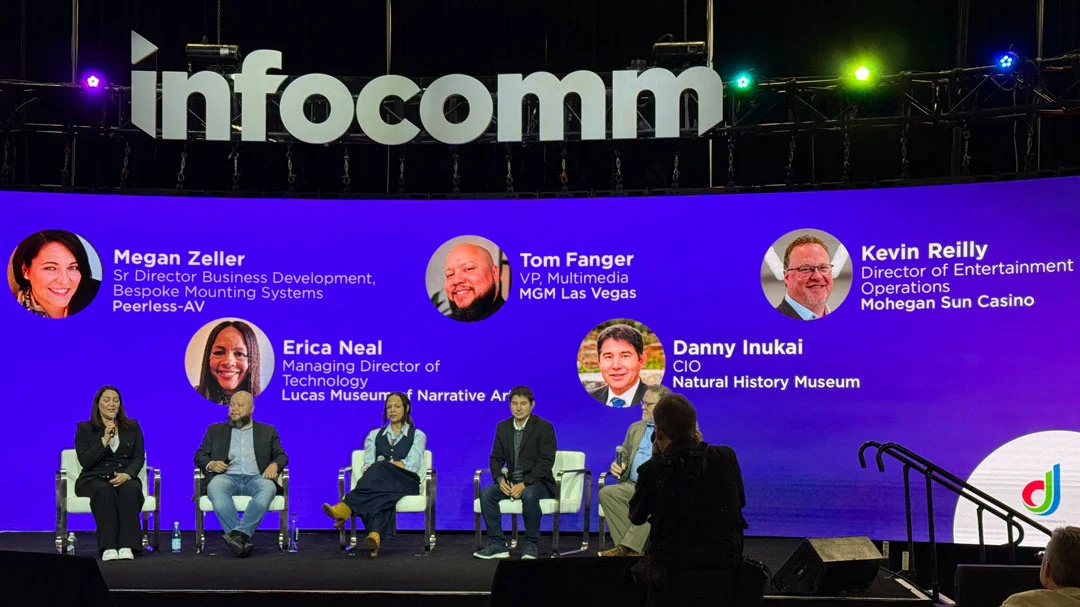
In a landmark panel titled “The Experience Engine: How AV is Driving Engagement and Revenue in Entertainment Venues,” industry titans from the worlds of gaming, museums, and hospitality gathered to dissect the rapid evolution of immersive environments. The discussion, presented by the Digital Signage Federation (DSF), highlighted a seismic shift in how venues approach technology. No longer viewed as a mere utility, AV has become the core architecture of the modern guest experience, serving as the bridge between physical spaces and digital storytelling.
Main Facts: The New Frontier of Immersive AV
The panel, moderated by Megan Zeller, Senior Director of Business Development at Peerless-AV, featured a diverse array of perspectives:
- Tom Fanger, VP of Multimedia at MGM Las Vegas.
- Kevin Reilly, Director of Entertainment Operations at Mohegan Sun Casino.
- Erica Neal, Managing Director of Technology at the upcoming Lucas Museum of Narrative Art.
- Danny Inukai, CIO of the Natural History Museum of Los Angeles.
The consensus among these experts was definitive: the "wow factor" is now a baseline requirement. Whether in a high-stakes casino or a non-profit educational institution, the integration of high-resolution displays, spatial audio, and interactive content is being used to transform passive visitors into active participants. This transformation is driven by two primary goals: increasing dwell time and diversifying revenue streams.
According to the panel, the explosion of immersive tech is not just about hardware; it is about the "narrative journey." From the moment a guest enters a venue, they are seeking a cohesive story that justifies their physical presence in an increasingly digital-first world.
Chronology: From Static Signage to Living Environments
To understand the current state of the "Experience Engine," the panel reflected on the trajectory of the industry over the last decade.
The Era of Information (2010–2018)
In the early 2010s, digital signage was primarily utilitarian. Screens were used for wayfinding, menu boards, and basic advertising. The technology was often siloed, with different departments managing different displays, leading to a fragmented and often confusing visual landscape for the guest.
The Era of Interactivity (2018–2023)
With the rise of mobile technology and social media, venues began integrating touchscreens and "Instagrammable" moments. However, as Tom Fanger noted during the session, this era was plagued by technical complexity. Venues often juggled dozens of different Content Management Systems (CMS), making it nearly impossible to synchronize a unified brand message across a large property.
The Era of Immersion (2024–Present)
We are now in the era of "Living Environments." Modern AV installations are no longer "bolted on" to the architecture; they are the architecture. The panel highlighted how the current landscape is defined by seamless integration, where AI-driven content, massive LED canvases, and synchronized sensory effects create environments that respond to the presence of the guest.
Supporting Data: The Business Case for Immersion
The push toward immersive AV is backed by compelling economic data. Industry reports shared during InfoComm 2026 suggest that venues investing in advanced AV experiences see a significant uptick in Key Performance Indicators (KPIs):
- Increased Dwell Time: In retail and museum environments, immersive exhibits have been shown to increase the average time spent on-site by up to 35%.
- Revenue Growth: For gaming facilities like MGM and Mohegan Sun, dynamic digital signage allows for real-time promotion of shows, dining, and gaming floor specials, leading to a measurable "uplift" in secondary spending.
- The "Social Currency" Factor: According to recent consumer surveys, 72% of Gen Z and Millennial visitors prioritize "experiences" over material goods. A venue that provides a unique visual story generates free organic marketing through social media shares.
- Operational Efficiency: Standardizing AV stacks can reduce long-term maintenance costs by 20-30% by streamlining spare parts inventory and reducing the specialized training required for IT and AV staff.
Official Responses: Insights from the Front Lines
The panelists provided a rare look behind the curtain of some of the world’s most prestigious venues, offering both philosophical and practical advice.
Erica Neal: The Power of Anticipation
Erica Neal, representing the Lucas Museum of Narrative Art, emphasized that the digital experience begins before the guest even reads a word of text. "People want to feel this anticipation of seeing something," Neal explained. "Instead of having just a regular sign that says ‘enter here,’ they want to know what they’re getting into. They are looking for something visually pleasing—something that is more of a story."
For Neal, the technology must serve the narrative. In a museum dedicated to the art of storytelling, the AV systems are designed to evoke emotion and curiosity, setting the stage for the artifacts on display.
Tom Fanger: Taming the "CMS Nightmare"
Tom Fanger of MGM Las Vegas spoke to the logistical hurdles of managing a global-scale entertainment destination. He recalled the early days of "two dozen content management systems," describing the process of updating content as a "nightmare."
Fanger’s response to this chaos was a move toward radical standardization. By simplifying the hardware and software stack, MGM has been able to turn its vast network of screens into a singular, responsive engine that can be updated instantly to reflect current events, emergencies, or high-value marketing opportunities.
Danny Inukai: The Reality of Maintenance
Danny Inukai of the Natural History Museum LA brought a CIO’s pragmatic perspective to the stage. While "cool" technology is great for marketing, it can be a burden for operations if not managed correctly.
"We’re the ones that actually have to maintain systems," Inukai said. "If we have to train staff to maintain different technology stacks, it just makes life immensely harder. 100% standardization makes our lives easier in the long run." He argued that the "Total Cost of Ownership" (TCO) must be calculated at the design phase, ensuring that the "Experience Engine" doesn’t break down six months after the ribbon-cutting.
Kevin Reilly: The "Big Picture" Philosophy
Kevin Reilly shared insights into the massive $30 million renovation currently underway at the Mohegan Sun arena. He cautioned the audience against getting bogged down in "pixel-peeping" and granular details at the expense of the guest’s journey.
"We had an hour-long conversation in a meeting with 15 people about a sign on a column," Reilly shared, illustrating a common pitfall in project management. "To look at the big picture is to step back and say, ‘What’s the guest experience going to be as you come in?’ Do I really need to have a sign here, or did I miss this experience?"
Reilly’s philosophy is that every piece of AV must justify its existence by contributing to the overall "vibe" and flow of the venue.
Implications: The Future of the Experience Engine
The discussions at InfoComm 2026 suggest several long-term implications for the AV industry and the venues they serve:
1. The Death of the "Static" Venue
In the future, a venue that does not change its visual and auditory environment will be seen as obsolete. The ability to "re-skin" a room using projection mapping or LED walls allows a single space to serve as a conference hall in the morning, a luxury lounge in the afternoon, and a high-energy nightclub at night. This flexibility is essential for maximizing ROI on expensive real estate.
2. Convergence of IT and AV
The panel’s focus on CMS and standardization highlights the final stages of the convergence between Information Technology and Audiovisual departments. CIOs like Danny Inukai are now central players in the "Experience" design, ensuring that the creative vision is backed by a robust, secure, and scalable network.
3. Personalization via Data
While not the primary focus of the panel, the move toward "Experience Engines" sets the stage for hyper-personalization. As AI becomes more integrated into CMS platforms, venues will soon be able to tailor content to the specific demographics of the crowd in the room at any given moment, further driving engagement and revenue.
4. Sustainability and Longevity
As venues move toward "100% standardization," the industry is seeing a shift toward more sustainable practices. Standardized hardware means fewer "orphaned" systems and a more circular economy for parts and repairs. Furthermore, as digital signage replaces physical posters and vinyl wraps, the environmental footprint of venue marketing is significantly reduced.
Conclusion
The "Experience Engine" is more than just a collection of bright screens and loud speakers; it is a sophisticated, standardized, and story-driven ecosystem that defines the modern entertainment venue. As the panel at InfoComm 2026 made clear, the success of future venues—whether they are museums, casinos, or arenas—depends on their ability to balance creative storytelling with operational discipline.
By stepping back and viewing the "big picture," as Kevin Reilly suggested, and by embracing the technical rigor advocated by Tom Fanger and Danny Inukai, venue operators can ensure that their investments in AV not only dazzle the eye but also provide a solid foundation for long-term growth and guest loyalty. In the high-stakes world of 2026, the experience is the product.