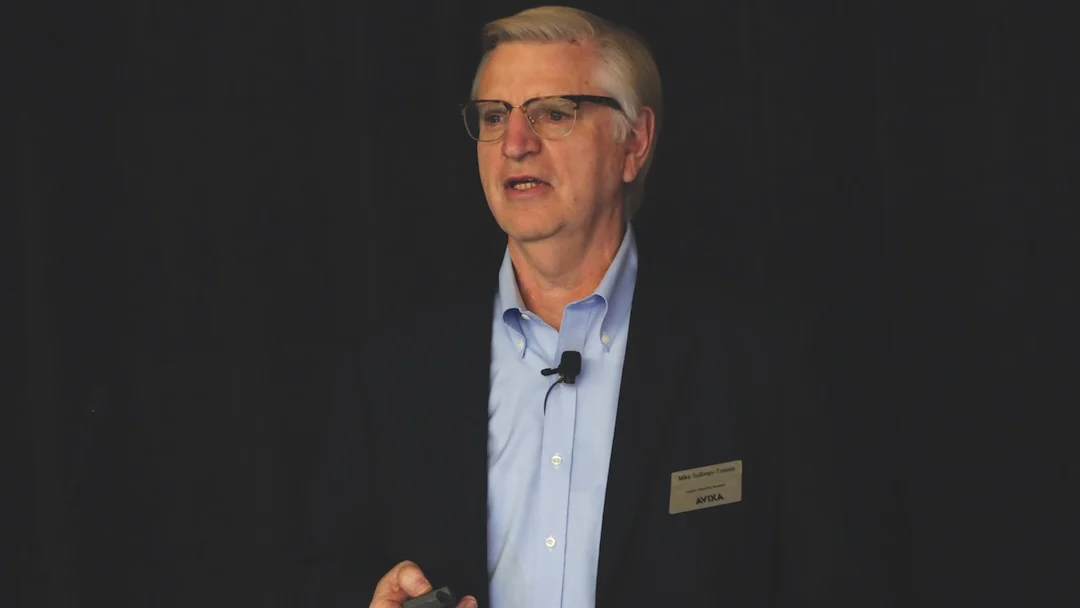
LAS VEGAS, NV — Against the high-octane backdrop of the 2026 InfoComm circuit, the professional audiovisual (Pro AV) industry has signaled a defiant stance against global economic headwinds. At the annual AVIXA Press Lunch held on Wednesday, June 18, 2026, Mike Sullivan-Trainor, a lead industry analyst for AVIXA, delivered a comprehensive keynote titled “The State of Pro AV: AI, Convergence, and the Next Phase of Growth.”
While the global economy continues to navigate a period of recalibration, Sullivan-Trainor’s data-driven address painted a picture of an industry that is not merely surviving, but fundamentally transforming. The narrative has shifted from one of hardware sales to the orchestration of "experiences," driven by a deepening convergence with broadcast technology and the rapid, albeit complex, integration of Agentic AI.
Main Facts: A Resilient Industry in Transition
The central takeaway from the 2026 state-of-the-industry report is the "shock-proof" nature of Pro AV. Despite a deceleration in growth rates compared to the post-pandemic surge, the sector remains a primary driver of modern business infrastructure.
Key Highlights from the Briefing:
- Economic Resiliency: Pro AV growth is currently holding steady at 3.9%, a dip from the previous 5.4%, yet it continues to outpace the Gross Domestic Product (GDP) in the majority of developed nations.
- The Experience Mandate: The industry is moving away from a commodity-based model toward the "Experience Economy," where AV acts as the primary enabler for corporate, educational, and event-based engagement.
- Sector Dominance: Corporate and government sectors are leading the charge in high-end broadcast adoption, with 34.5% and 32.3% adoption rates, respectively.
- The AI Shift: 65% of Pro AV users now incorporate AI into their daily workflows, with a significant shift beginning to occur from Generative AI toward "Agentic AI."
- Investment Surge: Corporate funding for AI integration has seen a staggering 60% increase year-over-year, signaling a transition from experimental use to operational necessity.
Chronology: From Economic Theory to Technological Reality
Sullivan-Trainor’s presentation was structured as a journey through the evolution of value within the industry. He began by grounding the current state of Pro AV in the economic theories of the late 20th century, specifically referencing Joseph Pine and James H. Gilmore’s seminal work, The Experience Economy.
The Evolution of Value
In the late 1990s, Pine and Gilmore argued that the next step in economic evolution followed the progression from commodities to goods, then to services, and finally to experiences. Sullivan-Trainor argued that in 2026, Pro AV has become the "stage" upon which these experiences are built.
By mid-presentation, the focus shifted from the "why" to the "how." The analyst detailed the timeline of the "Broadcast-AV Convergence." What was once a clear line between professional television production and office-space audiovisual setups has blurred into obscurity. This transition, which began in earnest around 2022, has reached a tipping point in 2026, where "production quality" is no longer a luxury for the C-suite but a requirement for every department within an enterprise.
The final segment of the briefing focused on the immediate future: the 2026–2027 AI roadmap. Sullivan-Trainor highlighted that while 2024 and 2025 were the years of "Generative AI" (content creation), 2026 marks the beginning of the "Agentic" era, where AI systems act as autonomous agents to manage signals, optimize environments, and troubleshoot networks without human intervention.
Supporting Data: The Metrics of Growth
To support the claim of industry resilience, AVIXA provided a granular look at where the capital is flowing and how user behavior is shifting.
Market Growth vs. Global GDP
While a growth rate of 3.9% might seem modest compared to the 5.4% seen in previous cycles, Sullivan-Trainor emphasized that in a cooling global economy, this figure is exceptional. Pro AV is now classified as "critical infrastructure" for the modern workforce, making it less susceptible to the discretionary budget cuts that plague other tech sectors.
Adoption of Broadcast Production Rooms
The democratization of broadcast technology is evident in the adoption rates across various verticals:
- Corporate: 34.5%
- Government: 32.3%
- Education: 19.0%
The relatively lower adoption rate in education was identified as a significant area for future growth, particularly as universities look to compete in the global hybrid-learning market.
AI Utilization Metrics
The AVIXA Business Index Pool provided startling insights into the ubiquity of Artificial Intelligence:
- 65% of Pro AV professionals use AI in their professional capacity.
- 27.7% utilize AI tools at least weekly.
- 37% use AI occasionally for specific task optimization.
- 70% of current usage is focused on Generative AI (text, image, and code generation).
However, the "Agentic AI" lag was noted. While other tech sectors have moved toward autonomous agents, Pro AV is still in the early adoption phase for these technologies, representing a massive opportunity for developers in the coming 18 months.
Official Responses: Insights from Mike Sullivan-Trainor
Throughout the briefing, Sullivan-Trainor provided context to the numbers, offering a nuanced perspective on the challenges facing integrators and manufacturers.
"Pro AV buyers remain resilient, enabling suppliers and integrators to continue to grow revenue," Sullivan-Trainor stated during the lunch. "While the pace has slowed… the growth remains ahead of GDP. Consumers and enterprises will continue to sustain spending on audio and visual despite economic fluctuations because users are looking to differentiate experiences—and experiences are driven by Pro AV."
Addressing the shift toward internal production, he noted that the "C-suite monopoly" on high-quality video has ended. "It is no longer just the CEO who needs a broadcast-quality setup. Every department—sales, marketing, HR—wants production quality available for internal communications. We are seeing a massive demand for real-time graphics, virtual sets, XR (Extended Reality) layers, and augmented reality integration."
On the topic of AI, Sullivan-Trainor was both optimistic and cautious. "The productivity benefits are gradually beginning to outweigh the risks. However, we must address the ‘Agentic’ lag. End users will soon expect AI to be fully embedded to enable automated, adaptive, on-demand, and personalized experiences. If the Pro AV industry doesn’t lead that charge, other tech sectors will."
Implications: The Road Ahead for 2026 and Beyond
The findings presented at the AVIXA Press Lunch have profound implications for the various stakeholders within the Pro AV ecosystem.
1. The Standardization of AV over IP
The report underscored that AV over IP is no longer a "future trend" but a current standard. The democratization of content production relies heavily on the reliability and signal integrity of IP-based networks. For integrators, this means a continued shift away from traditional hardware-centric skills toward IT and network fluency.
2. The Policy Gap and Security Risks
One of the most concerning data points presented was the lack of a specialized security framework for AI in AV. While the number of companies with an AI policy jumped from 31% to 47% in the last year, a significant 36% of firms still operate with no formal AI guidelines.
- The NIST Factor: Currently, firms are relying on general frameworks like NIST (National Institute of Standards and Technology).
- The Challenge: Sullivan-Trainor noted that these frameworks provide "incomplete coverage" for the specific needs of AV integrators, particularly regarding data privacy in "always-on" microphone and camera environments.
3. The Rise of "Agentic" Operations
The transition from Generative AI to Agentic AI will likely redefine the role of the AV manager. Instead of using AI to write a script or generate an image, Agentic AI will be used to manage "Self-Healing Networks." If a display in a satellite office fails or a latency spike occurs in a remote classroom, Agentic AI will diagnose and resolve the issue before a human operator is even aware of the glitch.
4. The Experience Economy as a Sales Strategy
For sales teams and manufacturers, the takeaway is clear: stop selling "specs" and start selling "outcomes." In the Experience Economy, a client is not buying a 4K display; they are buying a "high-impact executive presence" or an "immersive learning environment." The value is in the memory and the engagement created by the technology, not the technology itself.
Conclusion: A Future Defined by Convergence
As InfoComm 2026 continues, the message from AVIXA is one of cautious optimism. The Pro AV industry has successfully decoupled itself from the volatility of the general hardware market by embedding itself into the very fabric of how humans experience the world—whether that is in a boardroom, a courtroom, or a concert hall.
The challenges—economic cooling, AI security gaps, and the need for new skill sets—are significant. However, with a 60% increase in AI funding and a resilient demand for high-quality production, the industry is well-positioned to lead the next phase of the digital-physical convergence. As Sullivan-Trainor concluded, the future of Pro AV is not just about seeing and hearing; it is about experiencing.