NEW YORK, NY — In a move that signals a significant leap forward for the broadcast and motion picture production industries, Lectrosonics has officially announced the global shipping of its highly anticipated IFBT2.0 (Interruptible FoldBack) transmitter base station. As of June 15, 2026, the company confirmed that following the successful completion of rigorous production testing and the attainment of essential international certifications, the first wave of units has been dispatched to fulfill a backlog of professional orders.
The IFBT2.0 represents a comprehensive modernization of the IFB transmitter, a critical piece of hardware that serves as the backbone for communication between directors, producers, and on-camera talent. In an era where production environments are becoming increasingly complex and the radio frequency (RF) spectrum more crowded, the IFBT2.0 arrives as a versatile, high-fidelity solution designed to bridge the gap between legacy analog workflows and the digital future of Audio over IP (AoIP).
Main Facts: A Dual-Transmitter Powerhouse
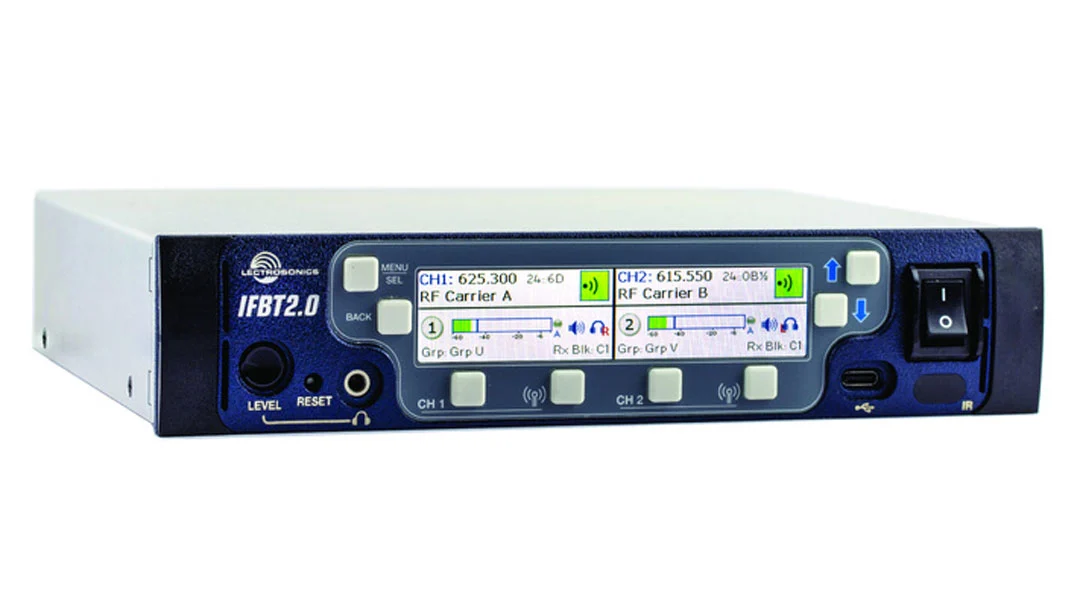
The Lectrosonics IFBT2.0 is not merely an incremental update; it is a fundamental redesign of the transmitter base station. Housed in a compact, half-rack metal chassis, the unit is engineered for both studio stability and the rigors of field production.
The defining characteristic of the IFBT2.0 is its dual-transmitter architecture. Unlike previous generations that often required multiple units to handle multiple feeds, the IFBT2.0 features two completely independent transmitters within a single frame. This allows for the simultaneous transmission of two separate IFB feeds—such as a "Program" feed for talent and a "Private" director’s cue—while occupying half the rack space of traditional setups.
Connectivity is the cornerstone of the IFBT2.0’s design. Recognizing the diverse nature of modern audio environments, Lectrosonics has equipped the unit with a wide array of menu-selectable inputs. These include:
- Analog Inputs: Traditional line and mic level support.
- Digital Integration: Native support for Dante and AES3 digital audio.
- Intercom Compatibility: Direct connectivity for industry-standard Clear-Com and RTS systems.
Furthermore, the unit is designed to handle "wet" signals—audio lines that carry DC voltage, often found in legacy intercom systems—without the need for external isolation transformers. This backward compatibility ensures that the IFBT2.0 can be integrated into existing infrastructure while providing a clear path toward future digital upgrades.
Chronology: From Development to Global Distribution
The journey of the IFBT2.0 from concept to market has been one of meticulous engineering and regulatory navigation. The development cycle was driven by the changing landscape of global RF regulations and the increasing demand for networked audio solutions in the broadcast sector.
Throughout late 2025 and early 2026, Lectrosonics engaged in an intensive production and certification phase. Because the IFBT2.0 is intended for a global market, it was required to pass stringent testing for multiple international standards.
- Initial Production Runs: Completed in early Q2 2026, focusing on hardware durability and signal integrity.
- Certification Phase: The unit successfully received FCC (Federal Communications Commission) approval for the United States, RCM (Regulatory Compliance Mark) for Australia and New Zealand, and CE (Conformité Européenne) certification for the European Economic Area.
- Official Shipping (June 15, 2026): Following the receipt of these certifications, Lectrosonics moved into full-scale distribution. The company confirmed that the first rounds of customer orders, many of which were placed shortly after the product’s initial preview at industry trade shows, have been fulfilled and are currently en route to rental houses, broadcast networks, and independent sound mixers worldwide.
Supporting Data: Technical Specifications and RF Efficiency
The technical specifications of the IFBT2.0 highlight Lectrosonics’ commitment to spectrum efficiency and user flexibility. As the UHF spectrum continues to be squeezed by the expansion of mobile broadband, the ability to operate across specific, clean frequency ranges is paramount.
Tuning Ranges and Global Compatibility
The IFBT2.0 is offered in three distinct tuning ranges to cover the available UHF TV frequencies in most global regions:
- A1 (470.100 – 537.575 MHz): Covering the lower UHF spectrum.
- B1 (537.600 – 614.375 MHz): Covering the mid-UHF spectrum.
- C1 (614.400 – 691.175 MHz): Addressing the upper UHF spectrum (where permitted).
These ranges are specifically matched to the existing IFBR1B and IFBR1C (IFBlue) receiver packs, ensuring that current owners of Lectrosonics IFB receivers can upgrade their base stations without needing to replace their entire inventory of belt packs.
Digital Integration and Software Control
One of the most significant data-driven upgrades is the inclusion of a front-panel USB-C port and a rear-panel Ethernet connection. These ports allow the IFBT2.0 to interface seamlessly with Lectrosonics’ Wireless Designer software.
Wireless Designer has become an industry standard for frequency coordination. By integrating the IFBT2.0 into this ecosystem, sound engineers can:
- Perform real-time system monitoring.
- Automate frequency coordination to avoid interference.
- Remotely configure transmitter settings across a network.
- Perform easy field firmware updates via the USB-C jack, ensuring the hardware remains current as new features are developed.
Physical and Ergonomic Design
The unit features a high-resolution color LCD on the front panel. Unlike older monochrome displays, the color interface provides clear, at-a-glance status monitoring for audio levels, RF output, and menu navigation. The buttons are designed for tactile feedback and long-term durability, catering to engineers who often work in low-light or high-pressure environments.
Official Responses: Insights from Lectrosonics Leadership
The launch of the IFBT2.0 is seen by Lectrosonics as a pivotal moment in their product roadmap. Karl Winkler, Executive Vice President of Product Design & Distribution at Lectrosonics, emphasized the importance of the certification process and the company’s readiness to meet market demand.
"Now that we have completed our initial production runs and received FCC, RCM, and CE certifications, our first rounds of customer orders have already shipped," Winkler stated. His comments reflect a broader corporate strategy of ensuring that products are not just "market-ready" in terms of features, but also fully compliant with the complex web of international RF laws.
Winkler also noted that the design of the IFBT2.0 was heavily influenced by user feedback. The inclusion of Dante, in particular, was a response to the growing number of "all-digital" mobile units and studio builds. By providing a bridge between the digital console and the wireless IFB receiver, Lectrosonics is positioning itself as a central player in the AoIP transition.
Industry analysts suggest that the "dual-transmitter" feature mentioned by Winkler is a direct response to the "rack-space wars" occurring in modern production trucks (OB vans). As more gear is packed into limited spaces, the ability to get two channels of transmission out of a half-rack unit is a significant value proposition.
Implications: The Future of Broadcast Communication
The introduction of the IFBT2.0 has several far-reaching implications for the professional audio community.
1. The Convergence of Analog and Digital
The IFBT2.0 serves as a "Rosetta Stone" for audio signals. By accepting everything from 2-wire and 4-wire intercoms to high-end Dante streams, it allows production houses to transition to digital at their own pace. A studio can use the IFBT2.0 with their current analog console today and switch to a Dante-based workflow tomorrow without changing their IFB transmitter.
2. Enhanced Reliability in Hostile RF Environments
With the "repacking" of the 600 MHz band in the United States and similar spectrum shifts globally, finding clear airwaves is harder than ever. The precision of the IFBT2.0, combined with the coordination power of Wireless Designer, provides sound mixers with a higher degree of confidence. The ability to fine-tune frequencies in small increments and monitor the RF environment in real-time is no longer a luxury—it is a necessity.
3. Streamlining the "Talent Experience"
For the talent on camera, the quality of the IFB feed is vital. Low-latency, high-fidelity audio ensures that cues are heard clearly, reducing the need for retakes. By utilizing the advanced companding and digital processing of the IFBT2.0, Lectrosonics is ensuring that the "foldback" (the audio sent back to the talent) is as clear as the primary broadcast signal.
4. Sustainability and Longevity
The inclusion of USB-C for firmware updates and the rugged, modular design of the hardware suggests a long lifecycle for the IFBT2.0. In an industry often criticized for "planned obsolescence," Lectrosonics maintains a reputation for building gear that lasts for decades. The IFBT2.0 appears to be built in that same tradition, offering a robust physical build coupled with software-upgradable internals.
Conclusion
The shipping of the IFBT2.0 marks the beginning of a new era for Lectrosonics and its global user base. By combining dual-transmitter efficiency, multi-protocol input support, and sophisticated software integration, the IFBT2.0 addresses the immediate needs of the modern broadcaster while anticipating the technological shifts of the next decade. As units begin to arrive in studios and on location sets this month, the industry will likely see a rapid adoption of this new standard in wireless communication technology.