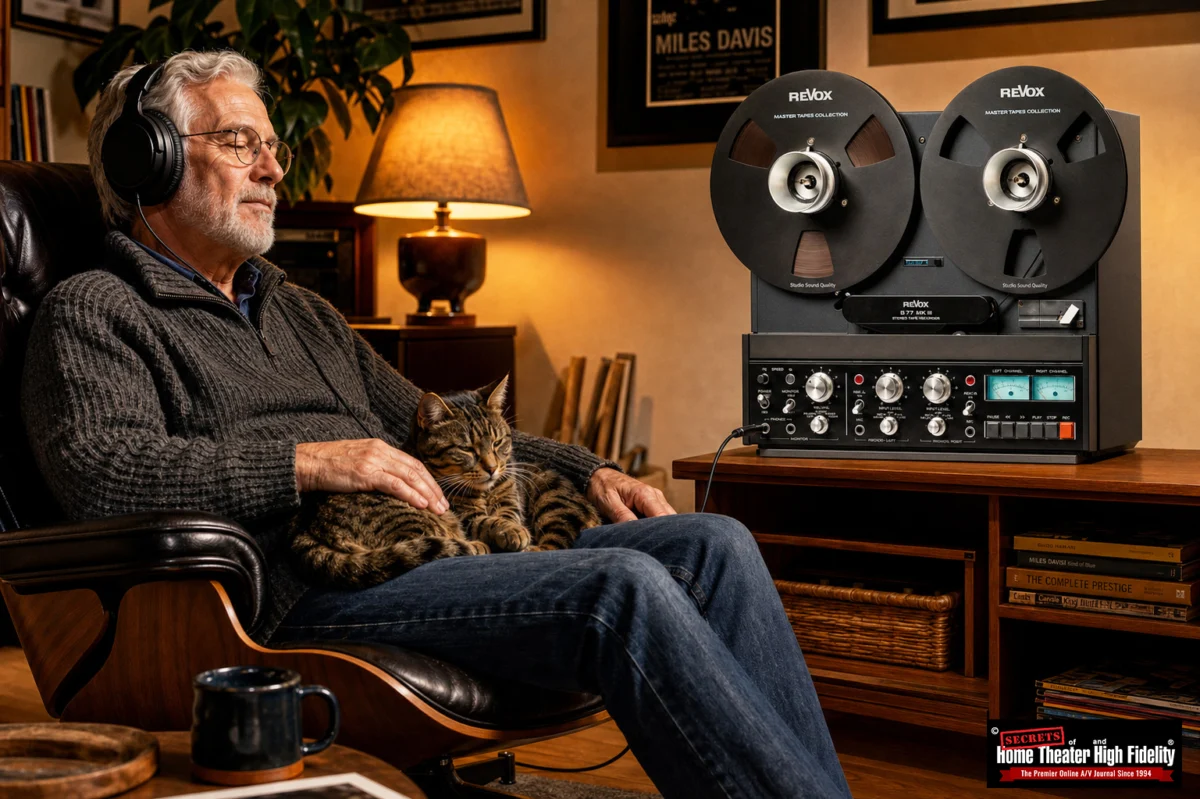
In the contemporary era of high-resolution digital streaming and algorithmic convenience, a dedicated cadre of audiophiles is turning back the clock—not out of mere nostalgia, but in pursuit of a sonic truth that they argue has been lost in the translation to binary. At the heart of this movement is the Horsch House (Revox) library, a collection of studio master tape copies that offer an uncompromising look at classical repertoire. By utilizing a Revox B77 MK III tape deck and 1/4" RTM SM 900 tape (two-track stereo, 15 IPS, CCIR EQ, 510 nWb/m), listeners are experiencing music with a sense of continuity that proponents suggest digital sampling simply cannot replicate.
The Case for the Analog Continuum
The fundamental argument for master tape over digital media rests on the physics of the signal. Digital audio is, by definition, a sequence of discrete samples—a grid of data points that, no matter how dense, must be reconstructed by a filter. Analog tape, conversely, is a continuous magnetic map of the original sound pressure.
When listening to a complex passage, such as the brass chords in the "Great Gate of Kiev," the difference becomes visceral. Digital artifacts, such as quantization error or "grain," can manifest as a string of tiny pieces. Analog tape’s inherent distortion is largely even-order harmonic, which the human ear perceives as warmth rather than error. The result is a "velvet" texture where decay is smooth, not stepped. For those seeking the pinnacle of high-fidelity, these tapes represent the closest one can get to the original studio event.

Chronology of Masterpieces: Three Pillars of the Library
The Horsch House collection currently highlights three distinct pillars of classical performance, each documented with unique historical context and engineering provenance.
1. Mussorgsky: Pictures at an Exhibition & Night on Bald Mountain
The Markevitch/Gewandhausorchester Session (1973)
Igor Markevitch’s recording of Mussorgsky’s masterworks serves as a bridge between two worlds. Recorded in Leipzig in 1973, it captures the Gewandhausorchester during a transitional period under the influence of the "leaner, more articulated" sound championed by Václav Neumann and Kurt Masur.
- Historical Context: Pictures at an Exhibition was born from Mussorgsky’s grief over the death of Viktor Hartmann. The 1874 original was a piano suite; Ravel’s 1922 orchestration became the definitive version. However, Markevitch, a composer in his own right, approaches the score with an analytical ear, treating every inner voice as a deliberate architectural choice rather than mere color.
- The "Bald Mountain" Controversy: Rimsky-Korsakov’s 1886 arrangement, which most audiences know, significantly sanitized Mussorgsky’s original, dissonant 1867 vision. Markevitch’s reading benefits from the transparency of the VEB Deutsche Schallplatten engineering, which prioritized natural, minimal-miking techniques in resonant church environments over the multi-miked studio polish common in the West.
2. Beethoven: The Piano Sonatas (Peter Rösel)
The Lukaskirche Sessions
Peter Rösel’s cycle of the Pathétique, Moonlight, and Appassionata sonatas offers an intriguing study in German-Russian pedagogy. Trained by Dieter Zechlin and later in Moscow under the influence of the late-Romantic Russian school, Rösel brings a unique duality to these works.

- Interpretive Arc: Rather than a chronological progression, this selection moves from the introspective Moonlight to the public rhetoric of the Pathétique, finishing with the cataclysmic Appassionata.
- Engineering Philosophy: The recordings utilize the Lukaskirche in Dresden. By pulling microphones back to a natural distance, the engineers avoided the "strident edge" caused by close-miking. On tape, this natural acoustic is preserved, allowing the hammer strikes and decay to blend into a singular, integrated musical event.
3. Brahms: Piano Concerto No. 2
The Gilels/Jochum/Berlin Philharmonic (1972)
Recorded at the Jesus-Christus-Kirche in Berlin, this partnership remains a cult benchmark. Brahms’ Second Concerto is notoriously dense, frequently causing lesser recordings to collapse into a congested "wall of sound."
- Architectural Clarity: The Jesus-Christus-Kirche’s unique roof construction—utilizing slotted wooden lamellae and a massive air cavity—absorbs low-frequency mud while supporting mid-range clarity. This allows the piano and the orchestra to occupy the same space without losing definition.
- The Role of Tape: In the fortissimo climaxes of the outer movements, the analog tape’s ability to handle high-level transients without smearing allows the listener to track individual strands of the orchestration, even under heavy load.
Supporting Data: Engineering and Venue Dynamics
The quality of these master tapes is not merely a result of the medium, but of the legendary "Tonmeister" culture of the mid-20th century.
- The Detmold Influence: The DG house sound of the 1970s was defined by graduates of the Detmold Academy, such as Klaus Scheibe. Their philosophy—placing the soloist within the hall’s natural reverberance—stands in stark contrast to the modern practice of "spot-miking," which often isolates the instrument from the room.
- Technical Specifications: The 1972 Brahms session, recently remastered for the "Original Source" series, confirms that the sessions were captured on 4-track analog tape. The lack of digital conversion at any stage in the Horsch House dubbing process ensures that the signal remains a pure representation of the original magnetic capture.
Official Responses and Scholarly Perspectives
Musicologists have spent decades reconciling the "posthumous edits" of works like Night on Bald Mountain. While the late 20th century saw a push to return to Mussorgsky’s raw, dissonant originals, these tape reissues allow listeners to evaluate the "fixed" versions through the lens of high-fidelity.

When discussing Peter Rösel’s Beethoven, scholars often note the tension between the "Germanic structural clarity" of his early training and the "Russian sense of sonority" acquired in Moscow. This duality makes his interpretations particularly resilient against the passage of time. Similarly, the Gilels/Jochum Brahms is frequently cited by conductors as the gold standard for orchestral balance, proving that even with the thickest of scores, transparency is possible if the recording venue and the capture medium are perfectly aligned.
Implications for the Future of Listening
The existence of these high-speed analog dubs has profound implications for the audiophile market.
- The Shift in Standards: As listeners become accustomed to the "velvet" continuity of master tapes, the limitations of digital compression (even at high bitrates) become more apparent. The "string of little pieces" criticism of digital audio is no longer just a fringe view; it is a measurable concern for those who prioritize phase accuracy and transient integrity.
- Archival Preservation: By reviving these sessions on tape, libraries like Horsch House are creating a secondary life for analog masters that might otherwise be relegated to digital-only archival storage. This keeps the "analog chain" alive, ensuring that future generations can hear the difference between a digitized file and a direct analog transfer.
- The "Listening Equivalent of Squinting": Perhaps the most significant takeaway is the reduction of listener fatigue. Modern, close-miked recordings often present an aggressive amount of detail that, while impressive in a 30-second audition, becomes exhausting over a full symphony. The "natural perspective" captured in these Eterna and DG tapes offers a more honest, sustainable way to experience the complexity of classical literature.
Ultimately, these tapes are not just products; they are time capsules. They preserve not only the notes written by Mussorgsky, Beethoven, and Brahms, but the specific acoustic signatures of the Lukaskirche and the Jesus-Christus-Kirche, as captured by engineers who understood that the goal of recording is not to create a new sound, but to facilitate a truthful encounter with the old.