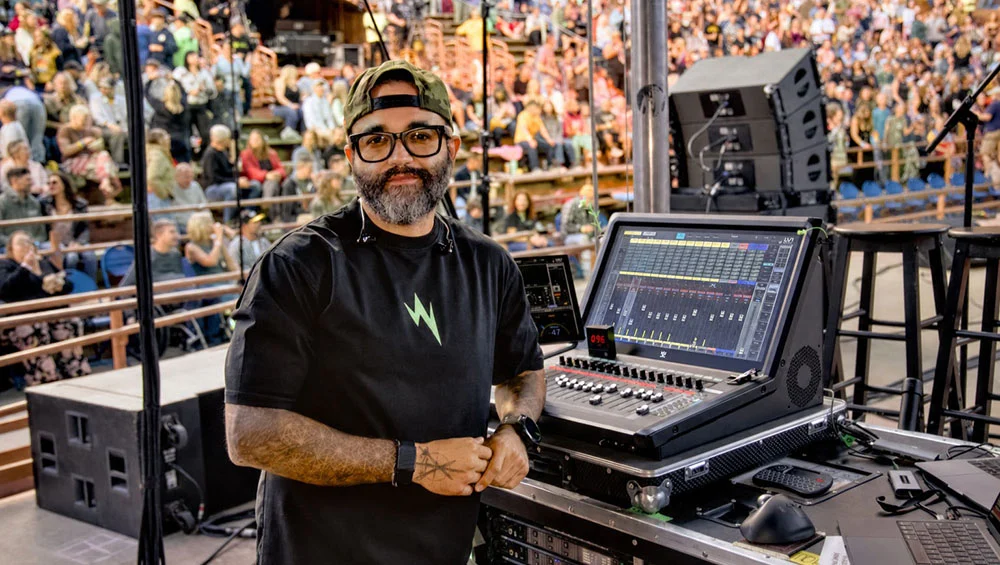
In the high-stakes world of live concert production, the monitor engineer is the unsung architect of the performer’s reality. For the artist on stage, the in-ear monitor (IEM) mix is not just a reference; it is the environment in which they live, breathe, and perform. Recently, at the iconic Red Rocks Amphitheatre, veteran audio engineer Lucas Pinzón elevated this experience to a new dimension, utilizing the Waves LV1 Classic console paired with the Waves eMo IEM immersive mixing engine to deliver a three-dimensional soundscape for Michael Franti & Spearhead.
This deployment marks a significant milestone in live touring, moving beyond the traditional, flat “inside-the-head” stereo mixes that have dominated the industry for decades. By leveraging spatial processing, Pinzón has demonstrated that immersive audio is not just a luxury for the audience—it is a transformative tool for the performers themselves.
The Genesis of an Immersive Workflow
A Career Built on Precision
Lucas Pinzón is a figure of considerable stature in the Latin music industry, boasting over 26 years of experience. His resume includes high-pressure roles for global superstars like Maluma and Becky G, both at Front of House (FOH) and in the monitor world. Pinzón’s philosophy is rooted in the idea that technology should serve the human element of performance. Having successfully experimented with immersive mixing on previous tours, he was well-positioned when the opportunity arose to join Michael Franti & Spearhead for a summer run.
When his colleague and FOH engineer, Karl Milan, reached out to invite him on the tour, the offer was too good to refuse. “Red Rocks? Let’s go,” Pinzón recounts with a laugh. The challenge was immediate: the band had not performed together in six months, the production crew was assembling for the first time, and the schedule was compressed, with an added show date occurring before formal rehearsals could even begin.
The Technical Foundation: LV1 Classic and eMo IEM
Building the 3D Soundscape
To manage the demands of the tour, Pinzón relied on the Waves LV1 Classic, a console renowned for its modularity and SoundGrid-based architecture. Crucially, he integrated the Waves eMo IEM, a specialized plugin engine that allows for spatial positioning of sources within a virtual 3D space.
Unlike traditional pan pots that merely shift volume between left and right channels, the eMo IEM allows an engineer to place instruments in a spherical field. For Pinzón, this is a matter of biological necessity. “In real life, we don’t listen in 2D,” he explains. “We listen in 3D. So, this gets us closer to that reality and reduces some of the mental stress that can happen with traditional in-ear mixes.”
Chronology of the Deployment
- Preparation Phase: Utilizing the LV1’s robust preset system, Pinzón configured an 80-channel session. Even before stepping into the venue, he had established a clear "mixing logic," creating a structural hierarchy for the audio.
- The First Show: Walking into a "cold" start, Pinzón deployed his immersive presets. The reaction from the musicians was immediate and positive, with many initially unaware that the improvement in clarity was due to the transition to immersive audio.
- Refinement: As the tour progressed, Pinzón moved from static mixes to dynamic, song-by-song adjustments, particularly for Michael Franti, whose specific hearing requirements necessitated a more personalized approach.
- Integration: By the final dates at Red Rocks, the immersive workflow was fully integrated, proving that spatial mixing could be deployed rapidly without compromising the speed or reliability required for professional touring.
Supporting Data and Mixing Methodology
The Layered Approach
Pinzón’s methodology relies on "layers of importance." Rather than simply adjusting gain or EQ, he categorizes sounds by their spatial placement. For bassist Carl Young, a veteran of 36 years with Franti, the mix was divided into three distinct spatial tiers:
- The Primary Tier: Up-front placement for core rhythmic and melodic drivers, including bass, sub-Moog, kick drum, hi-hat, and the artist’s own vocal.
- The Secondary Tier: Placed slightly behind the primary elements to provide context, containing beats, synths, backing vocal tracks, click, and keys.
- The Tertiary Tier: Occupying the wider stereo field to provide texture and room ambience.
This layering creates a "breathing" mix. By moving elements out of the center of the artist’s head, Pinzón achieves significantly higher dynamic range and separation. “That gave me a huge amount of space in the stereo field,” he notes. “Immersive audio makes more sense to the brain.”
Addressing Artist-Specific Needs
Michael Franti’s mix required a different strategy. After 40 years of touring, Franti manages some high-frequency hearing loss, which makes traditional monitoring fatiguing. Pinzón approached this by treating the IEM mix as a dynamic, evolving FOH mix. As Franti moved across the stage—and occasionally into the audience—the mix adapted to maintain orientation and confidence. By keeping the vocal and guitar anchored, yet rebalancing the band’s spatial positioning, Pinzón ensured that the artist remained connected to the music regardless of his physical location in the venue.
Implications for the Touring Industry
The Future of Monitor Engineering
The success of this deployment has implications that extend far beyond a single tour. As artists and engineers become more accustomed to the clarity provided by immersive IEMs, the industry is likely to see a shift in standard operating procedures.
- Reduction of Listener Fatigue: By creating a more "natural" soundstage, immersive audio allows musicians to perform at lower volumes while still hearing every detail. This preserves hearing and reduces the "mental clutter" associated with dense, 2D mixes.
- Workflow Flexibility: The LV1’s ability to handle high-resolution, 80-channel sessions with integrated spatial processing proves that immersive audio does not require massive, cumbersome hardware. The "native" feel of the eMo IEM within the console environment allows engineers to make creative decisions on the fly.
- Enhanced Performance Quality: As Pinzón succinctly puts it, “When the band is comfortable and confident in their ears, they perform better. And when they perform better, the whole show feels better out front, too.”
Official Perspectives and Looking Ahead
Beyond the Stage
The transition to immersive audio is not merely a technological upgrade; it is a fundamental rethink of the artist-to-audio relationship. Pinzón’s upcoming work on the Gigi Perez tour, where he will move to FOH while his colleague Andres Gomez manages monitors using the same eMo IEM workflow, signals that this approach is becoming a staple of his professional identity.
When asked if the move toward immersive is simply a trend, Pinzón is resolute. “It’s not about moving things around just because you can,” he says. “It’s about giving the musicians space, clarity, and a mix that feels closer to the way we naturally hear.”
As the touring world continues to recover and innovate, the work of engineers like Lucas Pinzón serves as a blueprint for the next generation of live audio. By blending the technical precision of the Waves LV1 Classic with the human-centric philosophy of immersive IEMs, Pinzón has not only improved the monitoring experience for Michael Franti & Spearhead but has also raised the bar for what is possible in the demanding, high-fidelity environment of live concert production. The era of the "flat" monitor mix is ending, and a new, three-dimensional standard is emerging.