It is a humbling experience to realize that, despite years of professional coverage, one’s core understanding of a company has been fundamentally incomplete. For years, I have chronicled the rise of SiMa Technologies (SiMa.ai) as a hardware powerhouse—a silicon vendor pushing the boundaries of system-on-chip (SoC) design for physical AI. My previous columns have meticulously dissected their multi-billion-transistor architectures and the intricacies of their Network-on-Chip (NoC) designs.
However, a recent, illuminating conversation with CEO Krishna Rangasayee and Software Product Manager Manuel Roldan corrected my trajectory. As we sat down to discuss their latest product rollout, they opened with a statement that reframed the entire SiMa value proposition: "We are an AI software company that builds its own silicon."
This pivot in perspective is not merely a branding exercise; it is the definitive strategy for a market that is moving past the "TOPS-per-watt" hardware race and entering the era of "time-to-market" dominance.
Main Facts: The "Any, 10x, Pushbutton" Strategy
The core of SiMa’s mission, and indeed the engine driving their latest announcements, can be distilled into three fundamental pillars: Any, 10x, and Pushbutton.

- Any: This pillar represents the company’s universal support mandate. SiMa is building for an ecosystem that spans any computer vision application, any neural network, any AI model, any development framework, any sensor, and virtually any resolution. It is a commitment to removing the friction of incompatibility.
- 10x: Long the hallmark of SiMa’s technical prowess, this refers to their performance-per-watt advantage. By moving away from general-purpose GPU architectures and toward specialized, heterogeneous silicon, SiMa delivers roughly an order-of-magnitude improvement in efficiency compared to conventional edge AI solutions.
- Pushbutton: This is the newest and most transformative element. It represents a "pushbutton simple" approach to physical AI development, facilitated by their new agentic software environment.
Chronology of a Shift: From Silicon Roots to Software Mastery
My confusion regarding SiMa’s identity was, in hindsight, a product of my own professional bias. My previous engagements were exclusively with Srivi Dhruvanarayan, the VP of Hardware Engineering. As a hardware design engineer, my questions were naturally tethered to the silicon—the transistor count, the thermal profiles, and the data-path efficiency.
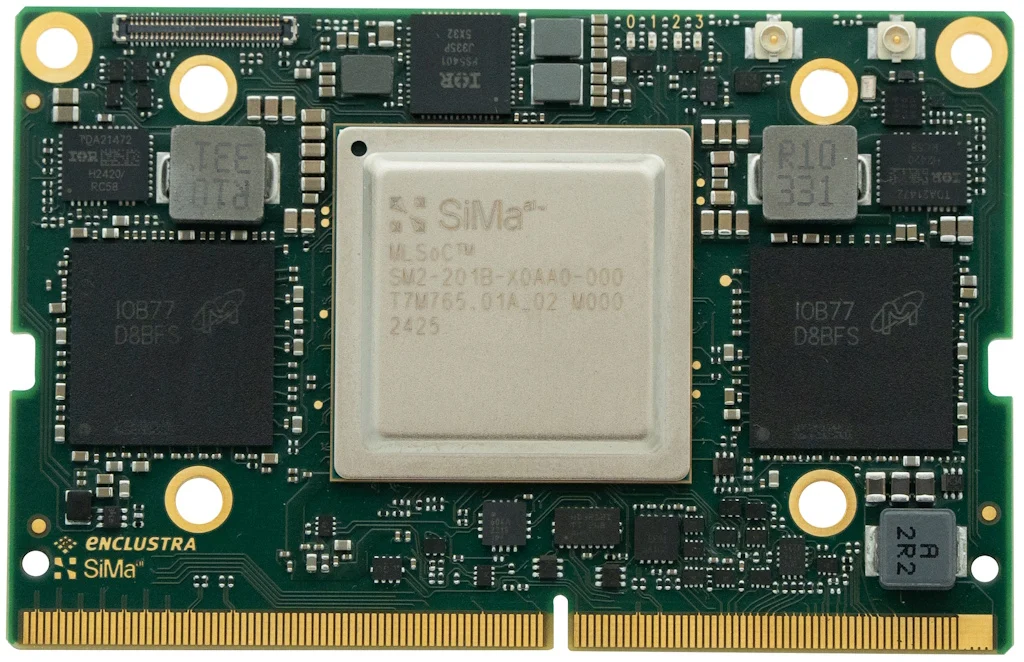
However, SiMa’s journey has been one of gradual maturation. They began by building the "Modalix" MLSoC—a heterogeneous architecture featuring an ARM processor subsystem for general logic, a vector DSP for signal processing, a dedicated computer vision pipeline, and a proprietary Machine Learning Accelerator (MLA) capable of 50 TOPS at a mere five-watt power envelope.
While the silicon was revolutionary, the company recognized that the "GPU Moat"—the entrenched position of Nvidia and other GPU vendors—wasn’t just about hardware; it was about the existing investment in carrier boards, software stacks, and engineering workflows. SiMa realized that to disrupt this, they needed to move up the stack. They weren’t just going to build a better chip; they were going to build a better way to use that chip.
Supporting Data: The Heterogeneous Advantage
To understand why SiMa’s approach is fundamentally different from the industry-standard GPU approach, one must look at the compute distribution. Conventional GPUs are monolithic; they force diverse workloads—from simple sensor processing to complex transformer-based LLMs—through a singular, massive parallel-processing structure. This is often overkill and highly inefficient for edge devices.

SiMa’s Modalix platform, by contrast, acts as a traffic controller. It delegates:
- ARM Cores: Handle the operating system and high-level application logic.
- Vector DSP: Manages signal processing and pre-processing tasks.
- Computer Vision Pipeline: Optimized for image manipulation and sensor fusion.
- MLA (Machine Learning Accelerator): Dedicated to high-throughput inference for neural networks.
By distributing the workload, SiMa avoids the "jack-of-all-trades, master-of-none" tax inherent in GPU-based edge devices. This architectural efficiency is exactly how they achieve that 10x performance-per-watt delta.
Official Responses: "English is the New C++"
During our discussion, CEO Krishna Rangasayee offered a striking observation: "English is the new C++."
While this might sound like typical industry hype, the reality—manifested in the new Palette Neat software—is substantial. Palette Neat is an agentic extension of SiMa’s established Palette SDK. Unlike generic AI coding assistants that try to be everything to everyone, Palette Neat is surgically optimized for the Modalix silicon.

"It knows one architecture and environment exceptionally well," Roldan explained. Because the problem space is constrained, the agent is far less prone to the "hallucinations" that plague broader, general-purpose LLMs.
Palette Neat handles the entire lifecycle:
- Code Generation: It takes natural language input to generate C++ or Python code.
- Deployment & Optimization: It cross-compiles and deploys the code to the target hardware.
- Iterative Debugging: It measures performance, identifies bottlenecks, and automatically migrates kernels to the most appropriate processor (e.g., moving a task from an ARM core to the MLA).
- Failure Resolution: If a crash occurs, the agent automatically triggers GDB, analyzes the thread dump, diagnoses the fault, and iterates on the solution.
This is not just coding assistance; it is an automated, high-velocity CI/CD pipeline for physical AI. Customer data suggests that projects which previously consumed weeks or months of engineering time—such as complex robotics or transit-monitoring systems—are now being completed in hours or days.
Implications: Dismantling the GPU Moat
The second major announcement from SiMa is the Modalix SOM (System-on-Module), which acts as a "little eye poke" at the GPU industry. Recognizing that companies are reluctant to scrap their existing carrier boards and custom hardware designs, SiMa has developed a module that is pin-compatible with the NVIDIA Jetson Orin NX family.

This is a masterstroke of market penetration. It allows engineers to swap out a GPU-based module for a SiMa Modalix module with little-to-no hardware redesign. The implication is clear: SiMa is no longer asking for a complete teardown and rebuild. They are offering an "upgrade path" that bypasses the high costs of hardware re-validation.
The market has shifted, and SiMa has read the room. As Rangasayee noted, customers are no longer asking "What are your benchmark numbers?" as their primary question. Instead, the question has become, "How quickly can you get me into production?"
The Path Forward
The convergence of Palette Neat’s automation and the plug-and-play accessibility of the Modalix SOM represents a significant shift in the competitive landscape. For the embedded engineer, the barrier to deploying high-performance, low-power AI is rapidly falling.
If SiMa.ai can successfully scale this model—where the hardware becomes an invisible, highly efficient substrate managed by an intelligent, agentic software layer—they will have successfully redefined the "AI company" archetype. They are moving away from selling raw silicon and toward selling a "Time-to-Production" platform.

In an industry currently obsessed with the latest, most complex model architectures, SiMa’s focus on the utility of that intelligence—on making it accessible, efficient, and deployable—is a refreshing and necessary maturation. As an engineer, I can say with confidence: the era of "vibe coding" isn’t just for web applications anymore. It has arrived in the physical, silicon-driven world of edge AI, and it is here to stay.