For decades, the fundamental architecture of the loudspeaker has remained stubbornly stagnant. Whether in the form of a high-fidelity concert hall array, a thin-profile television, or the ubiquitous earbuds tucked into our ears, the mechanism of sound production has been virtually identical since the inception of the dynamic moving-coil driver. Engineers, creatures of habit and efficiency, have long relied on the physics of moving a diaphragm back and forth to push air. It is a time-tested method, but it is also one constrained by the laws of mechanical inertia and physical space.
However, a quiet revolution is taking place in the world of micro-acoustics. Leading the charge is SonicEdge, a company that has spent the last three years transitioning from a fascinating industry outlier to a pivotal player in a burgeoning technological shift. By leveraging the power of modulated ultrasound, the industry is finally moving beyond the constraints of traditional membranes, promising a future where high-fidelity audio is smaller, more efficient, and infinitely more customizable.
The Core Innovation: Sound from Ultrasound
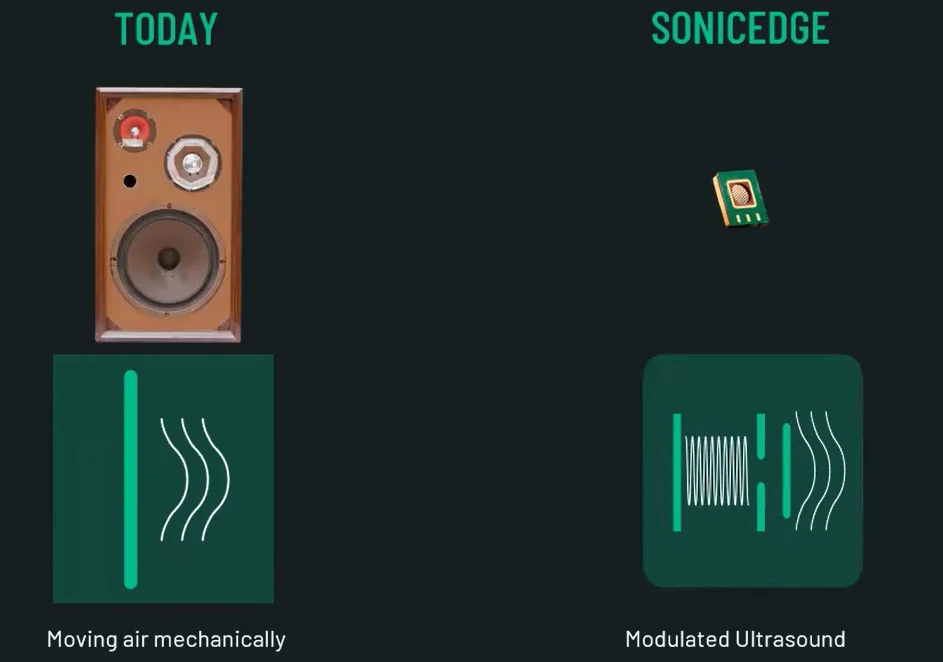
To understand the magnitude of this shift, one must first contrast it with the status quo. Conventional loudspeakers—whether moving-coil or piezoelectric—operate on a direct-drive principle. To reproduce a 1 kHz tone, the speaker’s diaphragm must oscillate physically 1,000 times per second. As frequencies climb into the high-end spectrum, the demands on the physical structure of the driver become increasingly difficult to manage without introducing distortion or requiring significant power.
SonicEdge’s approach is fundamentally different. Instead of trying to force a diaphragm to oscillate at high audio frequencies, the system utilizes microscopic MEMS (Micro-Electro-Mechanical Systems) cells that act as ultrasonic air pumps. These cells operate at approximately 400 kHz—well beyond the range of human hearing, which typically caps out at 20 kHz.
Each cell is a feat of engineering, measuring only 50 microns across. Within this space, three conductive membranes are stacked. The lower membrane oscillates against a fixed center membrane to create rapid pressure pulses, while an upper membrane functions as an ultra-fast valve. By selectively releasing these pressure pulses at precise intervals, the device creates an envelope that forms the desired audio waveform.
Moti Margalit, CEO and Co-Founder of SonicEdge, draws a compelling comparison to modern engineering marvels: "Think of a Dyson vacuum cleaner. Instead of using a large fan that turns slowly, it uses a compact, high-speed impeller. It moves less air per revolution, but because it spins at such extreme speeds, the result is a powerful, highly efficient flow. We are applying that same philosophy to sound. We aren’t moving a large, heavy diaphragm; we are moving a small volume of air with such velocity and precision that it rivals the performance of much larger, traditional drivers."
Chronology of a Breakthrough: From Concept to Silicon
Three years ago, SonicEdge was viewed as a bold, if somewhat solitary, pioneer. When I first interviewed Moti Margalit for a column in 2023, the technology was a promising prototype. Today, the conversation has changed significantly.
"We’ve got engineering samples. It’s real," Margalit confirmed during our recent follow-up. This milestone represents a critical shift from theoretical physics to manufacturable reality. The journey, however, was not without its hurdles.
The primary challenge between 2023 and the present was not the acoustic theory, but the manufacturing reality. Initially, SonicEdge aimed to develop a bespoke MEMS fabrication process. In the world of semiconductor manufacturing, this is a daunting task. Unlike digital CMOS, where designs are relatively portable between foundries, MEMS processes are notoriously idiosyncratic, requiring unique sequences of materials and fabrication steps.
Ultimately, the company made a strategic pivot that proved decisive: they redesigned their architecture to be compatible with the standard, mature manufacturing processes already used for capacitive MEMS microphones. While this decision required additional development time, it provided a massive long-term advantage. SonicEdge devices can now be produced in existing high-volume facilities that output billions of units annually, ensuring the reliability, scalability, and cost-effectiveness required for mass-market consumer electronics.
Supporting Data: Efficiency and Scalability
The physical metrics of this technology are staggering. A standard moving-coil speaker used in a premium earbud is typically 12 mm in diameter and up to 4 mm thick. Because piezoelectric MEMS speakers generally require larger actuators to compensate for limited travel, they are often bulky as well.

In contrast, the SonicEdge ultrasonic module occupies a footprint of only 7 x 7 x 1 mm. Within this tiny package, approximately 1,000 microscopic ultrasonic pumping cells operate in unison. While each individual cell contributes a negligible amount of air, their collective output provides acoustic performance that rivals, and in some cases exceeds, traditional drivers.
The benefits extend beyond mere dimensions. Traditional loudspeakers are famously inefficient, converting only a small fraction of electrical energy into acoustic power, with the remainder lost as heat. Margalit notes that the ultrasonic pumping mechanism is, at the cell level, roughly an order of magnitude more efficient than moving-coil drivers. As the technology matures and system-level electronic overhead is optimized, the potential for battery-life extension in portable devices becomes a significant selling point for manufacturers.
The Industry Landscape: A Convergence of Minds
Perhaps the most telling sign that the technology has arrived is the emergence of competition. In 2023, SonicEdge was effectively a voice in the wilderness. Today, the ecosystem is rapidly filling with interest. Companies such as xMEMS are introducing their own ultrasonic MEMS architectures, and major semiconductor firms are dedicating significant R&D budgets to similar concepts.
This "crowding" of the space is a positive development. When multiple industry leaders independently arrive at the same conclusion, it validates the underlying thesis: the industry is ready to move past the moving-coil era. While implementations differ, the shift toward using ultrasound as a foundation for miniature audio is becoming an industry-wide consensus. This collective momentum is helping to build a supply chain, attract talent, and normalize the technology in the eyes of product designers.
Implications: Beyond the Earbud
While current engineering samples are primarily targeted at the hearing aid, earbud, and smart glasses markets, the long-term roadmap for ultrasonic MEMS is expansive.
One of the most intriguing applications lies in automotive design. Conventional headrest speakers are heavy, bulky, and pose potential safety risks in the event of a collision. By utilizing an array of distributed ultrasonic MEMS speakers, an automotive manufacturer could replace heavy magnets and coils with a system weighing as little as 50 grams, while simultaneously providing superior acoustic coverage.
Furthermore, this technology could unlock the "audio bubble" concept—a vision for autonomous vehicles where each occupant enjoys a personalized soundscape. By integrating ultrasonic arrays with advanced beamforming algorithms and active noise cancellation (ANC), cars could theoretically play four different audio streams simultaneously without overlap or "leakage."
When combined with existing ANC technologies—such as those pioneered by companies like Silentium—the ultrasonic arrays act as a flexible, high-resolution platform. The system can monitor what is reaching a listener’s ear in real-time and dynamically compensate for unwanted sound, effectively isolating each passenger in a private acoustic zone.
A New Era of Engineering
The journey from a "fascinating outlier" to a "production-ready technology" is a testament to the persistence of modern engineering. Three years ago, the idea of generating high-fidelity audio from thousands of microscopic ultrasonic pumps seemed like a laboratory curiosity. Today, it is a tangible, scalable reality.
As we look toward the future of personal audio, it is clear that the constraints of the past are no longer the boundaries of the future. The shift toward MEMS-based ultrasonic audio is not just an incremental improvement; it is a fundamental transformation of how we interact with sound. The "magic" is being replaced by sophisticated, robust, and highly efficient engineering, and the results, quite literally, sound incredible.