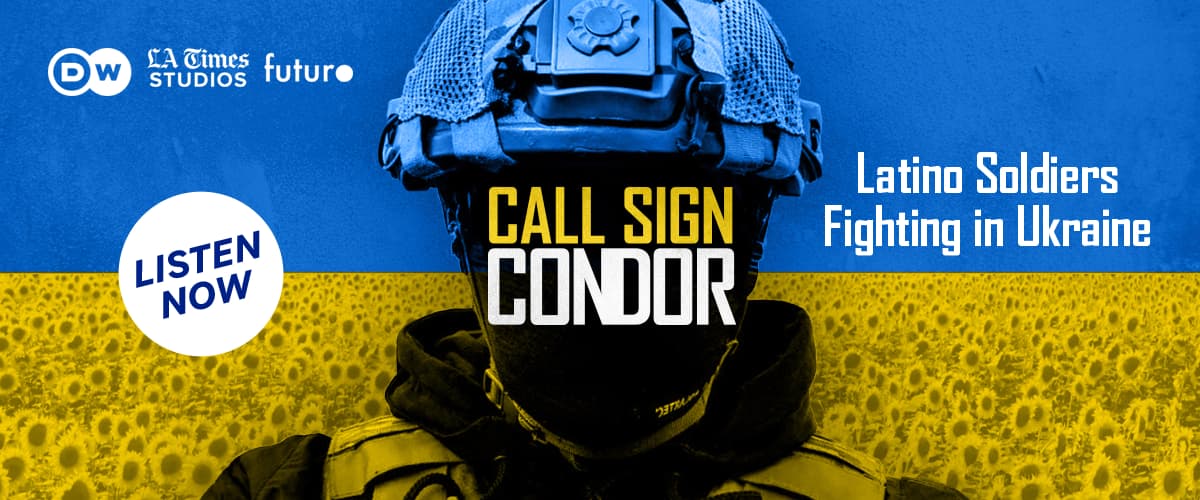
In the sprawling, complex landscape of the ongoing war in Ukraine, a quiet but significant demographic shift has emerged within the ranks of foreign volunteers. Beyond the well-documented presence of Western European and North American fighters, there is a growing contingent of combatants from Latin America—men and women who have traveled thousands of miles from their homes to take up arms for a cause situated on the other side of the globe.

A new, four-part podcast series, Call Sign Condor (or Alias Cóndor in its Spanish-language iteration), seeks to pierce the veil of mystery surrounding these individuals. Produced through a collaborative effort between DW, LA Times Studios, and Futuro Studios, the series offers an intimate, often harrowing, look at the motivations, struggles, and existential questions faced by Latin American soldiers serving in Ukraine.
Main Facts: The Human Story Behind the Call Sign
The core of Call Sign Condor rests on the personal journey of its protagonist, a volunteer known by the call sign "Condor." Through his eyes and the experiences of his peers, the documentary series explores the "why" behind the participation of Latin American volunteers.

The series does not treat these soldiers as mere numbers or geopolitical pawns. Instead, it frames them as individuals grappling with complex human emotions: fear, loss, a profound sense of belonging, and, perhaps most surprisingly, the capacity for love in the midst of systematic destruction. Hosted by Carolina Chimoy, the podcast serves as a bridge between the frontlines of Eastern Europe and the Latin American consciousness, examining how these individuals—some of whom have been embedded in the conflict for years—navigate the transition from civilian life in nations like Colombia, Chile, or Brazil to the trenches of the Donbas.

The production is a high-profile investigative effort, highlighting the logistical and emotional hurdles of reporting from an active war zone. By offering both English and Spanish versions, the creators ensure that the narratives reach a diverse global audience, emphasizing that this is a story of global interconnectedness in an age of regional conflict.

Chronology: A Path to the Frontline
To understand why a citizen of a Latin American country might risk their life for Ukraine, one must view the timeline of their involvement.

- Initial Mobilization (2022): Following the full-scale invasion of Ukraine in February 2022, President Volodymyr Zelenskyy made an international appeal for foreign volunteers. While the initial surge was primarily composed of individuals from NATO-allied nations, reports began to surface within months of small but determined groups of Latin American volunteers arriving in Poland to cross the border.
- The Professionalization Phase (2023): As the war settled into a protracted conflict, the demographic of volunteers shifted. Many of those who arrived during this period were veterans of their respective national militaries. Seeking purpose, financial stability, or an escape from domestic volatility, these individuals found a ready role within the International Legion for the Territorial Defense of Ukraine.
- Deepening Integration (2024–Present): Over the past year, the presence of these soldiers has become a permanent feature of the conflict. Call Sign Condor captures this period of "entrenchment," where volunteers are no longer just temporary observers but integral, long-term participants in the war effort. The podcast chronicles their evolution from outsiders to soldiers who have forged deep, often permanent, bonds with their Ukrainian comrades.
Supporting Data: The Motivations of the Volunteer
Why do they go? The motivations for Latin American volunteers are rarely singular. Based on investigative reporting within the series and broader geopolitical analysis, several driving factors emerge:

- Economic Disparity: For some, the compensation provided by the Ukrainian military is a significant draw compared to local wages in their home countries. While these individuals are often referred to as "mercenaries" in Russian state media, the volunteers themselves frequently describe their service in terms of "professional soldiering."
- Ideological Alignment: A significant number of volunteers cite a commitment to democratic values and an aversion to authoritarian expansionism. Having seen the effects of political instability or dictatorial tendencies in their own regions, they view the defense of Ukraine as a proxy for the defense of global freedom.
- The Quest for Identity: As highlighted in the podcast, many soldiers find a sense of "belonging" in the trenches that they struggled to find in their home nations. The camaraderie of the unit provides a structure and a purpose that is often missing in post-military civilian life.
- Escape: The series touches upon the trauma and personal history of the volunteers, suggesting that for some, the war is a place to confront, or perhaps run from, their own pasts.
Official Responses and Geopolitical Implications
The presence of foreign volunteers, particularly from the Global South, creates a complex diplomatic challenge.

- Ukrainian Stance: Kyiv has consistently maintained that all foreign volunteers are legally integrated into the Armed Forces of Ukraine (AFU) and are subject to the same international laws and conventions as any other soldier. They argue that these individuals provide critical expertise and morale.
- Russian Stance: The Kremlin has frequently characterized foreign volunteers as "illegal combatants" or "mercenaries," explicitly stating that they are legitimate targets and are not entitled to prisoner-of-war status under the Geneva Convention. This rhetoric has raised significant concerns regarding the safety and potential treatment of these individuals if captured.
- Latin American Governments: Most Latin American governments have maintained a policy of neutrality, neither encouraging nor explicitly forbidding their citizens from volunteering. However, the phenomenon has sparked domestic debates regarding the legality of private citizens participating in foreign conflicts, with legal experts noting a gray area in many national penal codes.
Implications: The Long-Term Impact
The story of the Latin American volunteer is not just a footnote in the Ukraine war; it is a signal of a changing world. As conflicts become increasingly globalized, the mobility of human capital—even in the context of violence—is accelerating.

The release of Call Sign Condor forces a broader conversation about what it means to be a "soldier of fortune" in the 21st century. Are these men and women heroes, desperate economic migrants, or misguided adventurers? The series avoids moralizing, choosing instead to let the visceral reality of their experiences—the fear of the drone overhead, the loss of a comrade, the quiet moments of longing for home—speak for itself.

Moreover, the podcast highlights the "after-war" challenge. What happens when these individuals return home? Many will carry physical injuries and significant psychological trauma. The lack of support structures for these "shadow volunteers" in their home countries could lead to long-term social instability, as these battle-hardened individuals attempt to reintegrate into societies that do not fully understand or acknowledge their experiences.

Conclusion: A Window into the Unknown
As listeners engage with Call Sign Condor, they are invited to step outside the familiar narratives of the Ukraine conflict. The series is a testament to the fact that wars are never just about borders or governments; they are about the thousands of individual stories that collide in the mud and the dark.

By centering the voices of those who chose to travel across the Atlantic to face an uncertain fate, the podcast provides a critical, if uncomfortable, perspective on the human condition in times of crisis. It reminds us that while the geopolitical maps may be drawn by leaders in distant capitals, the actual cost of history is paid by the individuals—from Colombia to Kyiv—who find themselves caught in its gears.

For those interested in the human element of the conflict, Call Sign Condor is an essential listen. It is not merely a record of military events, but a deep, empathetic exploration of the search for meaning in the most unlikely of places. Whether you are a student of history, a geopolitical analyst, or simply a listener seeking to understand the complexities of our modern world, the story of these Latin American volunteers is one that demands to be heard.

The series is available now across all major podcast platforms, offering an urgent, poignant, and deeply human contribution to the ongoing narrative of the war in Ukraine. In a world increasingly defined by conflict, understanding the motivations of those who fight is not just an academic exercise—it is a necessity for understanding the shape of the world to come.