
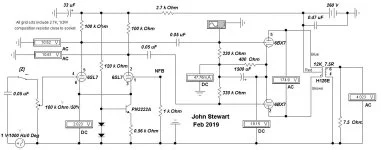
In the world of high-end audio, the pursuit of sonic purity often leads engineers back to the foundational building blocks of electronics: the vacuum tube. Recently, a significant development has emerged from the diyAudio community, as veteran enthusiast jhstewart9 has unveiled a series of bench-tested amplifier designs utilizing twin-triode octal-base tubes. These designs, optimized for compact "bookshelf" speaker systems, represent a rigorous intersection of classic thermionic architecture and modern precision measurement.

By utilizing versatile tubes like the 6BX7 and 6BL7, these projects offer a blueprint for hobbyists and professionals alike to achieve high-fidelity performance without the massive physical footprint typically associated with vacuum tube amplification.

Main Facts: The Architecture of Compact Power
The core of this project centers on the use of octal-base twin triodes. These tubes, originally designed for diverse industrial and television applications in the mid-20th century, have found a second life in the high-fidelity sector due to their linear characteristics and compact form factor.

The 6BX7 and 6BL7 Platforms
The primary design featured in this series utilizes the 6BX7, a tube prized for its ability to deliver meaningful output while remaining within safe dissipation limits. The design is a push-pull (PP) configuration, which inherently cancels out even-order harmonics and provides better power efficiency than single-ended alternatives.

The developer has also explored the use of the 6BL7. While it shares the same pinout as the 6BX7, the 6BL7 possesses a higher mu (amplification factor), necessitating higher B+ voltage for optimal operation. This design flexibility allows builders to tailor their amplifiers to specific power requirements and available power supply hardware.

Key Components and Methodology
A standout feature of these designs is the reliance on the Hammond 125E Universal Output Transformer (OPT). This choice is significant, as it bridges the gap between theoretical circuit design and practical, accessible implementation. By using a standard, high-quality transformer, the designs remain replicable for the average enthusiast.

The technical validation of these circuits is not based on "golden ear" subjective reviews, but rather on hard, bench-tested data. The testing suite includes:

- Total Harmonic Distortion (THD): Measured at 1-watt and 3-watt output levels.
- Intermodulation Distortion (IMD): Utilizing both SMPTE standards (80 Hz/5 kHz) and specific 3rd-order intermodulation tests.
- Load Balancing: Investigating the impact of cathode resistors on tube matching.
Chronology: From Concept to Validation
The development of these designs has been an iterative process, documented publicly within the diyAudio community.

Phase I: The Foundation (Early July 2026)
The project was initiated with the goal of providing a documented, tested path for building high-quality bookshelf amplifiers. The initial documentation focused on the PP 6BX7 design, setting a baseline for what could be achieved in terms of power output and signal clarity using standard components.

Phase II: Diversification and Refinement
Following the initial success, the project expanded to include the 6BL7, acknowledging that different tubes require different operating conditions. This phase saw the introduction of rigorous testing using an HP334A THD Analyzer, ensuring that the claims of performance were backed by professional-grade instrumentation.

Phase III: The "Leveling" Technique
A critical turning point occurred during the testing of the 5998 triode variations. The developer discovered that when using tubes with slightly mismatched emission characteristics (simulated via 10% variations), the choice of cathode resistors was paramount. The transition from common cathode resistors to separate cathode resistors acted as a "great leveler," significantly reducing distortion profiles and stabilizing the amplifier’s performance across a wider range of operating conditions.

Supporting Data: The Physics of Fidelity
The data presented by the developer highlights a critical aspect of tube amplifier design: the symbiotic relationship between the amplifier circuit and the power supply.

Power Supply Considerations
A point of discussion within the community has been the "Infinisupply" approach—a large, heavy, linear power supply used to feed a compact, lightweight amplifier circuit. This highlights a recurring truth in audio engineering: the amplifier is only as good as the power it draws. While the amplifier itself might be small enough to sit on a bookshelf, the power supply often requires a more substantial footprint. This pairing mirrors the trend seen in modern Class D amplification, where the amplifier module is miniaturized, but the power delivery system remains robust.

Distortion Analysis
The use of Electronic Workbench (version 5.1, licensed in 1998) as a simulation tool provided the initial theoretical framework. This was then validated against real-world results. The data shows:

- Cathode Resistor Impact: By utilizing separate cathode resistors, the design successfully mitigates the negative effects of imbalanced tubes.
- IMD Performance: The inclusion of 3rd-order intermodulation testing is particularly noteworthy, as this form of distortion is often more perceptible and fatiguing to the human ear than simple harmonic distortion.
Official Responses and Peer Review
The community response has been one of high engagement, particularly regarding the trade-offs between component size and power supply mass. User jjasniew noted the irony of a small, bookshelf-ready amplifier requiring a massive power supply that one "wouldn’t want to drop on your foot."

This dialogue underscores a fundamental challenge in DIY audio: the balance between the aesthetic of a compact system and the physical requirements of high-quality, low-noise power delivery. The developer’s willingness to share not just the schematics, but the specific, measured outcomes of varied component configurations, has provided a "lab-bench" environment for other builders to troubleshoot their own iterations.

Implications: The Future of DIY Tube Audio
The implications of this work are three-fold:

1. Standardization of Testing
By providing clear data sets and specifying the tools used (such as the HP334A), this project raises the bar for DIY amplifier documentation. It encourages other hobbyists to move beyond simple "it sounds good" testimonials and toward quantifiable performance metrics.

2. Accessibility of High Fidelity
The use of the Hammond 125E and readily available octal tubes proves that "audiophile" performance does not necessarily require exotic, unobtainable, or prohibitively expensive vacuum tubes. It makes high-end audio engineering accessible to those with moderate budgets and a willingness to learn the fundamentals of circuit biasing.

3. The "Bookshelf" Paradigm
The shift toward smaller, high-quality audio components reflects a broader trend in home living. As residential spaces become more compact, the demand for high-performance audio that does not dominate the living environment has grown. These octal-based designs provide a path forward for listeners who refuse to sacrifice the warmth and linearity of tubes for the sake of space, provided they are willing to dedicate the necessary footprint to the power supply.

Conclusion
The project initiated by jhstewart9 is more than just a collection of schematics; it is a masterclass in empirical audio design. By documenting the effects of cathode resistance on tube matching and providing comprehensive THD and IMD data, the developer has provided a reliable roadmap for the next generation of tube audio enthusiasts.

As the DIY community continues to iterate on these designs, the focus will likely shift toward further optimizing power supply regulation and exploring other tubes that fall within the octal-base family. For now, the "bookshelf" amplifier has been successfully redefined: it is no longer a compromise, but a deliberate, measured, and highly capable instrument of audio reproduction. Whether one is building for the joy of the craft or the final sonic output, these octal-based designs serve as a testament to the enduring relevance of vacuum tube technology in the 21st century.


