
In the esoteric world of high-end audio engineering, the quest for the "perfect" amplifier is often reduced to a pursuit of lower Total Harmonic Distortion (THD) figures. However, a dedicated community of DIY audio enthusiasts is challenging this long-held orthodoxy. Led by the user "maxlorenz" on the DIYAudio community, an ongoing experimental project—dubbed the "Amnesis Amp"—seeks to minimize what is known as Low Thermal Memory Distortion (LTMD). By targeting the microscopic thermal fluctuations within semiconductor junctions, these hobbyists are attempting to create an amplifier that, like a gentleman, has "no memory" of the signals that passed through it seconds prior.
Main Facts: What is LTMD?
At the heart of the "Amnesis" project is the hypothesis that standard solid-state amplifiers suffer from thermal instability at the component level. When an amplifier processes a complex musical signal, the instantaneous power dissipation across transistors changes rapidly. Because silicon devices have a non-zero thermal mass, these temperature fluctuations cause the operating parameters of the transistors—such as transconductance and gain—to drift in real-time.
Proponents of LTMD theory argue that even if an amplifier boasts near-zero THD at a steady state, it may be subject to "thermal memory." This phenomenon suggests that the device’s output is colored by the immediate history of its thermal state, leading to a perceived lack of transparency, "veiled" midrange, and a loss of dynamic punch. The goal of the Amnesis project is to implement circuit topologies that isolate these thermal effects, ensuring that the transistor’s operating environment remains as consistent as possible, regardless of signal intensity.
A Chronology of the Amnesis Project
The journey toward the Amnesis amplifier did not happen in a vacuum. It represents a synthesis of research from several luminaries in the field, including Douglas Self, Peufeu, and various contributors to the DIYAudio community.
The Foundation (2018–2021)
The project officially gained traction around 2018, when maxlorenz began documenting his attempts to modify existing "blameless" amplifier designs. The initial methodology involved a modular, section-by-section overhaul of the input, voltage amplification stage (VAS), and output stages. By replacing standard differential pair BJTs with cascoded Complementary Feedback Pairs (CFP) using JFETs, the researcher noted an immediate subjective improvement in sound quality: a more relaxed, smooth presentation with improved mid-bass presence.
The Lions Gate Breakthrough (2022)
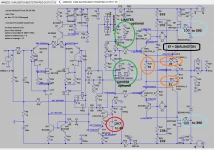
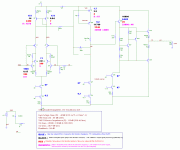
A major milestone occurred in August 2022, during what the community termed the "Lions Gate" of the project. Through extensive experimentation, a new output configuration was finalized: a Bootstrapped Darlington output stage. This configuration, which also proved compatible with VFETs, effectively addressed the thermal constraints that had plagued earlier prototypes. The diagram, released as post #806 in the community thread, serves as the current blueprint for the official Amnesis configuration.
The Expansion of Scope
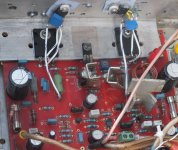
Beyond the initial blameless design, the project has expanded to include the modification of legacy equipment. A significant focus of this work is the Sony TA5650 VFET amplifier. By applying cascode techniques to the VFET common-source output stage, the team has successfully breathed new life into these vintage units, reporting significantly increased dynamic range and punch, further validating the efficacy of LTMD reduction.
Supporting Data and Experimental Methodology
The Amnesis project relies heavily on a "listen and measure" approach. While maxlorenz admits to having no formal electronic engineering background, the rigor applied to his experimental process is noteworthy.
Cascoding as a Primary Tool
The primary mechanism for reducing thermal memory is the use of cascoding—a two-stage amplifier configuration that places a common-base or common-gate stage after a common-emitter or common-source stage. This serves two functions:
- Voltage Regulation: It keeps the collector-to-emitter voltage (Vce) of the input transistor constant, shielding it from the fluctuations caused by the signal swing.
- Thermal Isolation: By offloading the voltage swing to a secondary device, the thermal load on the sensitive input device is stabilized.
The "Sziklai" Influence
The use of the Sziklai pair (Complementary Feedback Pair) in conjunction with JFETs has been central to the project’s success. By pairing JFETs with standard bipolar transistors, the project leverages the high input impedance and linearity of the JFET while maintaining the current-driving capability of the BJT. The reported results—a move away from "bright" or "fatiguing" sound toward a "soothing" and "transparent" experience—are consistent across multiple amplifiers, including the VSSA (Vertical Solid State Amplifier) design.
Official Responses and Peer Observations
The DIYAudio community has provided a robust, albeit cautious, reception to these findings. The project has attracted support from veterans who value the empirical nature of the work.
- The "Brave and Bold" Requirement: Recognizing that these mods push components to their limits, maxlorenz has made PCBs for the active Hawksford Current-Controlled Source (CCS) version available to others, provided they possess an oscilloscope and the necessary experience to manage potential high-frequency oscillations. This underscores a professional acknowledgment of the risks inherent in experimental high-fidelity design.
- The Theoretical Debate: There is a healthy, ongoing debate regarding the root cause of the perceived sound improvements. While the Amnesis team attributes the change to reduced thermal memory, others in the field suggest that the improvements might stem from increased overall loop gain, improved linearity, or the inherent properties of the JFETs themselves.
Implications for Future Amplifier Design
The Amnesis project offers several profound implications for the future of audio amplification:

1. Challenging the "THD-Only" Metric
The most significant takeaway is that THD—the industry standard for measuring amplifier performance—may be an insufficient metric for capturing the "musicality" or "transparency" of an amplifier. If two amplifiers measure with identical THD, yet one is perceived as "soothing" and the other as "bright," the difference likely lies in the time-domain or thermal domain.
2. The Resurgence of Legacy Tech
By demonstrating that vintage VFET technology can be modernized and improved through contemporary cascoding techniques, the project provides a roadmap for preserving and upgrading legendary amplifiers. This prevents the loss of historical hardware while allowing it to perform at levels previously unimagined by its original designers.
3. Democratization of R&D
The Amnesis project serves as a prime example of decentralized research. Without the need for a corporate laboratory, a small group of enthusiasts has managed to refine circuit topologies that challenge established notions of amplifier design. This "open-source" approach to audio engineering ensures that knowledge is shared, scrutinized, and improved upon in real-time.
Conclusion
The "Amnesis Amp" is more than just a collection of modified circuits; it is a philosophy of sound reproduction. By refusing to accept that an amplifier should have a "memory" of its electrical history, maxlorenz and his cohorts are pushing the boundaries of what is possible in solid-state audio. While the project remains in an experimental phase, the consistent reports of improved transparency, dynamics, and midrange liquidity suggest that the industry’s focus on static THD metrics may indeed be missing the forest for the trees. Whether or not LTMD is the definitive culprit, the pursuit of "amnesia" has undeniably produced amplifiers that satisfy the most discerning ears.


