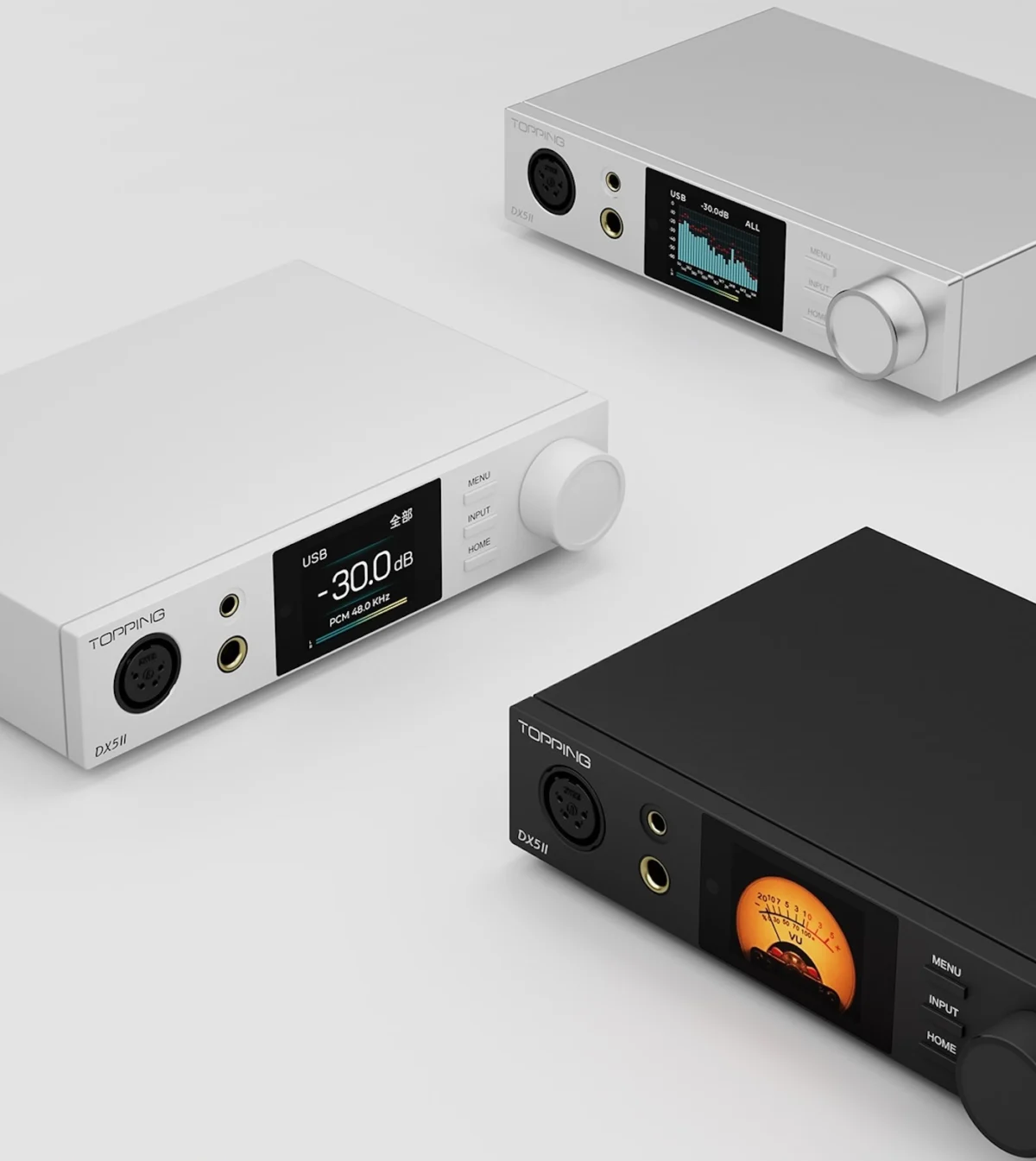
In the rapidly evolving world of high-fidelity audio, the "law of diminishing returns" is a concept that often haunts enthusiasts. For years, the pursuit of state-of-the-art digital-to-analog conversion necessitated a four-figure investment. However, Topping—a brand that has spent the last decade systematically disrupting the high-end audio market—has once again challenged the status quo. With the release of the DX5 II, the company has delivered a DAC and headphone amplifier that not only hits the "sweet spot" of pricing but fundamentally alters the value proposition for entry-to-mid-level audiophiles.
Main Facts: A Technical Powerhouse
The Topping DX5 II is a compact, feature-rich device designed to serve as the nerve center for modern digital audio systems. At its core, it utilizes dual ESS Sabre ES9039Q2M DAC chips, a choice that underscores Topping’s commitment to precision. These chips are renowned for their ultra-low noise floors and exceptional detail retrieval.
The device is not merely a high-performance DAC; it is a versatile headphone amplifier and digital pre-amplifier that boasts:

- 10-Band Parametric Equalizer (PEQ): Allowing for surgical adjustments to frequency responses.
- High-Resolution Connectivity: Bluetooth 5.1 support with the LDAC codec for near-lossless wireless streaming.
- Customizable User Interface: Featuring a vibrant 2-inch full-color display with configurable skins, including a modern, aesthetic VU meter.
- Robust Output Power: Delivering up to 7600mW per channel at 16Ω, ensuring it can drive even the most demanding planar magnetic headphones with ease.
Priced under $300, the unit is housed in a sleek, anodized aluminum chassis, available in black, white, or silver, making it a sophisticated addition to any desk or rack.
Chronology: A Decade of Iterative Perfection
Topping’s trajectory over the past ten years has been characterized by a relentless focus on engineering refinement. Unlike manufacturers that rely on marketing hype, Topping has built its reputation on "The Numbers"—the measured performance that defines their components.
- Early Years (2015–2018): Topping established itself as the king of "chi-fi," offering budget DACs that performed at a level usually reserved for boutique brands.
- The Rise of Balanced Output (2019–2022): The original DX5 and its peers introduced balanced circuitry to the masses, setting a new standard for noise floor reduction in the sub-$500 category.
- The Software Era (2023–Present): With the introduction of the "Aurora" user interface and integrated PEQ, Topping transitioned from a hardware-only company to a provider of holistic digital experiences. The DX5 II represents the zenith of this evolution, where firmware, software, and hardware are optimized in concert.
Supporting Data: Engineering Under the Microscope
The DX5 II’s performance is defined by its transparency. In technical terms, the unit delivers a THD+N (Total Harmonic Distortion plus Noise) of less than 0.00006% (XLR) at 1kHz. To put this in perspective, these figures are well below the threshold of human hearing, essentially ensuring that the device adds no "color" to the music, but rather serves as a pristine window into the source material.

The Signal-to-Noise Ratio (SNR) of 132dB on the balanced XLR outputs provides a "black background" that allows micro-details in complex music—such as the decay of a piano note or the subtle intake of breath by a vocalist—to emerge with startling clarity.
The headphone output power is equally impressive, scaling from 7600mW at 16Ω down to 490mW at 600Ω. This versatility ensures that whether a user is plugging in high-sensitivity IEMs or power-hungry high-impedance studio monitors, the DX5 II maintains control and authority over the drivers.
In Practice: The Emotional Resonance of Precision
To test the DX5 II, we utilized it in a dual-environment setup. First, as a bridge for a Sony Bravia OLED system, and second, as a dedicated high-fidelity source fed by a Bluesound Node Nano streamer.

When playing back complex, genre-defying music—such as the latest work from the Quebec duo Angine de Poitrine (ADP)—the DX5 II’s strengths become immediately apparent. ADP’s music, characterized by microtonal guitars and shifting time signatures, requires a DAC that can handle rapid, violent transients without smearing the sound. The DX5 II managed this with ease. The "volcanic energy" of the drums remained tight and punchy, while the microtonal guitar textures were rendered with a precision that felt physically tangible.
Furthermore, the unit’s ability to render phantom center channels is exceptional. During long-form video content, such as the Apple TV series Your Friends and Neighbors, the DX5 II demonstrated a remarkable ability to handle dialogue-heavy soundscapes. Even during moments of whispering or hushed conversation, the unit maintained perfect clarity, ensuring that no syllable was lost in the mix.
Official Responses and Industry Implications
The audio industry has responded to the DX5 II with cautious awe. Competitors in the $500–$1,000 range are now facing a significant challenge: how to justify their higher price points when a $300 unit offers comparable distortion levels and superior software features.

Topping’s official stance, reflected in their design philosophy, is that "high-fidelity is a right, not a luxury." By integrating the power supply internally (dispensing with the industry-standard, yet cumbersome, "wall wart"), Topping has signaled a move toward a more integrated, user-friendly design language.
The implications for the broader market are profound:
- Standardization of PEQ: The inclusion of a 10-band parametric equalizer at this price point will likely force other manufacturers to follow suit or risk obsolescence.
- Increased Demand for Build Quality: The shift toward premium materials like anodized aluminum and full-color displays at the sub-$300 level sets a new expectation for consumer-grade audio equipment.
- The Death of the "Entry-Level" Compromise: The DX5 II proves that users no longer need to sacrifice musicality for affordability.
Conclusion: A Masterclass in Value
In an era of rising inflation and shrinking purchasing power, the Topping DX5 II stands as a beacon of genuine value. It is rare to encounter a product that is "without fault," yet the DX5 II comes remarkably close. By focusing on technical perfection, high-quality component selection, and a user-centric software experience, Topping has created a device that satisfies both the objective measurements of the engineer and the subjective desires of the audiophile.

Whether you are building your first serious desktop audio setup or looking for a compact, high-performance DAC to integrate into a larger home theater system, the DX5 II is a no-brainer. It is, quite simply, one of the greatest bargains currently available in the high-fidelity audio market. It doesn’t just process digital signals; it connects the listener to the music, stripping away the mechanical barriers that often stand between us and our favorite recordings. For under $300, it is not just a purchase; it is an investment in sonic satisfaction that will remain relevant for years to come.