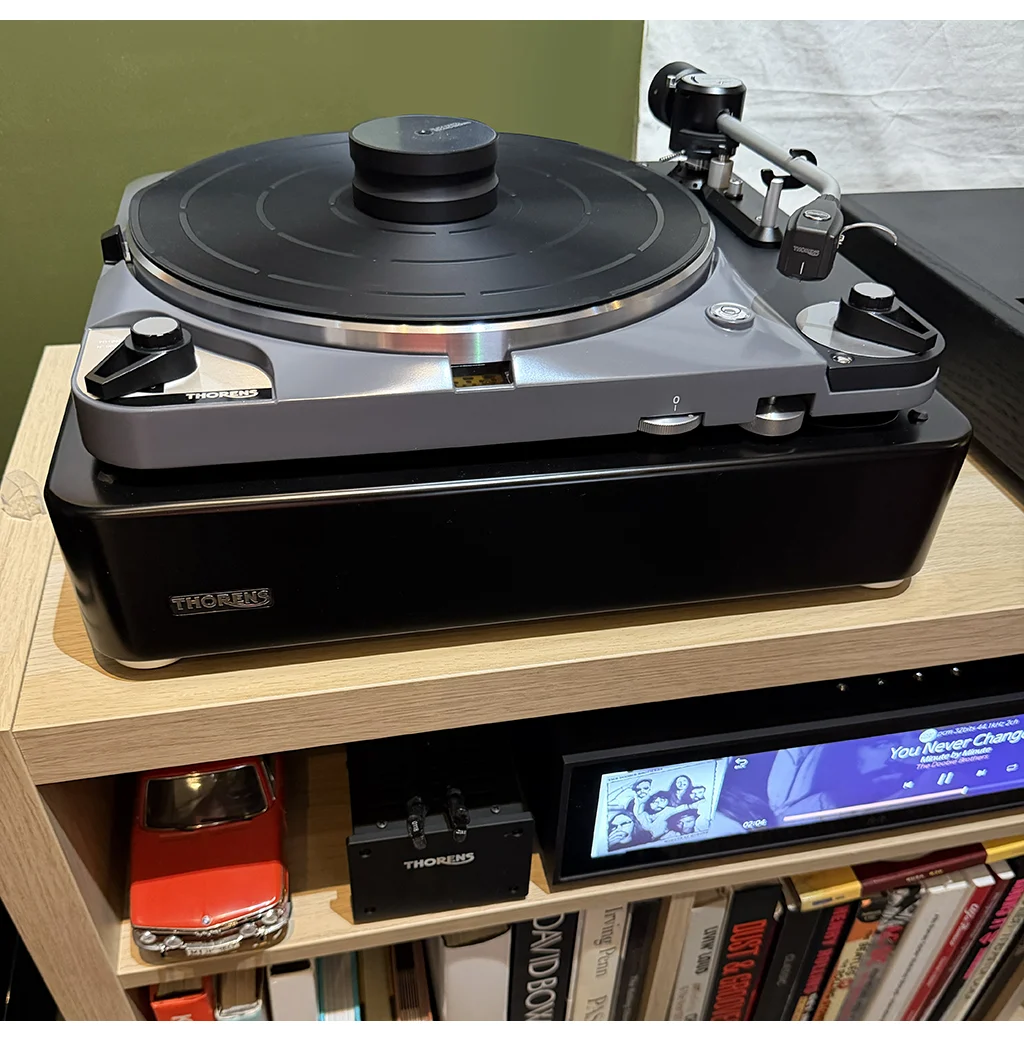
Main Facts
In the high-end audio community, few model numbers carry the legendary weight of the Thorens TD 124. For decades, the Swiss-engineered transcription turntable has stood as a towering monument of analog playback history, celebrated for its robust engineering, distinctive aesthetic, and authoritative sound. Traditionally, the name Thorens has been inextricably linked to idler-wheel and belt-drive mechanisms—architectures that defined the golden age of high fidelity.
However, the landscape of analog reproduction is shifting, and heritage brands are increasingly tasked with bridging the chasm between vintage purism and contemporary engineering efficiency. Enter the modern direct-drive iteration of the iconic Thorens platform.
In this contemporary reimagining, the letters "DD" take on a new meaning: Direct Drive. Moving away from the mechanical complexity of idler wheels and the compliance-dependent nature of traditional belt drives, this new deck introduces a modern direct-drive motor system wrapped in the unmistakable visual DNA of its illustrious ancestor.
Supplied for initial evaluation courtesy of MoFi Distribution, the review sample arrived as a complete, highly optimized analog ecosystem. Outfitted with a factory-matched 9-inch Thorens tonearm and paired with Ortofon’s latest SPU cartridge—specifically designated for the TD 124 lineage—this setup represents a fascinating collision of old-school analog soul and contemporary precision engineering.
Initial listening sessions, anchored by the MoFi Master Phono stage operating in current mode, reveal a sonic signature that is arrestingly large, lush, and dynamically potent. Yet, beneath the immediate acoustic gratification lies a deeper journalistic and audiophile inquiry: How does a modern, direct-drive interpretation of a vintage idler-wheel classic stack up against the ghost of its historical predecessor?
Chronology: From Vintage Icon to Modern Direct Drive
To understand the gravity of this new release, one must trace the historical trajectory that brought Thorens to this technological crossroads.
The Mid-Century Apex
Introduced in the mid-1950s, the original Thorens TD 124 was designed as a precision transcription turntable meant for both broadcast studios and elite home audio systems. Utilizing a sophisticated hybrid drive system that combined a belt and an idler wheel, the original 124 was a masterpiece of mechanical engineering. It allowed for fine speed adjustment, robust torque, and a heavy cast-iron platter that helped maintain rotational stability. However, that very same cast-iron platter possessed a notoriously strong magnetic stray field—a quirk that famously wreaked havoc on sensitive moving-coil (MC) cartridges of the era if proper shielding wasn’t employed.
Decades of Evolution
Over the subsequent decades, Thorens shifted its focus primarily toward belt-drive designs, establishing benchmarks with models like the TD 160 and expanding into various high-end variations. While the vintage market for fully restored TD 124 units continued to thrive—often commanding premium prices among collectors—the brand itself underwent numerous corporate transformations, changing hands and relocating production before stabilizing under current leadership, which has aggressively honored the company’s rich heritage while embracing modern manufacturing capabilities.
The Shift to Direct Drive
The decision to implement a direct-drive system in a modern chassis bearing the 124 moniker represents a significant philosophical pivot. Direct-drive technology, long popularized in broadcast environments and legendary Japanese decks (most notably the Technics SL-1200 series), offers undeniable performance benefits: exceptional speed stability, rapid start-up times, and freedom from belt degradation.
When unpacking the review unit, setup proves remarkably swift and user-friendly—a stark contrast to the painstaking calibration often required by vintage units that have survived six decades of wear and tear. Furthermore, modern metallurgy and manufacturing have eliminated the hazards of the past; the contemporary platter, while possessing substantial mass, no longer threatens to compromise modern moving-coil cartridges with problematic magnetic fields.
Supporting Data and Technical Architecture
Evaluating a turntable of this caliber requires looking past the nostalgia and examining the hard specifications, architectural choices, and component synergies that dictate real-world performance.
The Motor and Drive System
The transition from an idler/belt hybrid to a modern direct-drive motor addresses the primary mechanical compromises of the original design—namely, rumble, belt creep, and idler-wheel degradation. A high-torque, electronically controlled direct-drive motor ensures absolute rotational accuracy (33 1/3, 45, and even 78 rpm capabilities are typically expected in this class). Under the hood, modern quartz-lock speed stabilization guarantees that pitch deviations are virtually nonexistent, offering a pitch-black background against which transient details can emerge.
Platter Design and Mass Management
While the original TD 124 relied on a heavy cast-iron upper platter combined with an aluminum lower stepped pulley platter, the modern iteration modernizes this approach. It retains sufficient mass to store kinetic energy and smooth out micro-fluctuations, but utilizes non-magnetic alloys. This prevents cartridge-motor interactions, eliminating the historical hazard where users accidentally ruined expensive moving-coil cartridges due to excessive magnetic pull.
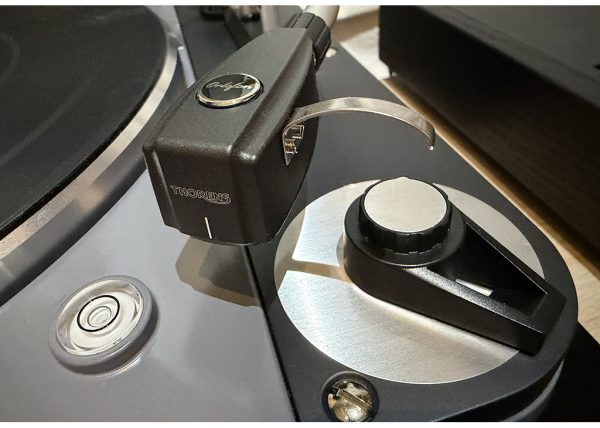
Tonearm and Cartridge Synergy
The review configuration features a 9-inch Thorens tonearm paired with Ortofon’s specialized SPU cartridge designed for the TD 124 ecosystem.
- The SPU Factor: Ortofon’s SPU (Stereo Pick-Up) cartridges are legendary for their warm, heavy-tracking, dynamic presentation. They are traditionally low-compliance cartridges that demand mass in the tonearm to perform at their absolute best.
- Tonearm Performance: The factory-supplied 9-inch arm strikes a fine balance, providing the rigidity and bearing quality necessary to extract intricate micro-details from complex groove walls without inducing fatigue.
Amplification and Phonation
To properly test the limits of the new direct-drive platform, the turntable was integrated with the MoFi Master Phono stage running in current mode.
- Current-Mode Amplification: Unlike traditional voltage-mode phono stages, current-mode amplification measures the current output of the moving-coil cartridge rather than its voltage. Because low-output MC cartridges possess very low internal impedance, current-mode stages effectively eliminate the resistive loading bottleneck, resulting in lightning-fast transient response, wider bandwidth, and reduced distortion.
Official Perspectives and Industry Reception
The introduction of high-end direct-drive turntables by heritage brands that built their reputations on belt or idler drives has sparked lively debates across the audiophile landscape.
Industry analysts and distributors point out that modern direct-drive technology has advanced leaps and bounds past the limitations of 1970s and 1980s mass-market implementations. Modern motor controllers utilize sophisticated digital signal processing (DSP) to monitor and correct micro-variations in speed thousands of times per second, effectively neutralizing the "cogging" artifacts that once plagued early direct-drive designs.
Representatives from MoFi Distribution emphasize that packaging these legacy-inspired tables with turnkey arm-and-cartridge solutions lowers the barrier to entry for high-end analog playback while ensuring that every component operates within its optimal engineering parameters.
However, purists within the vintage community have raised logistical and philosophical questions. Upon lifting the modern platter, observant audio critics note an unmistakable visual and structural familiarity—reminiscent of industrial layouts found in legendary broadcast decks like the Technics SL-1200. Yet, rather than viewing this as a design compromise, industry observers frame it as industrial evolution: form follows function, and when a drive system achieves near-perfection in reliability and isolation, its underlying geometry is naturally adopted by modern engineers.
Implications for the Audiophile Market
The arrival of a direct-drive Thorens bearing the spiritual weight of the TD 124 carries profound implications for the high-end audio market.
1. Bridging the Vintage-Modern Divide
For decades, audiophiles faced a binary choice: purchase a temperamental, expensive vintage turntable requiring restoration and ongoing maintenance, or buy a modern belt-drive deck that offered reliability at the expense of historical charm and physical presence. This modern direct-drive Thorens offers a compelling middle ground. It delivers the aesthetic heritage and gravitational pull of a 1950s icon paired with 21st-century plug-and-play reliability.
2. The Rehabilitation of Direct Drive in Audiophile Circles
For many years, direct-drive turntables suffered an unfair reputation in audiophile stereophonic circles, largely dismissed as "DJ decks" due to the overwhelming market dominance of belt-drive systems in high-end audio since the 1980s. Products like this challenge those outdated biases. By combining precision quartz-locked motor control with ultra-rigid plinth design and high-end tonearm engineering, direct drive is increasingly recognized as a superior method for achieving speed stability and dynamic slam.
3. The Road Ahead: Comparative Analysis
While initial impressions—characterized by a big, lush, and aggressively dynamic soundstage when paired with the MoFi Master Phono—are overwhelmingly positive, the ultimate test remains on the horizon. A rigorous, head-to-head comparison against a fully restored, pristine vintage TD 124 is currently underway.
This upcoming confrontation will answer the ultimate question occupying the minds of analog enthusiasts: Can silicon-era motor control and modern metallurgy truly capture the elusive, organic magic of the original mid-century Swiss mechanical masterpiece, or does the future sound entirely different from the past?
As the analog revival continues to accelerate, the conversation sparked by this reimagined legend proves that the quest for sonic perfection is an ongoing dialogue between historical reverence and technological innovation. Stay tuned as the comprehensive, side-by-side evaluation unfolds.