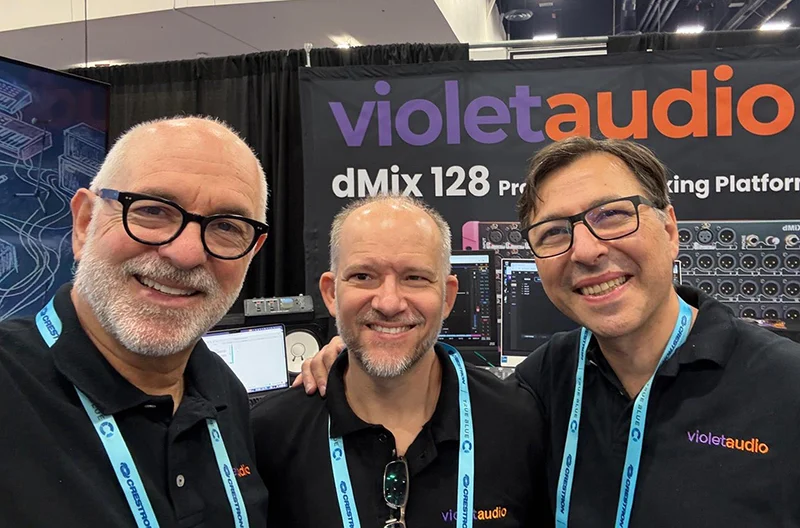
In a significant leap for professional audio infrastructure, Violet Audio has announced the integration of a native Model Context Protocol (MCP) server into its flagship dMix 128 digital mixer. This development marks one of the industry’s first major deployments of AI-centric communication protocols within a hardware-based mixing ecosystem. By enabling direct interaction between the mixer and Large Language Models (LLMs) like ChatGPT or Claude, Violet Audio is effectively transforming the digital console from a static control surface into an intelligent, conversational node within a broader AV network.
The Convergence of AI and Professional Audio
The integration of the MCP server is not merely a software update; it represents a fundamental shift in how engineers and facility operators interact with complex audio systems. Traditionally, mixing consoles have relied on physical faders, touchscreens, or rigid API structures for control. While these methods remain essential for precision, they often present a steep learning curve for non-technical users or require cumbersome manual input for complex, multi-step routing tasks.
By adopting the Model Context Protocol, the dMix 128 now speaks the language of modern AI. An operator no longer needs to hunt through sub-menus to adjust a channel’s EQ or recall a specific scene; they can simply issue a natural language request. Whether it is a house of worship volunteer asking to "boost the lectern mic by 2 decibels" or a broadcast engineer requesting a "full virtual soundcheck for the afternoon broadcast," the dMix 128 can interpret, process, and execute these commands in real-time.
Chronology of Development: From Traditional Mixing to Intelligent Control
The journey toward the dMix 128’s current iteration is a study in the rapid evolution of network-based audio.
- Foundation Phase: Initially, the dMix 128 was engineered to be a flexible, browser-based digital mixer. Its early architecture focused on breaking the limitations of proprietary hardware, prioritizing open standards such as OSC (Open Sound Control) and QRC/JSON frameworks.
- Networking Integration: Following the initial release, Violet Audio aggressively adopted professional-grade network standards. The inclusion of AES67 for audio-over-IP and SMPTE ST 2110-30 ensured the console’s place in high-end broadcast environments.
- The NMOS Milestone: With the addition of NMOS (Networked Media Open Specifications) for discovery and connection management, the mixer gained the ability to "plug and play" within large-scale SMPTE-based infrastructures.
- The AI Pivot (Current): The introduction of the MCP server represents the most recent milestone. By recognizing the potential of AI assistants to act as a bridge between human intent and machine execution, the development team at Violet Audio began coding the MCP integration in late 2025, culminating in this mid-2026 launch.
Technical Architecture and Interoperability
The dMix 128’s appeal to systems integrators lies in its "Swiss Army Knife" approach to connectivity. The inclusion of the MCP server does not replace existing control methods; it wraps them in a new layer of accessibility.
The Role of MCP
The Model Context Protocol provides a standardized way for AI assistants to "understand" the mixer’s state. When a user asks an AI to change a setting, the AI doesn’t just guess; it uses the MCP server to query the current status of the dMix 128, determine which parameters are available, and then send a precise command that the mixer understands. This ensures that the audio remains pristine and the hardware remains secure, as the AI acts as a sophisticated remote controller rather than an autonomous operator of the audio signal itself.

The Connectivity Ecosystem
The dMix 128 maintains a robust suite of connectivity options that ensures it can function in virtually any professional environment:
- Control Protocols: OSC, QRC/JSON, and now MCP.
- Network Audio: AES67 and SMPTE ST 2110-30 for interoperability with broadcast hubs.
- Discovery: NMOS for seamless integration into existing IP networks.
- Local Connectivity: MADI for legacy integration and CoreAudio/ASIO for direct-to-DAW recording.
Official Responses and Strategic Vision
Violet Audio’s leadership views this move as a proactive response to the shifting demands of the AV market.
"At Violet Audio, we focus on building products that solve real problems while anticipating where the industry is heading," says Danny Olesh, founder of Violet Audio. "Professional audio systems are increasingly expected to communicate with control systems, automation platforms, network infrastructure, and now AI-assisted technologies. Integrating MCP directly into dMix 128 is another step toward creating a platform that is both incredibly powerful and remarkably easy to integrate."
Phil Wagner, president/CEO of Violet Audio US, emphasizes the practical benefits for the end-user. "The dMix 128’s integrated MCP server allows users to control the mixer through natural conversation," Wagner notes. "An operator can ask an AI assistant to perform tasks like muting a microphone, adjusting a channel level, or recalling a snapshot. The AI interprets the request and securely communicates with the dMix 128’s MCP server, which executes the command and confirms completion. This transforms conversational AI into an intelligent control interface while all audio processing remains safely inside the mixer."
Implications for Industry Sectors
The implications of this technology are vast, impacting several key sectors of the professional audio market:
1. Houses of Worship and Education
In environments where the technical staff may consist of volunteers or students, the ability to control a complex console via voice commands is a game-changer. A volunteer can prepare a room for a Sunday service or a lecture by asking the AI to "set the stage for the speaker," triggering a sequence that unmutes the appropriate mics, adjusts levels to a preset, and routes audio to the house system—all without manual patching.
2. Broadcast and Live Production
For broadcast engineers, the primary benefit is the speed of configuration. In high-pressure scenarios, such as live esports or news broadcasts, the ability to execute "complex operational sequences through a single conversational request" reduces the potential for human error. It allows the engineer to focus on the mix, while the AI handles the routing and configuration overhead.
3. Corporate and Enterprise AV
Facility managers now have a way to manage multi-room audio installations without needing to become certified audio engineers. A simple interface can allow a manager to mute lobby speakers or balance volume levels across multiple breakout rooms via a tablet or integrated AI assistant, simplifying facility management significantly.
Future-Proofing the Audio Workflow
The integration of MCP is intended to be evolutionary. Because the protocol is designed to be extensible, the capabilities of the dMix 128 are expected to grow alongside the AI ecosystem. As LLMs become more capable at understanding context—such as recognizing that a "clipping channel" might need a slight gain reduction or a change in compression settings—the dMix 128 will effectively gain new "skills" without requiring a hardware overhaul.
"Integrators increasingly need systems that are open, controllable, and adaptable," Olesh adds. "With MCP joining our existing suite of standards, the dMix 128 can function as a professional live console, an installed audio processor, a broadcast audio hub, or a network-connected control platform."
Conclusion
Violet Audio has managed to bridge the gap between traditional professional audio hardware and the frontier of artificial intelligence. By implementing an MCP server, they have not only expanded the functionality of the dMix 128 but have also set a new standard for what it means to be a "connected" audio platform. As the industry continues to move toward software-defined workflows and network-centric architectures, the dMix 128 stands as a testament to the power of open standards and the potential for AI to enhance, rather than replace, the role of the professional audio operator. The future of mixing, it seems, is no longer just about faders and knobs—it is about conversation.