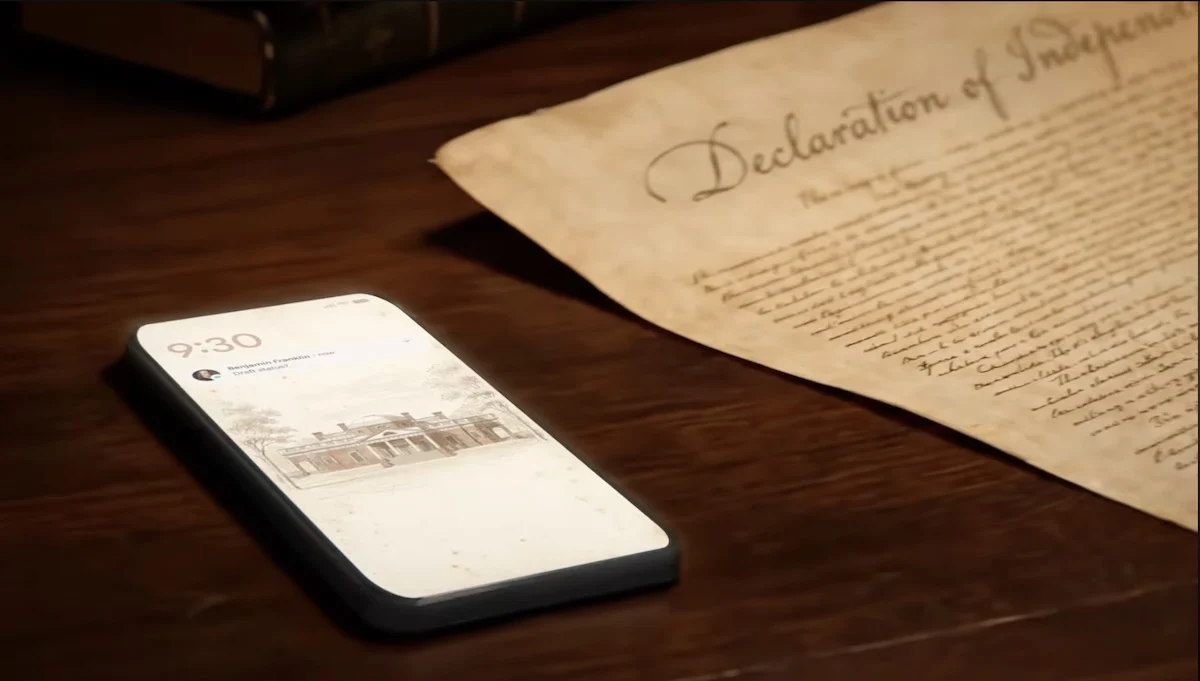
Two hundred and fifty years after the quill first touched parchment to declare American independence, the lines between historical reverence and modern corporate branding have blurred. Google has unveiled a high-profile, tongue-in-cheek commercial titled "Group project, but make it 1776," which imagines the Founding Fathers navigating the complexities of nation-building using the full suite of modern Google Workspace tools.
While the campaign is designed to showcase the efficiency and collaborative potential of Google’s ecosystem, it has inadvertently ignited a firestorm of debate regarding the role of Artificial Intelligence in creative expression and the sanctity of historical narratives.
The Digital Founding: A Breakdown of the Campaign
The advertisement serves as a playful, if surreal, reimagining of the Continental Congress. It depicts a harried Thomas Jefferson attempting to draft the Declaration of Independence, only to be interrupted by a persistent Ben Franklin via text message.
As the narrative unfolds, the "Founding Fathers" transition into a seamless, cloud-based workflow. The viewer watches as edits are suggested in real-time within Google Docs, meetings are scheduled via Google Calendar, and the revolutionary cohort huddles in a Google Meet session—notably, with every participant keeping their camera off, a humorous nod to modern remote-work culture. The process concludes with the digital signing of the document via e-signatures, culminating in a burst of digital fireworks.
The ad is heavily infused with Google’s latest generative AI integrations. The characters utilize the "Help me visualize" tool to iterate on the design of the national seal, while Gemini is employed to transcribe meeting minutes. In one of the more meta moments of the ad, the founders consult the chatbot for strategic advice before formally declining King George III’s request for document access.
A Chronology of the "Group Project" Narrative
To understand the impact of this marketing push, one must look at the progression of Google’s recent advertising strategy:
- Early 2026 (The AI Pivot): Following a year of intense competition in the AI sector, Google shifted its advertising strategy to emphasize the "utility" of Gemini in everyday life.
- The Development Phase: Production on the "1776" spot began as part of a larger campaign to humanize the often-abstract concept of AI-driven productivity.
- The Launch: The commercial premiered across social media platforms, targeting professional demographics accustomed to the Google Workspace ecosystem.
- The Backlash: Within 24 hours of the launch, the digital discourse shifted from the ad’s humor to its perceived "tone-deaf" nature, particularly on platforms like Bluesky, where the tech-literate user base dissected the ethics of using AI to simulate historical figures.
The AI Paradox: Creative Tool or Uncanny Valley?
A central point of contention for critics is the visual nature of the commercial itself. The footage possesses the distinct, slightly ethereal glow often associated with AI-generated video. This has led to a meta-narrative where the technology being advertised is the very same technology used to render the ad, creating a self-referential loop that some find impressive and others find deeply unsettling.
Unlike Google’s 2024 controversy, where a father used Gemini to draft a fan letter for his daughter—a move widely criticized for dehumanizing personal communication—this current ad avoids suggesting that AI could "write" the Declaration of Independence. Instead, it positions AI as a facilitator of human collaboration. However, the distinction is subtle, and for many viewers, the line remains uncomfortably thin.
Supporting Data and Industry Context
Industry analysts have noted that this ad is part of a broader trend of "AI Evangelism." According to recent data from marketing research firms, companies have increased their expenditure on AI-focused advertisements by nearly 40% in the last year.
However, the efficacy of these ads is increasingly tied to the "uncanny valley" effect. When audiences see historical icons manipulated by AI, the visceral reaction often overrides the intended message of efficiency. While YouTube and Instagram comments have leaned toward a positive, lighthearted reception, professional social networks and platforms like Bluesky have hosted rigorous critiques.
Historian Angus Johnston was among the most vocal critics, noting that while the ad tries to sell the utility of AI, it fails to demonstrate how these tools would actually benefit the complex, messy, and highly human process of political organizing. Johnston argued, "Even in a corny fantasy joke, it’s impossible to make the case that AI is a useful tool for political organizing, writing, or human collaboration."
Official Responses and Corporate Stance
Google has maintained a relatively low profile in response to the criticism, framing the ad as a piece of creative satire rather than a historical commentary. In a brief statement, a representative noted that the goal of the campaign was to "celebrate the spirit of collaboration that has always driven progress," and that the historical setting was intended to highlight the timeless nature of teamwork.
The company has pointed to the positive engagement metrics on mainstream platforms, suggesting that the "cringey" label applied by critics on specialized social media platforms represents a niche sentiment rather than the broader public reaction.
Implications: The Ethics of Historical Simulation
The implications of this campaign extend far beyond the immediate advertising cycle. As we move deeper into the era of generative AI, brands are increasingly leveraging historical figures to sell modern software. This raises several ethical questions:
1. The Dilution of Historical Agency
By suggesting that the Founding Fathers would have benefited from a calendar app or a chatbot, the ad risks trivializing the genuine, often dangerous, intellectual labor of 1776. It reframes a radical political movement as a "group project," effectively stripping the historical context of its weight.
2. The Normalization of AI-Generated History
If AI is used to simulate the voices and actions of historical figures for commercial gain, where does the boundary lie? As synthetic media becomes more sophisticated, the public’s ability to distinguish between historical fact and corporate-sponsored fiction will inevitably decline.
3. The Tech Sector’s Struggle for Relevance
The "1776" ad highlights the existential struggle of modern tech giants: how to make abstract, backend AI services feel relatable to the average consumer. By grafting AI onto a universally recognized historical event, Google is attempting to create an "emotional anchor" for a tool that many users still view with suspicion or confusion.
Conclusion
The "Group project, but make it 1776" commercial is a masterclass in the tensions of our current technological moment. It is a highly produced, technically impressive, and intentionally humorous piece of marketing that nevertheless managed to alienate a significant portion of its audience.
Whether the campaign is viewed as a harmless bit of fluff or a "stunningly tone-deaf" misuse of history, it serves as a crucial case study for the tech industry. It underscores a fundamental truth about the current state of AI: the technology is no longer just about the code, but about the stories we choose to tell with it. As Google and its competitors continue to push the boundaries of what AI can do, they will find that the most difficult hurdle isn’t the software itself, but the public’s perception of its place in human history.
In attempting to make the Founding Fathers look like modern-day project managers, Google has inadvertently reminded us that some things—like the messy, non-algorithmic process of building a nation—are perhaps best left without a "help me visualize" prompt.