VANCOUVER, B.C. — In the competitive world of high-end hospitality and private dining, the guest experience is shaped by a delicate symphony of sights, tastes, and sounds. While restaurateurs frequently invest fortunes in curated lighting, bespoke interior design, and world-class culinary programs, one crucial sensory element is often overlooked until it becomes a critical liability: acoustics.
When Vancouver’s prestigious Terminal City Club (TCC) noticed a decline in daytime business-lunch patronage following a major interior design overhaul, club leadership realized they were facing a silent deterrent. The culprit wasn’t the food, the service, or the aesthetic; it was the noise.
Through an ingenious collaboration between acoustic manufacturer Primacoustic and AV integrator Paramount Automation, TCC embarked on a meticulous acoustic retrofit. The project successfully resolved the club’s noise issues while preserving its award-winning interior architecture—proving that top-tier sound control can be heard, but never seen.
Main Facts: The Challenge of the Modern Dining Room
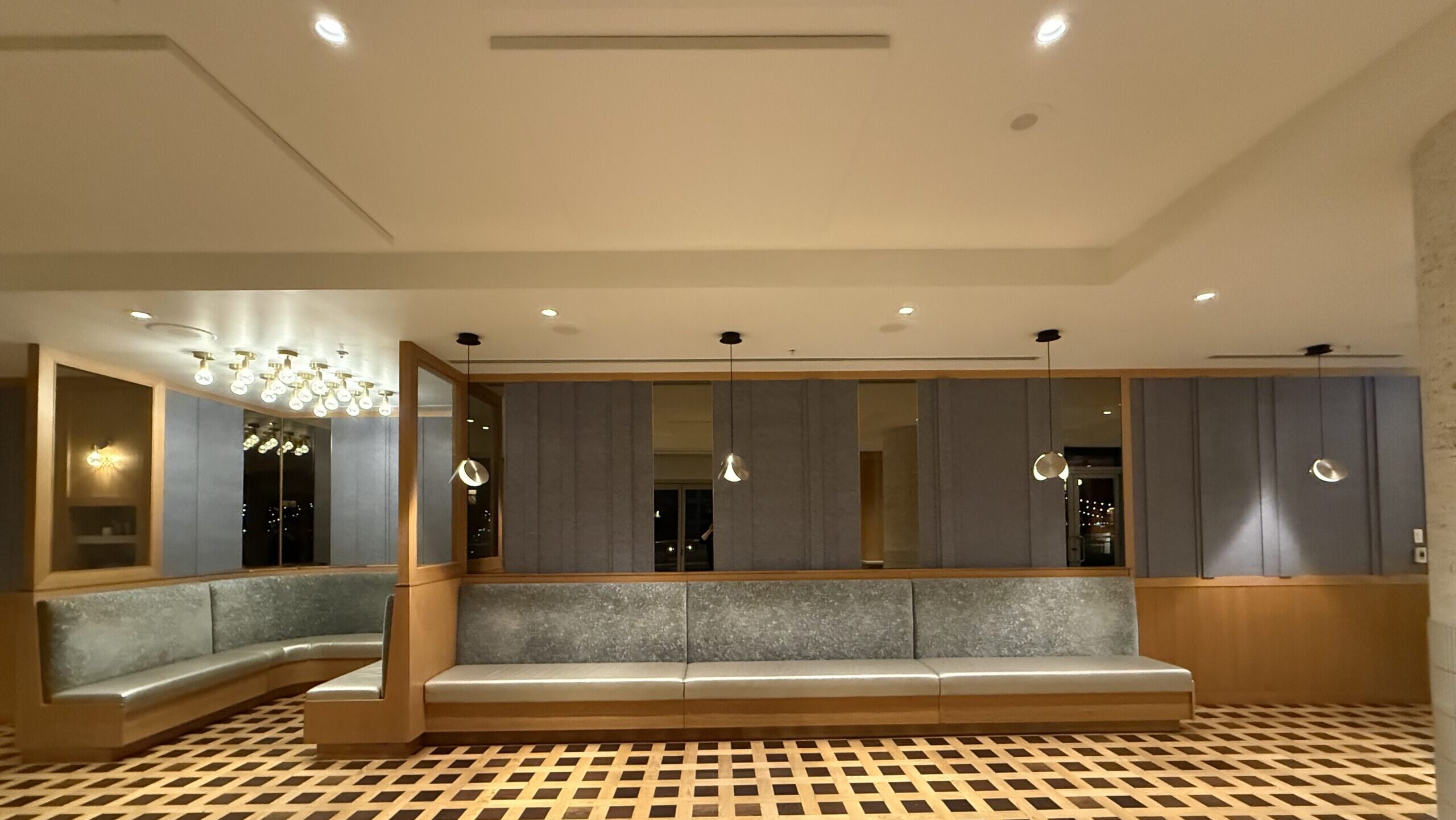
Situated on West Hastings Street in the heart of Vancouver, the Terminal City Club is a cornerstone of the city’s business and social elite. Offering a comprehensive suite of amenities—ranging from state-of-the-art fitness facilities and versatile banquet spaces to an exclusive members’ lounge, fine-dining restaurant, and private dining rooms—the club serves as a vital hub for local professionals.
A significant portion of TCC’s membership consists of corporate executives, entrepreneurs, and business leaders who routinely utilize the dining rooms for power lunches and confidential corporate meetings. However, following a recent aesthetic renovation, Iain Fletcher, TCC’s Director of Club Outlets, noticed a puzzling trend: fewer patrons were choosing to conduct business over lunch in the newly redesigned space.
+-------------------------------------------------------------------------+
|                      THE ACOUSTIC DILEMMA AT A GLANCE                   |
+--------------------------+----------------------------------------------+
| Location                 | Terminal City Club, West Hastings St.,       |
|                          | Vancouver                                    |
+--------------------------+----------------------------------------------+
| Core Problem             | Diminished speech intelligibility and        |
|                          | excessive reverberation after a renovation   |
+--------------------------+----------------------------------------------+
| Architectural Obstacles  | Hard, sound-reflecting surfaces, glass walls,|
|                          | structural mirrors, minimal soft furnishings |
+--------------------------+----------------------------------------------+
| Project Partners         | Primacoustic & Paramount Automation          |
+--------------------------+----------------------------------------------+
| Solutions Deployed       | Primacoustic EcoScapes PET panels & studio-  |
|                          | grade Broadway glass wool treatments         |
+--------------------------+----------------------------------------------+
Fletcher was acutely aware of how sound shapes human behavior in hospitality venues. "I’ve been to some places in the city with thoughtful acoustic treatment, and the experience is memorable," Fletcher reflects. "But there are also restaurants I might not return to because they’re just too loud. And I can’t help but think how often others feel the same—but don’t tell the people running the restaurant."
The root of TCC’s acoustic woes lay in the unintended consequences of the renovation. In modernizing the space to achieve a clean, contemporary look, designers had introduced hard, sound-reflecting surfaces while removing carpets, heavy drapery, and plush furniture that previously acted as natural sound absorbers. The result was a spike in ambient noise, prolonged reverberation times, and severely compromised speech intelligibility. Conversations bled into neighboring tables, forcing patrons to raise their voices, which only exacerbated the problem—a phenomenon acoustic engineers refer to as the "Lombard effect."
Chronology: From Recognition to Tailored Resolution
Recognizing that the ambiance was actively driving away business-lunch clientele, TCC leadership began searching for a viable intervention. The turning point arrived when Fletcher came across digital case-study videos showcasing an acoustic makeover executed by Primacoustic and AV integrator Paramount Automation at Piva Restaurant in nearby New Westminster.
"One of our previous managers had actually started working at Piva," Fletcher recalls. "And seeing his comments, and a video showing how it sounded and looked before and after, we thought we’d give it a shot."
Armed with a referral and a clear objective, TCC engaged Paramount Automation. Known for handling complex integration projects requiring meticulous attention to detail, Paramount tapped Marty Nightingale—affectionately dubbed their "resident craftsman"—to lead the design phase.
Phase One: The Dining Room Diagnostics
Nightingale began by evaluating the primary dining room. He quickly discovered that the space was fraught with physical and architectural constraints. "There were many limitations to where treatments could actually be placed," Nightingale explains. "A wall of glass, structural design elements to recreate, millwork, mirrors, lights…"
Compounding these challenges was a strict design mandate from TCC management: the restaurant had recently won multiple design accolades, meaning any acoustic treatment had to be entirely invisible to the untrained eye.
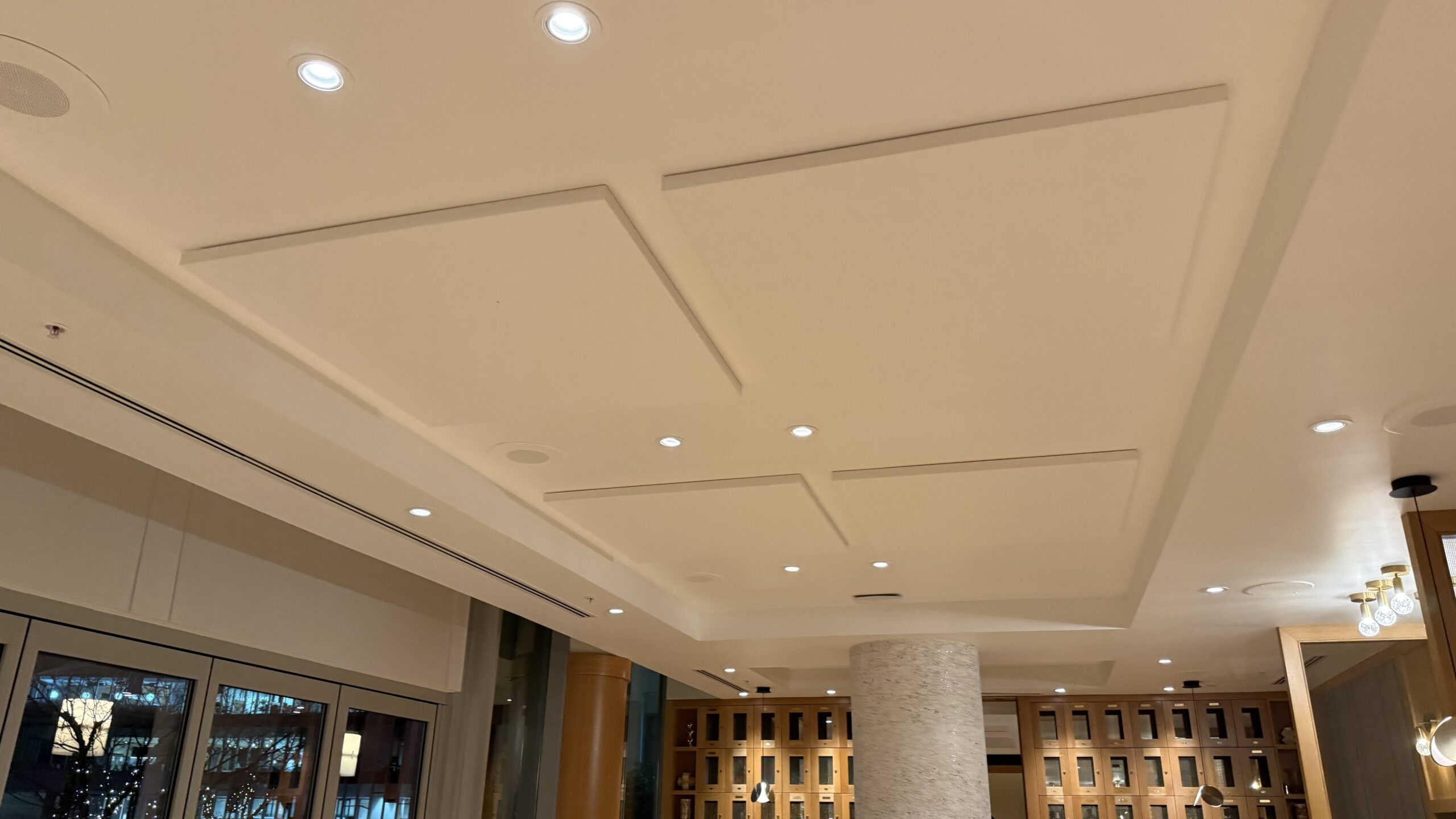
To bridge the gap between sonic performance and aesthetic preservation, Nightingale teamed up with Dylan Bubel, Primacoustic’s Western Canada Sales Manager. Together, they engineered a dual-material approach, combining Primacoustic’s eco-friendly EcoScapes PET (polyethylene terephthalate) panels with studio-grade Broadway glass wool treatments.
Phase Two: The Private Lounge Expansion
Buoyed by the initial progress in the main dining room, TCC management identified similar acoustic shortcomings in an attached private lounge. This secondary space introduced its own unique set of obstacles: glass patio doors, decorative wall laminate, a large-screen television, and a high-traffic entryway leading directly to the kitchen. With minimal wall real estate available for traditional acoustic panels, the team had to innovate.
Using a custom layering technique, Nightingale adapted the strategy deployed in the dining room—employing a base layer of white EcoScapes panels overlaid with precision-cut strips to mimic the room’s original coffered ceiling architecture while soaking up rogue sound waves.
Supporting Data: Material Science Meets Craftsmanship
To achieve high-performance acoustic treatment without compromising interior design, the project relied heavily on the versatility and precision of Primacoustic’s product lines.
+--------------------------------------------------------------------------+
|                     MATERIAL SELECTION & DEPLOYMENT                      |
+---------------------+-----------------------+----------------------------+
| Material Type       | Specific Application  | Acoustic & Aesthetic Value |
+---------------------+-----------------------+----------------------------+
| Primacoustic        | Ceiling above the     | Controls floor-to-ceiling  |
| Broadway Glass Wool | main dining area      | reflections; clean 'Arctic |
| (Arctic White)      |                       | White' finish matches      |
|                     |                       | existing ceiling scheme    |
+---------------------+-----------------------+----------------------------+
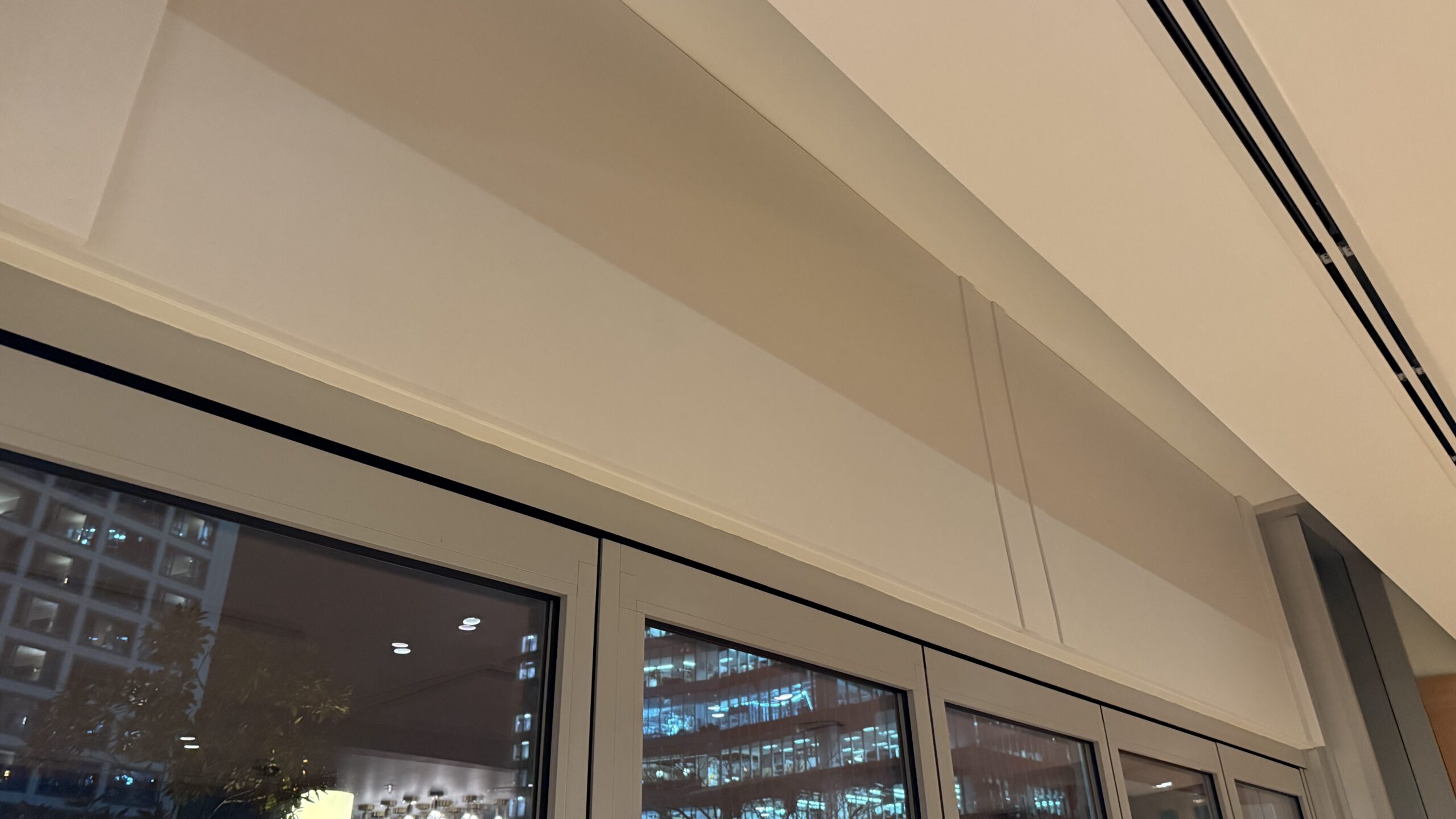
| EcoScapes PET       | Drywall section above | 'Glacier White' panels     |
| Panels (Glacier)    | glass doors           | create an even, seamless   |
|                     |                       | visual transition          |
+---------------------+-----------------------+----------------------------+
| EcoScapes PET       | Eye-level walls over  | Two thicknesses of 'Slate' |
| Panels (Slate Grey) | tables                | grey panels hand-layered   |
|                     |                       | to recreate felt features  |
+---------------------+-----------------------+----------------------------+
The Precision Wall Treatment
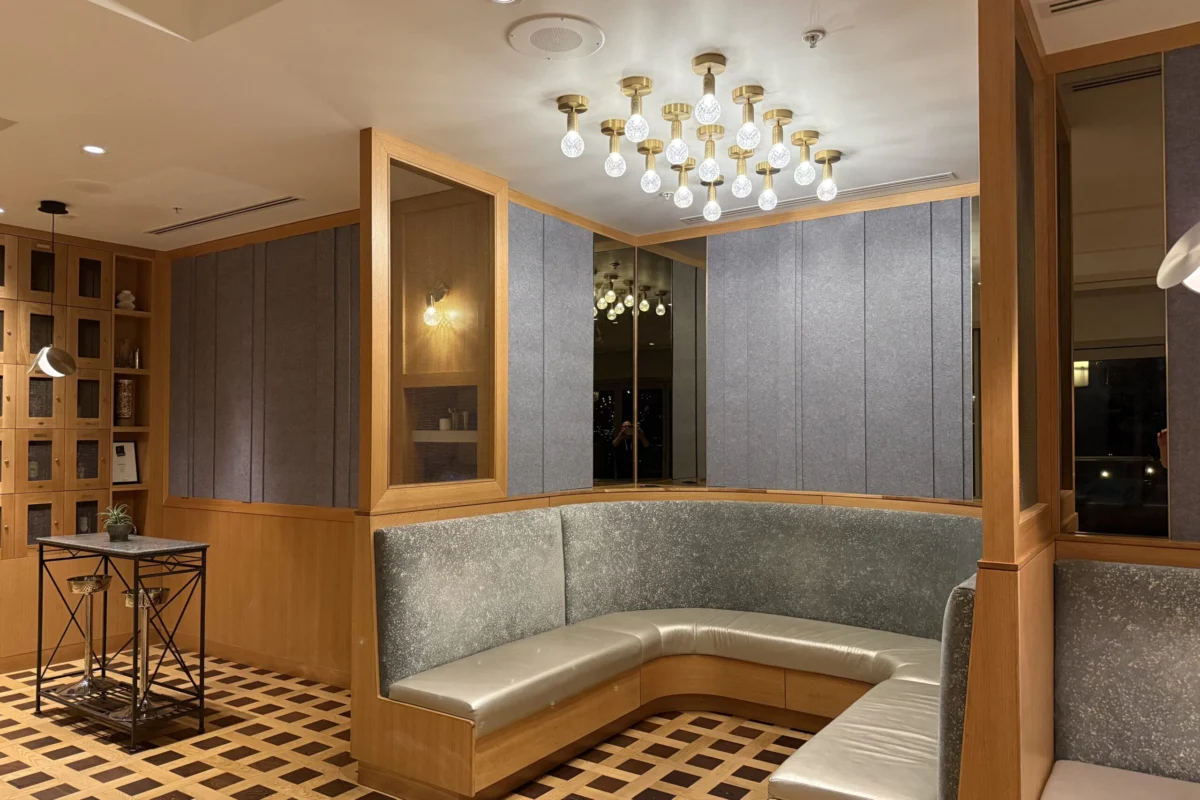
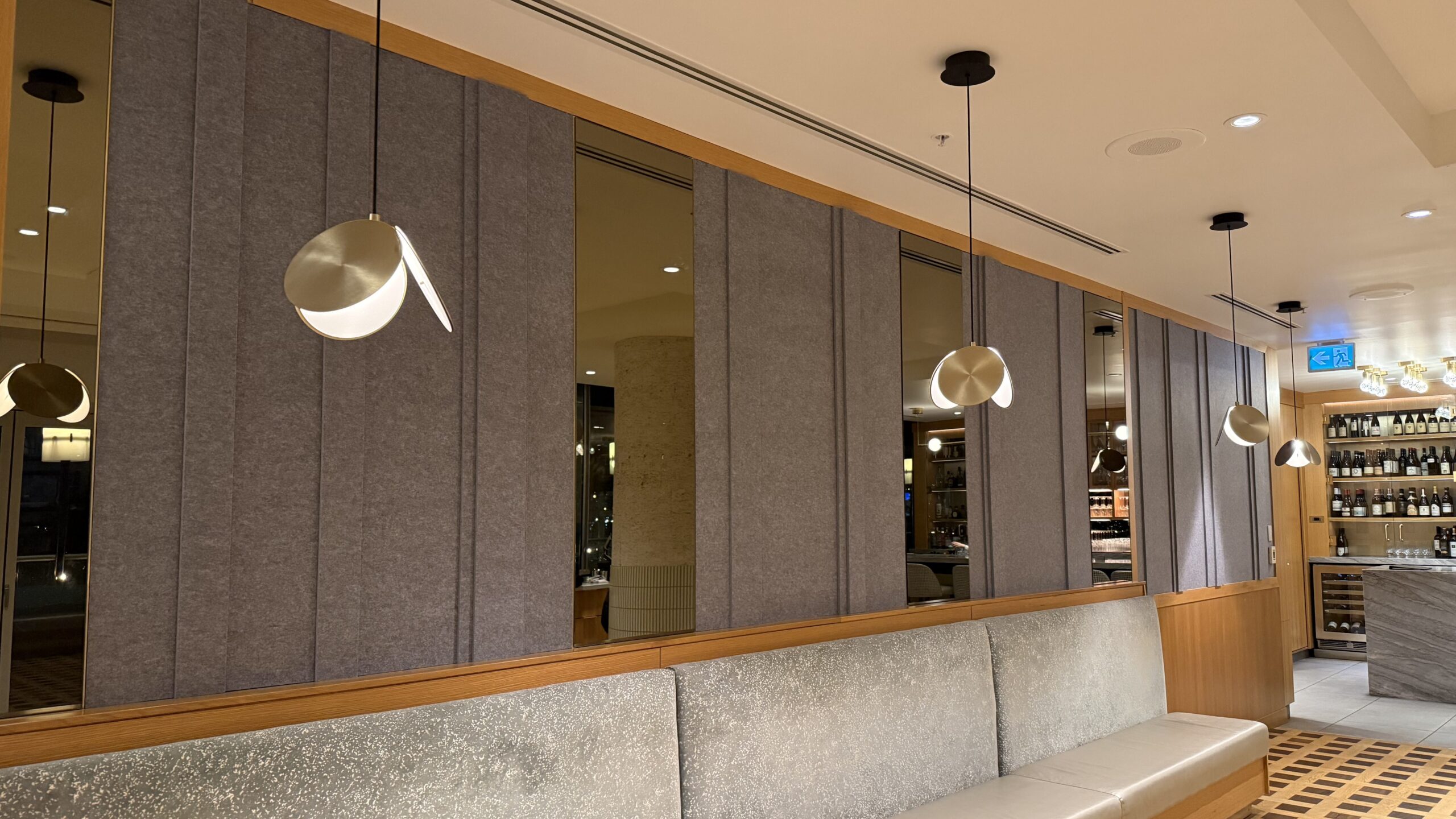
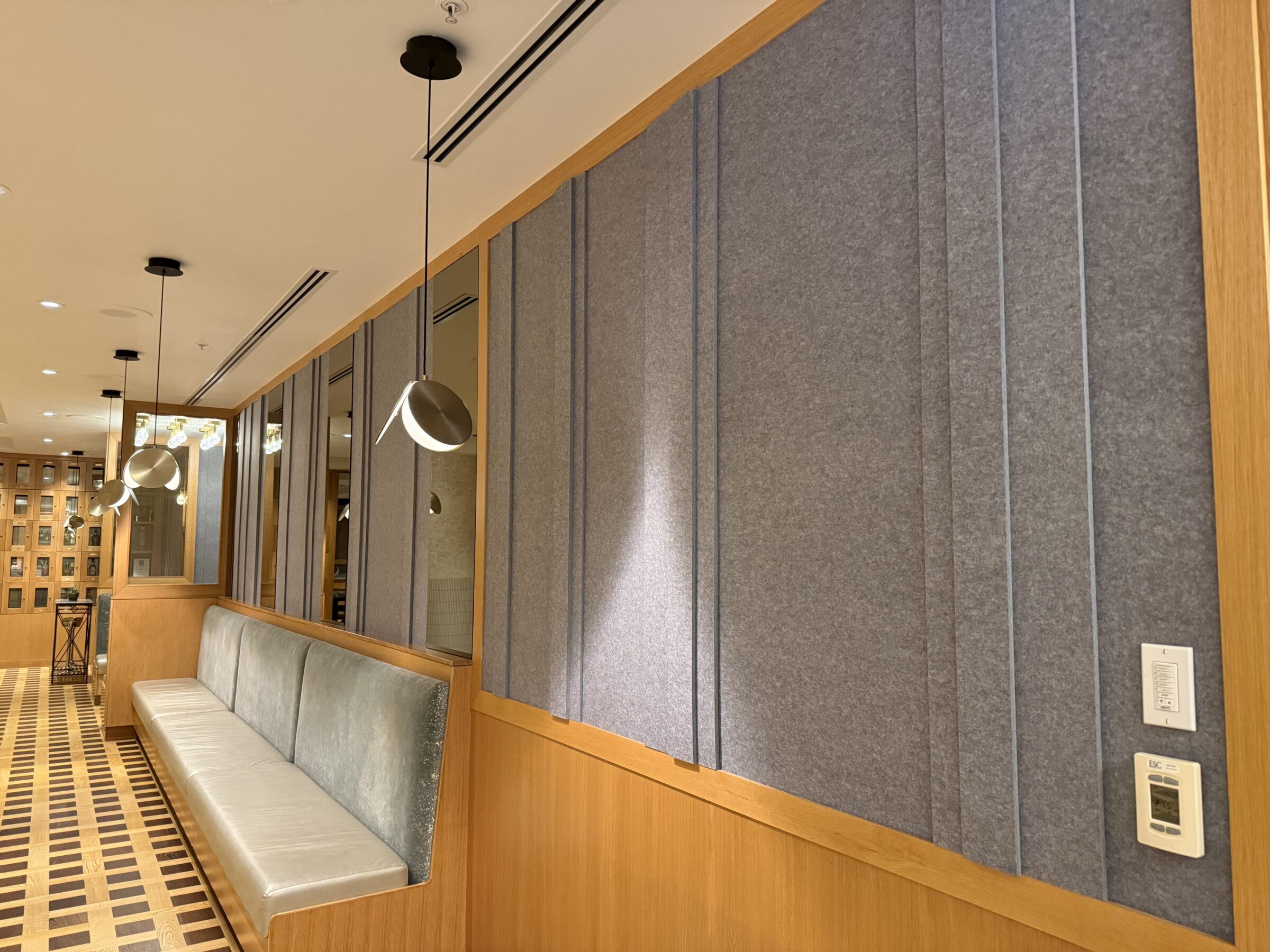
Arguably the most technically demanding aspect of the entire installation was recreating a series of grey felt wall features located at eye level directly above the dining tables.
"Those are at eye level," Nightingale notes, emphasizing the zero-tolerance margin for error. "So there was no place to hide a rough edge or seam."
The installation team stripped away the existing, acoustically ineffective felt material. In its place, they laid down a continuous base layer of Primacoustic EcoScapes PET material in Slate grey. On top of this foundation, Nightingale hand-cut and individually layered multiple strips of PET panels of varying thicknesses to meticulously match the contours of the original design.
Though constructed from multiple layers of synthetic felt, the finished installation creates an optical illusion: it appears as though it were sculpted seamlessly from a single, unified panel of high-end architectural material.
Official Responses and Industry Perspectives
The success of the Terminal City Club project underscores the importance of synergy between manufacturers, integrators, and venue operators. Behind the technical achievements lie strong professional relationships forged over years of collaboration.
Drew Campbell, founder and owner of Paramount Automation, emphasizes that the partnership with Primacoustic is rooted in a shared corporate philosophy. "We work well together because we’re like-minded, because we complement each other," Campbell states. "And Primacoustic is always open to feedback." According to Campbell, this openness fosters a continuous cycle of improvement, characterized by a shared team mindset: “How can we do this better?”
Marty Nightingale echoes this sentiment, framing installation challenges not as roadblocks, but as creative opportunities. "At Paramount Automation, we’re outside-the-box thinkers," Nightingale says. "So it’s a perfect fit, because with both Paramount and Primacoustic, it’s like, ‘This is a challenge, not a problem—let’s figure it out.’"
For TCC’s Iain Fletcher, the proof is in the member feedback and the daily operations of the club. "Right away, it’s something you can feel when you walk into the restaurant," Fletcher observes.
Crucially, the intervention achieved its primary aesthetic goal: absolute discretion. "I have had people ask what we did and where the panels are," Fletcher beams, "so they’ve noticed a difference [in sound], but haven’t seen a difference."
Implications: The Bottom-Line Value of Acoustic Design
The successful acoustic overhaul at the Terminal City Club carries broad implications for the broader hospitality, corporate dining, and private club sectors.
For years, interior designers prioritized minimalist aesthetics—polished concrete floors, exposed ceilings, expansive glass facades, and sleek metal fixtures. While visually striking on social media or in architectural portfolios, these hard-surface-heavy environments create hostile acoustic conditions. As TCC discovered, when rooms are too loud to hold a conversation, high-value patrons quietly vote with their feet, migrating to quieter, more accommodating competitors.
By integrating advanced acoustic science with bespoke craftsmanship, TCC has reversed this trend. The results extend beyond mere quietude:
- Restored Business Utility: Members can once again conduct confidential business discussions and corporate meetings during busy lunch hours without straining their voices.
- Optimized Ambiance Control: With the oppressive, chaotic echo neutralized and replaced by a gentle, comfortable murmur of conversation, management regained control over the room’s atmosphere. Fletcher notes that he has successfully increased background music volume to cultivate an inviting, energetic ambiance without driving up overall noise levels.
- Protected Architectural Integrity: By utilizing customizable PET panels and color-matched glass wool absorbers, TCC preserved its award-winning interior design layout without compromise.
As private clubs, fine-dining establishments, and corporate hospitality venues continue to evolve post-pandemic, the Terminal City Club stands as a benchmark for modern acoustic retrofitting. It demonstrates that comfort and aesthetics do not have to exist in mutual opposition—and that the best acoustic treatments are the ones guests can feel, appreciate, and enjoy, without ever knowing they are there.
Are you looking to elevate class-leading sound control while maintaining design-forward flexibility for your commercial, hospitality, or corporate project? Visit Primacoustic.com to explore comprehensive product lines—including cutting-edge PET sound control systems, EcoScapes Blades, Dimensional Baffles, and Contour Panels—or contact their expert staff directly to schedule a professional consultation.