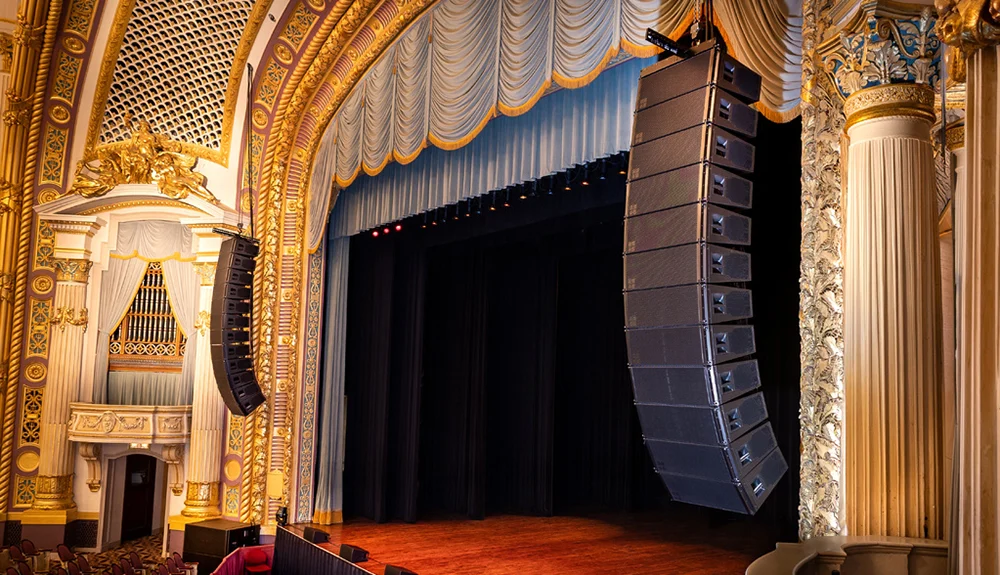
The cultural landscape of downtown Minneapolis has witnessed a significant technological evolution. Hennepin Arts, the non-profit steward responsible for preserving and enhancing the city’s historic theatrical crown jewels, has officially unveiled a comprehensive audio overhaul at the 2,181-seat State Theatre. Designed and installed by the Minneapolis-based integration firm Audio Logic Systems, the project centers on the implementation of the d&b audiotechnik KSL-Series line array system. This upgrade not only replaces aging, unsupported infrastructure but marks a pivotal moment in the venue’s 103-year history, ensuring it remains a premier destination for Broadway touring productions, world-class concerts, and high-profile comedy acts.
A Legacy Preserved, A Future Secured: The Core Facts
The State Theatre, originally opened in 1921, has long been a centerpiece of Minnesota’s entertainment scene. However, as production demands have increased, the theatre’s original sound reinforcement system had reached the end of its operational lifespan. Hennepin Arts faced a critical decision: continue maintaining obsolete equipment or pivot toward a modern standard that aligns with the high expectations of touring acts and audiences alike.
The chosen solution—the d&b KSL-Series—is widely regarded as the "wish list" PA for high-end touring professionals. By transitioning to this system, the State Theatre has effectively eliminated the "tech gap" between its historic architecture and the sophisticated, rider-heavy productions that define the modern touring circuit. The installation is not merely a replacement; it is an architectural and acoustic optimization designed to provide uniformity across one of the most challenging acoustic environments in the Twin Cities.
Chronology of a Transformation
The journey to this upgrade began with a strategic assessment by Hennepin Arts management, focusing on sustainability, performance, and operational efficiency.
- Phase I: Needs Assessment: The technical team at the State Theatre, led by Head Sound Engineer Merritt Benton, identified that their existing rig was no longer meeting the fidelity standards expected by modern touring engineers.
- Phase II: The Partnership: Audio Logic Systems was commissioned to engineer a solution that could respect the historic structural integrity of the venue while providing the precision of modern acoustic modeling.
- Phase III: Design and Modeling: Utilizing d&b’s ArrayCalc software, the integration team spent months modeling the unique, multi-layered geometry of the theatre—which includes a main floor, a traditional balcony, and a notoriously deep, 50-foot under-balcony space.
- Phase IV: Execution and Deployment: The physical installation occurred in coordination with the theatre’s busy event schedule, requiring precise logistical management.
- Phase V: Integration and Tuning: Post-installation, the team utilized d&b’s ArrayProcessing to calibrate the system, ensuring tonal consistency from the front row to the very back of the under-balcony area.
Addressing Architectural Complexity
The State Theatre presents a triple-threat of acoustic challenges. As John Simshauser, Director of Operations and Design at Audio Logic Systems, notes, the venue is essentially three distinct acoustic spaces in one. Managing the transition between the main floor, the balcony, and the deep, recessed area beneath the balcony required a surgical approach to sound dispersion.
The Power of Broadband Directivity
The KSL-Series was selected specifically for its broadband directivity. In historic theaters, the 90 to 400 Hz range often suffers from "muddy" buildup, which can compromise vocal clarity and instrumental definition. The KSL’s design allows for exceptional control in this frequency range, effectively "cleaning up" the room. Furthermore, the system’s rear rejection capabilities were instrumental in solving a long-standing issue at the State Theatre: the 250 Hz low-mid buildup that would bleed back onto the stage, interfering with performers’ microphones and causing feedback loops. By keeping that energy off the stage and focused on the audience, the new system has created a more comfortable environment for touring artists.
ArrayProcessing: The Great Equalizer
To achieve a uniform listening experience, the installation team implemented d&b’s ArrayProcessing. This technology allows engineers to determine the tonal balance at every seat in the house. By applying complex filtering, the system ensures that a patron in the balcony receives the same sonic impact as someone sitting in the orchestra section, mitigating the need for excessive manual EQ adjustments or "carving" of the signal.
Technical Specifications and Practical Victories
The renovation was as much about physics and real estate as it was about audio fidelity. The logistical improvements achieved by Audio Logic Systems demonstrate the efficiency of modern audio engineering.
Recovering Real Estate
One of the most immediate benefits of the new system is the reduction of the physical footprint required to power the venue. The previous audio infrastructure relied on six 44-space amplifier racks. By upgrading to a more efficient power distribution model using fifteen 40D and two D90 amplifiers, the team was able to consolidate the power requirements into just three racks. This maneuver recovered 15 square feet of valuable floor space in the amp room, while simultaneously reducing the venue’s power consumption.
Sightline Optimization
By utilizing the precise data provided by d&b’s ArrayCalc software, the installation team was able to fly the new line arrays five feet higher than the previous system. This simple yet effective adjustment has significantly improved sightlines for patrons seated on the outer sides of the theatre, removing visual obstructions that had been a point of frustration for decades.
The System Configuration
The current State Theatre rig consists of:
- Main Hangs: A left/right configuration featuring 20 KSL8 and four KSL12 loudspeakers.
- Low-Frequency Support: Four SL-GSUB subwoofers, installed with a 30-degree toe-in to minimize unwanted onstage energy and sharpen the low-frequency nulls.
- Fill Systems: Six Y10P point source loudspeakers act as front fills, while five Yi10P units are dedicated to covering the challenging under-balcony area.
- Power: The entire rig is driven by 15 40D and two D90 amplifiers.
Environmental Adaptability
A unique challenge for any venue in Minneapolis is the radical shift in humidity and temperature throughout the seasons. Merritt Benton explains that in the past, a change in weather could force an engineer to spend hours fighting the acoustics of the room. "When the doors open, the humidity in the room can swing by as much as twelve points," Benton observes. "In the past, I would reach for a 31-band EQ to tame the highs. Now, I just update the temperature and humidity control in the R1 Remote Control software, and it adjusts the frequencies right back into place." This capability represents a paradigm shift for the venue’s technical staff, allowing for proactive, software-based adjustments rather than reactive, hardware-heavy solutions.
The Pantages Theatre Expansion
The commitment to audio excellence by Hennepin Arts extends beyond the State Theatre. As part of the same initiative, Audio Logic Systems also overhauled the nearby 1,014-seat Pantages Theatre, which has been in operation since 1916. For this venue, the team opted for d&b’s CCL-Series arrays.
The Pantages required a system that offered significant power and pattern control while utilizing fewer amplifier channels. The resulting configuration—14 CCL8 and two CCL12 boxes—has provided the venue with increased headroom and a surprising amount of high-frequency extension. According to Simshauser, the installation at the Pantages was a "no-brainer," providing a high-performance, cardioid-capable system that has been met with immediate acclaim from visiting sound engineers.
Implications for the Future of Minneapolis Arts
The investment made by Hennepin Arts signals a broader trend in the performing arts sector: the realization that heritage and technology are not mutually exclusive. By choosing to outfit these historic venues with top-tier, rider-friendly technology, Hennepin Arts has solidified its position as a world-class host for touring productions.
For the audiences of Minneapolis, the result is a superior entertainment experience where the nuances of a Broadway score or the crisp delivery of a comedy set are no longer lost to poor acoustics. For the touring industry, the State and Pantages theatres are now "plug-and-play" ready, reducing the stress and setup time for production crews. As Merritt Benton aptly puts it, this is the technology that touring professionals want to see. By meeting that demand, Hennepin Arts has ensured that the State Theatre remains a vibrant, relevant, and technologically superior pillar of the downtown arts community for the next century.