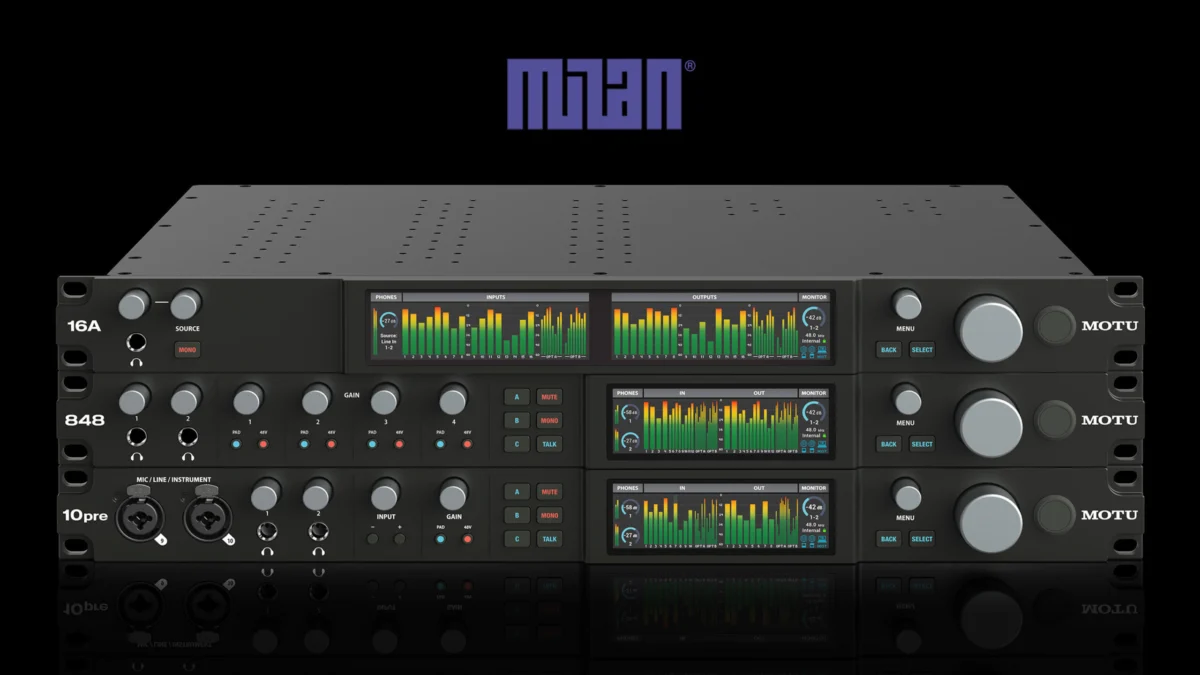
In a significant move that underscores the ongoing transition toward networked audio environments, MOTU has officially announced that its flagship audio interfaces—the 16A, 848, and 10pre—have achieved Milan Certification. This milestone, granted by the Avnu Alliance, marks a transformative step for professional audio workflows, ensuring that these high-performance interfaces can now function with unprecedented reliability and interoperability within complex Milan AVB (Audio Video Bridging) networks.
By integrating these units into the open Milan standard, MOTU is providing studio engineers, live sound technicians, and systems integrators with a robust framework for distributing hundreds of audio channels across large-scale setups, bridging the gap between recording studio precision and the demands of large-venue production environments.
The Milan Standard: Ensuring Interoperability in Pro Audio
At the heart of this announcement is the Milan protocol, an industry-standard network protocol built on top of IEEE Audio Video Bridging (AVB). Unlike proprietary audio-over-Ethernet solutions that often lock users into a single manufacturer’s ecosystem, Milan is designed to be manufacturer-agnostic.
For users of the MOTU 16A, 848, and 10pre, this certification means that these devices can now be deployed alongside Milan-certified equipment from industry titans such as Meyer Sound, L-Acoustics, d&b audiotechnik, and DiGiCo. This capability addresses one of the most persistent challenges in modern professional audio: the need for a unified "plug-and-play" experience that maintains deterministic performance—meaning predictable, low-latency audio transmission regardless of network complexity.
Technical Foundations: The "Bridged End-Station" Architecture
What sets the MOTU 16A, 848, and 10pre apart is their implementation as "bridged end-stations." Each unit is equipped with two dedicated Gigabit AVB networking Ethernet ports located on the rear panel. This hardware design is far more than a simple passthrough; it acts as a built-in 1 Gigabit Milan AVB switch.
This internal architecture allows for a daisy-chain topology, where multiple units can be connected in series without the immediate necessity of an external, stand-alone network switch for basic setups. For mobile recording rigs or mid-sized studio installations, this hardware redundancy simplifies cable management and reduces the footprint of the required infrastructure, all while maintaining the strict timing and synchronization requirements of the Milan standard.
A New Era of Workflow: Firmware and Feature Enhancements
The Milan Certification is not a standalone update; it arrives as part of a comprehensive suite of firmware, driver, and software improvements for the MOTU ecosystem. This update demonstrates MOTU’s commitment to longevity, ensuring that existing owners of these interfaces receive a substantial upgrade to their hardware’s capabilities at no additional cost.
Key Enhancements Include:
- ARM Processor Support for Windows: Recognizing the shift in computing architecture, MOTU has released optimized firmware, drivers, and a native version of the CueMix Pro controller app for Windows ARM systems.
- 24-Channel WDM Streams: Windows users now gain the ability to enable 24-channel WDM (Windows Driver Model) streams, with independent controls for input and output, providing greater flexibility for multi-application audio routing.
- Precision Delay Compensation: The routing matrix within CueMix Pro has been expanded to include 64 multi-purpose delay lines, each offering up to 2 ms of delay. This is an essential feature for time-aligning speakers or compensating for phase discrepancies in complex multi-microphone setups.
- One-Click Network Synchronization: A unified sync mechanism now allows users to harmonize all MOTU devices across a network, bridging the gap between current-generation interfaces and legacy models.
- Static IP and Network Discovery: To support complex IT environments, devices now support static IPv4 assignment via front-panel controls. Additionally, for networks that block standard multicast discovery (such as VPNs), the CueMix Pro app can now search for devices via specific IP addresses.
- Clock Freewheeling: In the event of a network clock interruption, MOTU devices now utilize a "freewheeling" mechanism to maintain audio continuity until the master clock lock is re-established, effectively eliminating the "pops" or "clicks" that usually accompany digital sync errors.
- DAC Filter Flexibility: Catering to high-end monitoring, users can now select between Minimum Phase, Linear Phase Fast, and Linear Phase Slow filter options to optimize the digital-to-analog conversion process.
Official Perspectives: Bridging the Gap
The industry response to this certification has been overwhelmingly positive. Jim Cooper, Director of Marketing at MOTU, emphasized the strategic importance of the collaboration. "Milan Certification means that studio engineers, systems integrators, and other audio professionals can now seamlessly incorporate MOTU audio interfaces into networks with other Milan Certified devices from leading pro audio brands," Cooper noted. He further credited the Avnu Alliance for their pivotal role in defining the standards that allow for this level of interoperability, which he describes as a vital step toward consistency in pro audio.
Dave Cavalcanti, President and Chairman of the Avnu Alliance, echoed these sentiments while welcoming MOTU into the fold. "We are delighted to welcome MOTU as the newest Milan Associate Member of the Avnu Alliance," said Cavalcanti. "As an industry-led organization driving the adoption of Time Sensitive Networking (TSN) and Milan in the market, we are always excited when new members such as MOTU achieve the certification milestone."
Implications for Systems Integration and Live Sound
The certification of these specific interfaces changes the math for professional installations. Traditionally, integrating a studio-grade interface into a large-scale live sound environment required complex protocol converters or proprietary bridges. By adopting the open Milan standard, MOTU has effectively turned the 16A, 848, and 10pre into "network-native" devices.
For a systems integrator, this means a lower cost of entry for redundant network topologies. A front-of-house engineer can now use a MOTU 16A as an I/O bridge directly connected to a Milan-enabled console, bypassing the need for expensive third-party interface cards. Furthermore, the inclusion of features like "Front Panel Lockout"—which prevents accidental setting changes during high-pressure production scenarios—indicates that MOTU is designing these units with the realities of live performance in mind.
Looking Ahead: The Future of Networked Audio
The addition of MOTU to the list of Milan-certified manufacturers is a bellwether for the professional audio industry. As production environments move away from point-to-point analog cabling and toward centralized, high-bandwidth IP networks, the demand for interoperable, standards-based hardware will only grow.
By providing free firmware updates to existing users, MOTU has effectively extended the product lifecycle of its interfaces, ensuring that the 16A, 848, and 10pre remain relevant in an increasingly digital-first world. For the professional audio community, this development is more than just a software patch; it is an invitation to build larger, more resilient, and more flexible audio networks without the constraints of proprietary silos.
As of this writing, the firmware updates are available for download directly through the MOTU website. With the integration of Milan, the 16A, 848, and 10pre stand as a testament to the power of open-standard collaboration, signaling a future where the studio and the stage are finally speaking the same language.