WESTLAKE VILLAGE, California — In the realm of house of worship audio design, balancing architectural aesthetics with pristine acoustic performance has long been a formidable challenge. Historic and contemporary sanctuaries alike frequently feature hard reflective surfaces, soaring ceilings, and striking architectural centerpieces—such as stained-glass windows—that complicate sound reinforcement.
For St. Jude’s Catholic Church in Westlake Village, California, this decades-long acoustic compromise finally came to an end. Following a comprehensive system overhaul executed by DayTech Consulting in collaboration with Rat Sound Systems, the parish has replaced its aging infrastructure with cutting-edge Eastern Acoustic Works (EAW) AC6 ADAPTive column loudspeakers. The result is a sonic transformation that brings modern clarity, uniform coverage, and aesthetic harmony to a sacred space serving hundreds of parishioners weekly.
Main Facts: The St. Jude’s Audio Overhaul
The sanctuary at St. Jude’s Catholic Church recently underwent a major technological transition, bidding farewell to a legacy audio system that had faithfully served the congregation for more than twenty years. The primary objectives of the upgrade were multifaceted: eliminate an obtrusive central speaker cluster, resolve uneven audio coverage across the sanctuary seating area, and introduce high-precision digital control capable of meeting the demands of contemporary worship environments.
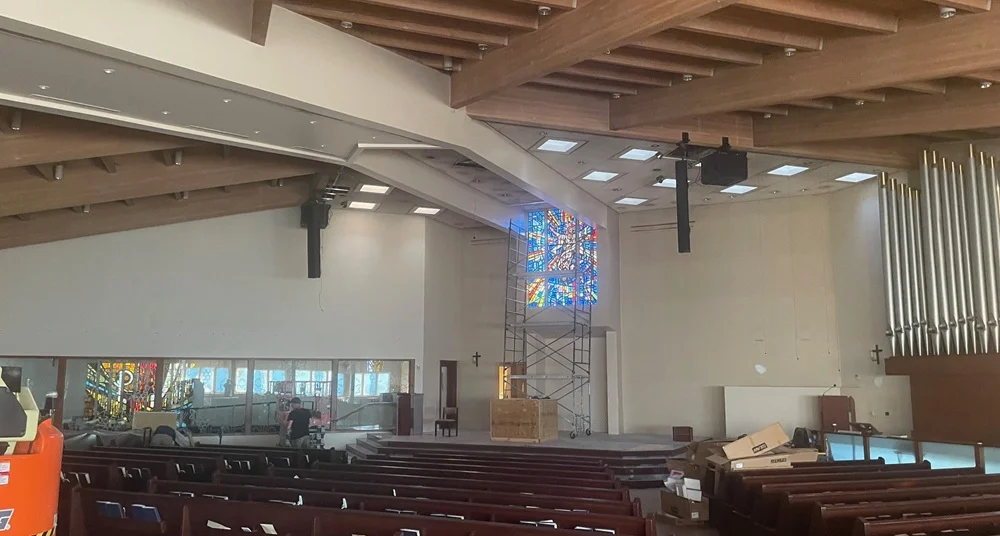
At the core of the new deployment are four EAW AC6 ADAPTive column loudspeakers configured into dual seven-foot arrays—two columns per side—boasting a compact 12 x 12-inch footprint. To ensure rich, balanced low-frequency reinforcement across the room, the arrays are complemented by a pair of EAW 18-inch subwoofers positioned just outside the main speaker paths.
- Project Lead: DayTech Consulting (Andrew Day) in partnership with Rat Sound Systems.
- Audio Engineering: Brian Stanley.
- Core Hardware: EAW AC6 ADAPTive column loudspeakers and EAW 18-inch subwoofers.
- Software Integration: EAW Resolution software for real-time digital steering and coverage optimization.
- Key Benefit: Elimination of the visual obstruction over the altar, vastly improved speech intelligibility, and uniform acoustic delivery to every seat in the house.
Chronology of the Project: From Conception to Commissioning
The Legacy System and Its Limitations
For over two decades, the sanctuary at St. Jude’s relied on a conventional loudspeaker configuration consisting of four main loudspeakers and two large subwoofers. While the setup had endured the test of time, acoustic standards and church audio requirements evolved significantly during its operational lifespan.
The legacy system suffered from two critical flaws. First, it utilized a prominent center cluster design that physically obstructed a magnificent stained-glass window behind the altar—a focal point of the sanctuary’s sacred architecture. Second, despite the sheer output of the older gear, coverage was fundamentally inconsistent. Parishioners seated in the rear corners or under deep architectural overhangs experienced muddy speech and uneven volume levels, detracting from the spoken word during homilies and the dynamic range of musical instrumentation.
Designing the Solution
Recognizing the need for a modern paradigm shift, church leadership engaged Andrew Day of DayTech Consulting, who teamed up with industry heavyweights Rat Sound Systems to engineer a replacement.
The design team faced an immediate spatial puzzle: removing the center cluster meant the replacement arrays had to be flown to the left and right sides of the chancel. However, shifting the speakers outward required careful acoustic planning to avoid phase cancellation and ensure that the sound field wrapped smoothly around the room without bouncing aggressively off hard boundaries.

The deployment settled on four EAW AC6 columns, creating sleek, aesthetically unobtrusive seven-foot vertical arrays that seamlessly integrated into the proscenium architecture without blocking the prized stained-glass window.
Tuning and Commissioning
The true test of the new hardware occurred during system commissioning, handled by Day and audio engineer Brian Stanley. Utilizing EAW’s proprietary Resolution software, the engineering team mapped the room’s precise physical dimensions and acoustic properties to digitally steer the sound dispersion.
During the tuning process, an unexpected acoustic reflection materialized, driven by a rear glass window that was bouncing high-frequency energy back into the sanctuary. Rather than resorting to physical dampening materials or altering the speaker brackets, Stanley and Day utilized the software interface to dynamically adjust the vertical coverage pattern.
"He snapped a line in the software and lowered it less than a foot," Day recalled. "We could hear the difference instantly."
The ultimate proof of concept arrived during the first full Sunday Mass following the installation. Walking the sanctuary with an iPad during live services, Stanley fine-tuned the coverage zones while sitting in areas historically known as acoustic dead zones. The transformation was absolute: what was once considered the worst seat in the house had suddenly become acoustically pristine.
Supporting Data and Technical Architecture
The success of the St. Jude’s installation hinges upon the sophisticated engineering embedded within the EAW AC6. Unlike passive column speakers or traditional line arrays that require physical tilting to direct sound, ADAPTive systems utilize advanced DSP (Digital Signal Processing) and discrete amplification channels assigned to individual transducer elements.
The Power of ADAPTive Technology
Each AC6 column houses numerous individually powered transducers, allowing the system’s internal computer architecture to shape and direct the vertical coverage beam entirely through software control.
- Precision Steering: Sound energy is mathematically sculpted to blanket the seating plane precisely while steering energy away from reflective surfaces like ceilings and rear glass walls.
- Form Factor vs. Output: Despite standing seven feet tall, the cabinets maintain a slim 12 x 12-inch profile, minimizing visual intrusion in architecturally sensitive spaces such as traditional churches.
- Low-Frequency Extension: The integration of dual 18-inch EAW subwoofers ensures that musical performances—ranging from contemporary worship bands to traditional choir and organ arrangements—retain warmth, depth, and clarity without muddying vocal intelligibility.
Redundancy and Long-Term Serviceability
Houses of worship operate under strict reliability expectations; audio system failures during a service are highly disruptive. A major selling point for DayTech Consulting in selecting the AC6 was its modular internal architecture and built-in redundancy safeguards.

"One of the biggest selling points was that if one module goes down, the other two make up for it," Day noted. "You can keep going and not have to take the system down immediately."
This modular fault-tolerance ensures that maintenance can be scheduled proactively rather than reacting to catastrophic mid-service failures, protecting the parish’s capital investment over the long term.
Official Responses and Industry Perspectives
The collaboration between DayTech Consulting, Rat Sound Systems, and EAW has drawn praise from the professionals who brought the project to life.
Andrew Day emphasized that the performance of the system is rooted in rigorous physics rather than marketing hyperbole:
"The AC6 with its ADAPTive technology delivers. It’s not a secret sauce; it’s real engineering that you can rely on. We could tell that during commissioning, when we made even tiny adjustments in the software, you could instantly hear the difference."
Audio engineer Brian Stanley highlighted the democratization of the listening experience across the entire sanctuary floor:
"It now sounds the same, no matter where you choose to sit in the room. There is not a bad seat anywhere."
Recalling his experience walking the room during the inaugural Sunday Mass with an iPad, Stanley noted the disbelief of sitting in the historically problematic rear corner:

"We were sitting in the back corner, which originally was one of the worst seats in the house. He leaned over and said, ‘Wow, this is a really good seat.’"
Broader Implications for House of Worship Audio Design
The successful modernization of St. Jude’s Catholic Church serves as a compelling case study for contemporary acoustic design within traditional houses of worship. As congregations increasingly demand higher fidelity for speech intelligibility, multimedia presentations, and diverse musical styles, facilities managers face mounting pressure to upgrade aging sound reinforcement systems.
1. Aesthetic Preservation Meets Acoustic Excellence
For decades, churches faced a binary choice: preserve architectural heritage (such as stained-glass windows, hand-carved altars, and high vaulted ceilings) or install intrusive, industrial-looking speaker clusters to achieve adequate sound coverage. ADAPTive column technology demonstrates that modern systems can blend seamlessly into interior designs while providing performance capabilities that far outstrip legacy point-source configurations.
2. The Shift Toward Software-Driven Acoustics
The ability to digitally steer sound beams via software interfaces like EAW Resolution represents a paradigm shift in installation workflows. Sound system tuning is no longer solely dependent on mechanical adjustments, ladder work, and physical rigging tweaks. Instead, acoustic engineers can sculpt sound fields in real time while walking the room with mobile devices, drastically reducing commissioning times and minimizing human error.
3. Future-Proofing Through Modularity
As demonstrated at St. Jude’s, long-term reliability and serviceability are paramount considerations for non-profit and religious institutions operating on capital improvement budgets. Specifying modular hardware that can sustain partial internal component failures without a total system blackout provides church administrators with operational peace of mind, ensuring that Sunday services, weddings, and community events proceed uninterrupted.
Conclusion
The audio renovation at St. Jude’s Catholic Church underscores the profound impact that modern acoustic engineering can have on communal worship. By replacing an obsolete, visually obstructive legacy system with state-of-the-art EAW AC6 ADAPTive columns, DayTech Consulting and Rat Sound Systems have future-proofed the parish’s audio infrastructure. Today, every spoken word, prayer, and musical note is delivered with pristine clarity to every corner of the sanctuary—allowing the architecture and the liturgy to shine in equal measure.