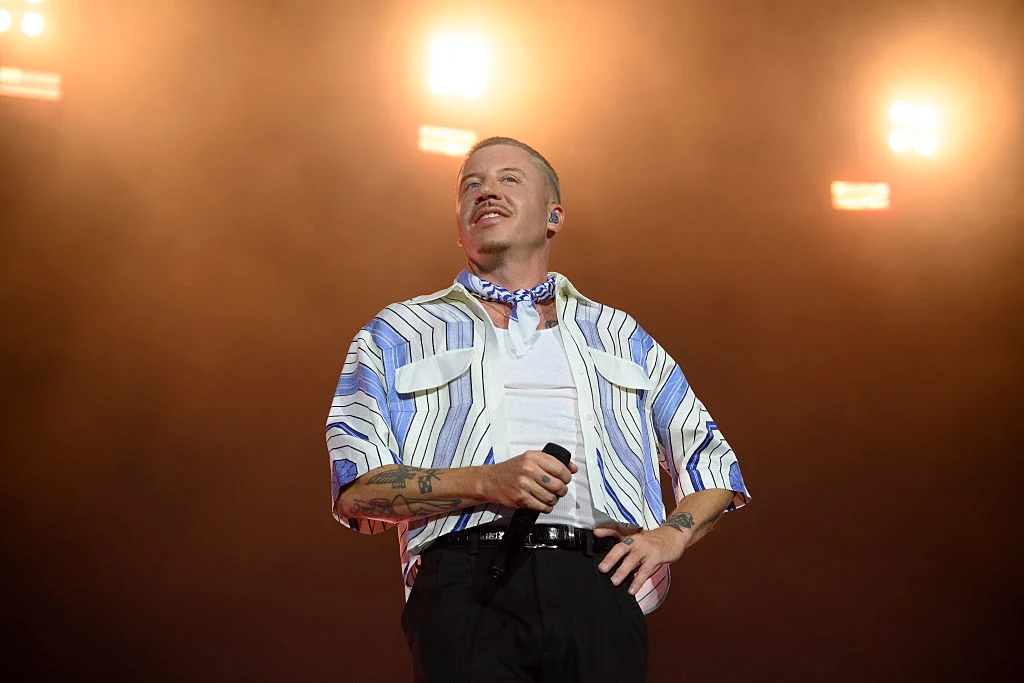
Macklemore made a powerful return to the stage on Thursday night (Oct. 22) at Colorado’s legendary Red Rocks Amphitheatre, delivering a 17-song set that served as both a musical performance and a political manifesto. The concert marked the rapper’s first live appearance since a tumultuous series of events in September, when he was removed from Ed Sheeran’s "Mathematics" (Loop) Tour following his outspoken commentary on the humanitarian crisis in Gaza.
Undeterred by the professional fallout that saw him barred from multiple high-profile venues, Macklemore used the Red Rocks platform to double down on his advocacy. His performance was not merely a return to form; it was a reaffirmation of his intent to use his platform to address global conflicts, including those in Sudan, the Congo, Lebanon, and Haiti, while explicitly calling for a "Free Palestine."
The Red Rocks Moment: A Stand for Humanitarianism
During the set, Macklemore paused the music to address the audience directly, framing his activism not as a partisan political stance, but as a fundamental moral obligation.
"Being a human being in this moment is not complicated," Macklemore told the crowd, according to footage circulated online. "It is not political. It is human to have a heart, to watch others suffering and to say, ‘Not anymore!’ So I say, free Palestine. I say, free Palestine!"
He expanded his advocacy to include a broader scope of international suffering, stating, "I say, free Sudan. I say, free Congo, Lebanon, to Haiti, to all the people that are affected by ICE in America, who are afraid to leave their houses." He concluded the address by emphasizing that, for him, the central message of his music and his activism "will always be love."
Chronology of the Controversy: From MetLife to Red Rocks
The path to this week’s concert has been marked by significant professional upheaval. The tension began in September during two high-profile performances at MetLife Stadium in East Rutherford, New Jersey.
During those dates, Macklemore—who was serving as an opening act for Ed Sheeran’s global stadium tour—used his stage time to perform his 2024 protest track, "Hind’s Hall." The song, which explicitly calls for Palestinian liberation and criticizes the U.S. government’s stance on the conflict, was accompanied by visual imagery from Gaza.
The reaction was immediate and polarized. Various advocacy groups, including the Israeli-American Council, publicly condemned the performance. The criticism culminated in a decision by tour promoters, the Messina Touring Group, to remove Macklemore from the remaining U.S. dates of the tour.
The situation grew more complex when Robert Kraft, owner of the New England Patriots and Gillette Stadium, confirmed that he had personally barred Macklemore from performing at his Massachusetts venue. Kraft cited the rapper’s "rhetoric and imagery" as offensive and harmful to the Jewish community, marking a rare instance of a venue owner directly intervening to remove a supporting act based on the content of their performance.
The Ripple Effect: Sheeran’s Diplomacy and Tour Fallout
Ed Sheeran, the headliner of the tour, found himself caught in the crossfire of the controversy. In the weeks following the removal, Sheeran sought to distance himself from the decision, clarifying that the move was initiated by the promoters and individual venue owners rather than his own camp.
"I respect Macklemore’s strength of purpose to stand up and shout for what he believes," Sheeran stated in a public comment. However, he maintained that his personal approach to the situation was to "maintain diplomacy and keep conversations open, not closed."

The fallout proved substantial, creating a domino effect across the tour’s logistics. Several other artists and collaborators, including FINNEAS, Aaron Rowe, Lukas Graham, and the backing band Beoga, subsequently withdrew from scheduled appearances. This mass departure forced a significant restructuring of the tour’s remaining dates, highlighting the profound tension between artistic expression, venue management, and the current political climate.
Economic Implications and Streaming Trends
While the controversy resulted in the loss of major stadium dates, it also sparked a massive surge in public interest surrounding Macklemore’s discography. According to data provided by Luminate and reported by Billboard, the rapper saw a significant spike in consumption metrics immediately following the MetLife controversy.
Between Sept. 13 and Sept. 15, on-demand U.S. streams for his solo catalog rose from 282,000 to 767,000—a 172% increase. When including his collaborative work with producer Ryan Lewis, his total catalog streams nearly doubled, growing by 97% to reach nearly 2 million streams in that 48-hour window.
The protest anthem "Hind’s Hall" saw the most dramatic increase, jumping from roughly 5,000 daily streams to 87,000—its highest daily performance since its release. Industry analysts suggest that this surge reflects a "streisand effect," where the public effort to censor or silence an artist’s message inadvertently draws more attention to their work, thereby amplifying the reach of the very message the critics sought to suppress.
Strategic Shift: The "Free Palestine" Tour
Macklemore has responded to his removal from the mainstream tour circuit by organizing his own independent "Free Palestine" tour. The venture has proven successful, with sold-out shows scheduled for Dublin, Paris, and London at the end of October.
Unlike his previous stadium runs, these shows are explicitly designed as charitable events. Proceeds from the ticket sales are earmarked for humanitarian aid organizations, including the Gaza Soup Kitchen, Medical Aid for Palestinians, and the Palestine Children’s Relief Fund.
By pivoting to self-booked, mission-driven shows, Macklemore has managed to reclaim control over his professional narrative. He is no longer operating under the constraints of corporate tour promoters or the approval of stadium owners. Instead, he has built a direct pipeline between his performance revenue and the causes he advocates for, effectively turning his entire tour business into a mechanism for humanitarian fundraising.
Broader Implications for Artists and Activism
The Macklemore situation has ignited a wider debate within the music industry regarding the role of artists as political actors. Historically, stadium tours have been treated as "neutral" commercial spaces, where artists are encouraged to entertain rather than polarize. However, the events of this fall suggest that the traditional boundary between the stage and the political arena is becoming increasingly porous.
For artists, the incident serves as a cautionary tale about the financial risks associated with taking a hardline stance on controversial geopolitical issues. Venue owners and promoters, fearing backlash from donors, local governments, or specific community groups, are demonstrating a lower threshold for tolerating political displays that challenge their established interests.
Conversely, for fans and activists, Macklemore’s actions have been hailed as an example of integrity. His willingness to sacrifice high-revenue, high-visibility opportunities in order to maintain his advocacy suggests a shift toward a "fan-first" model of engagement, where an artist’s value is measured by their adherence to personal values rather than their participation in corporate-sponsored entertainment structures.
As Macklemore continues his independent tour, the industry remains watching. His Red Rocks performance confirms that he has no intention of pivoting back to the status quo. Instead, he is charting a new path, one where the concert stage is treated as an extension of the public square—a space for protest, charity, and open, albeit heated, discourse. Whether this strategy remains sustainable in the long term remains to be seen, but for now, it is clear that the "Hind’s Hall" moment was not an end, but a catalyst for a more radical phase in the rapper’s career.