By Marcelo
Published by Headfonics | Independent Audio Review
Introduction: Raising the Bar for Sub-$200 Tribrid IEMs
In the rapidly evolving landscape of personal audio, the quest for high-end acoustic performance at an accessible price point has never been more fiercely contested. Audiophiles no longer need to spend upwards of a thousand dollars to experience complex, multi-driver configurations.

Enter the Juzear Light Shuttle, a seven-driver hybrid in-ear monitor (IEM) priced competitively at $189.99.
Over the years, reviewing tribrid and multi-driver hybrid IEMs—those utilizing a large dynamic driver for bass alongside a combination of balanced armatures (BAs), micro-planars, bone conduction, or MEMS drivers for the mids and highs—has become an exercise in managing expectations. Models like the Tipsy M5, QoA Martini, and Kiwi Ears Halcyon have all attempted to balance driver coherence with cost. However, very few manage this feat below the $200 threshold.

Given Juzear’s strong track record for value-to-performance ratios, anticipation for the Light Shuttle was notably high. Marketed with a product page promising a "pure, natural sound with a vocal-focused sound signature," the Light Shuttle immediately sparked both curiosity and skepticism. Can a sub-$200 IEM successfully harmonize three distinct driver technologies without falling into the traps of phase cancellation, timbre mismatch, or unnatural tonality? Let’s dive deep.
Architectural Breakdown & Core Features
Underneath its striking exterior, the Juzear Light Shuttle packs a formidable acoustic engine. It employs a seven-driver hybrid configuration per side:

- Low Frequencies: A custom-developed 10 mm dynamic driver dubbed the MACCD driver.
- Midrange: Dual balanced armature drivers dedicated to the critical vocal and instrumental frequencies.
- High Frequencies: Dual balanced armature drivers handling the upper registers.
- Ultra-High Frequencies: Dual micro-planar drivers designed to capture micro-details and air.
To manage this complex array and prevent internal acoustic congestion, Juzear utilizes a dedicated physical sound tube incorporating a spiral acoustic waveguide. Named ATI-SW (Acoustic Tube Integration – Spiral Waveguide), this system is engineered specifically for the midrange drivers to minimize internal reflections and clean up vocal delivery.
Specifications at a Glance
- Impedance: 32Ω
- Sensitivity: 113 dB/mW @ 1kHz
- Connector Type: 2-pin (0.78mm)
- Cable: Modular 6N OCC silver-plated copper with interchangeable 3.5mm and 4.4mm plugs.
Design, Ergonomics, and Accessories
Aesthetics and Shell Construction
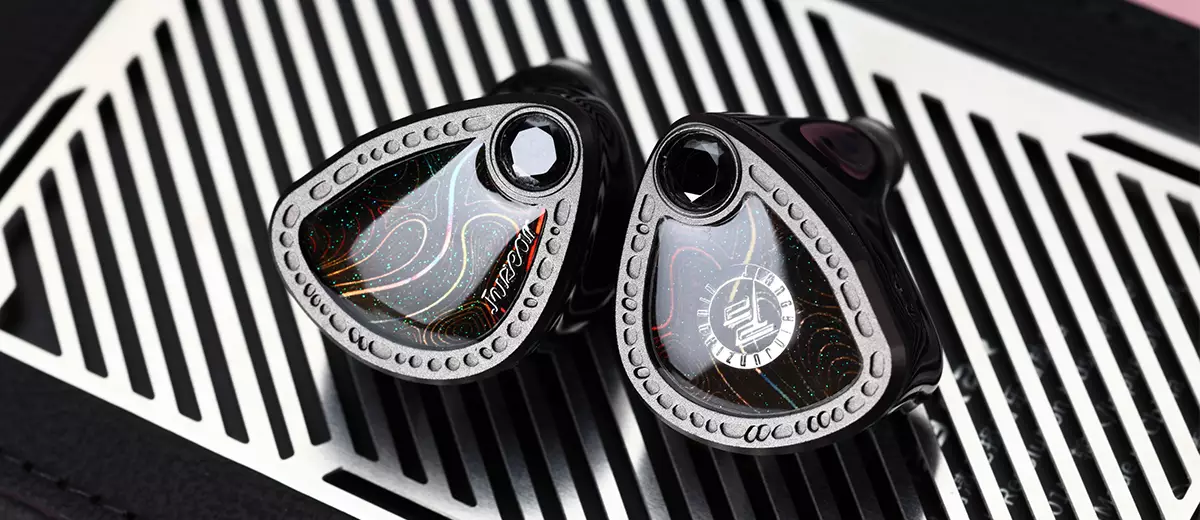
The Light Shuttle features a lightweight 3D-printed resin shell weighing just 6.4 grams per earpiece. The faceplates are machined aluminum inlaid with a colored, iridescent layered resin process that shifts dynamically under direct light, yielding a distinct, premium aesthetic.

The metal nozzle measures 6.2 mm in diameter, tipped with a secure metal grille. Strategic venting is positioned near the faceplate and the 2-pin connector to alleviate internal pressure buildup.
Stock Cable and Unboxing Experience
Unboxing the Light Shuttle is a premium affair, housed in a sleeved black presentation box (193 x 141 x 54 mm) packed with dense protective foam.

Out of the box, the inclusion of a high-purity 6N OCC silver-plated copper modular cable is a massive win for a $189.99 product. Featuring durable all-metal hardware and a swappable plug system (supporting both single-ended 3.5mm and balanced 4.4mm connections), it rivals cables often sold separately as aftermarket upgrades.
Comfort and Isolation
Thanks to the ergonomic resin contours, lightweight profile, and well-chosen stock ear tips, the Light Shuttle disappears in the ear during extended listening sessions—even during active walking workouts. Passive sound isolation is average, allowing faint ambient noise through when music is paused, but completely drowning out the outside world once playback begins.

Sound Impressions & Measurements
Following a standard 24-hour burn-in period to allow the multi-driver array to settle, critical listening was conducted using the standard black normal-bore ear tips, which widen the soundstage compared to the tighter, vocal-forward foam or white tips. Sources included the MUSE HiFi M3 Ultra, xDuoo XP-2 Bal, FiiO M15S DAP, and standard mobile devices running lossless files via UAPP and PowerAmp.
Frequency Response and Technical Measurements
Acoustic measurements reveal an exceptionally well-matched left-to-right channel balance, pointing toward tight quality control during manufacturing.

Sub-bass and treble extensions are robust, while the upper-midrange pinna gain—vital for natural vocal localization—is kept at a smooth, non-fatiguing 8 dB boost.
Tonality: The Surprise Beneath the Shell
Expectations dictated a heavily midrange-forward, clinical presentation based on marketing materials. Instead, the Light Shuttle delivers a bassy, mildly U-shaped sound signature.

- Bass: Exceptional quality. The MACCD dynamic driver produces a taut, elastic sub-bass texture with genuine physical impact and slam. It provides an engaging foundation without ever bleeding into the lower mids or overstaying its welcome.
- Midrange: Neutral and flat with a mildly laid-back character. It avoids shoutiness entirely, resulting in an exceptionally smooth, fatigue-free listen.
- Treble: Extended, airy, and brimming with detail, showcasing the capabilities of the dual micro-planar drivers without introducing harsh peaks.
Vocal Performance and Coloration
The most notable discrepancy between expectation and reality lies in the vocal presentation. Marketed as a vocal-centric IEM, the Light Shuttle actually plays it quite safe in the upper-vocal region.
Even with wide-bore tips that bring vocals slightly forward, voices lack the intimate, breathy air and dynamic immediacy found in dedicated high-end vocal sets. However, this trade-off results in incredible coherence; the blending between the dynamic driver, balanced armatures, and micro-planars is seamless, completely avoiding the disjointed timbre common in cheap hybrid setups.

Soundstage, Imaging, and Dynamics
The soundstage is comfortably above average, offering balanced width, depth, and height. Instrument decay is clean, resolving into a dark background that enhances spatial realism. Imaging is precise—center vocals project firmly in front of the listener, though they lack ultimate palpability. Dynamically, the Light Shuttle is energetic, handling complex transients at high volumes without compression or distortion.
Synergy and Source Pairing
Thanks to a sensitive 32Ω/113dB rating, the Light Shuttle is exceptionally easy to drive, reaching ample listening volumes even out of a basic USB-C dongle. Furthermore, electromagnetic shielding is robust, showing zero noise or radio-frequency interference when placed adjacent to active mobile devices.

- MUSE HiFi M3 Ultra: Yields a warm, energetic bass presentation coupled with airy highs and solid transparency.
- xDuoo XP-2 Bal: Delivers leaner, tighter bass control while maintaining adequate body and weight without sounding clinical.
- FiiO M15S: Enhances sub-bass punch, midrange clarity, and treble smoothness, rounding off any extreme upper-treble edges for an exceptionally refined listen.
Competitive Benchmarking
vs. Kiwi Ears Étude
The Kiwi Ears Étude ($199 range) utilizes a beryllium-plated dynamic driver, balanced armatures, and a proprietary bone conduction transducer.
- Sound: Both share a mild U-shaped signature, but the Étude features a more elevated upper-treble response and a forward vocal presentation, making it better suited for true vocal lovers.
- Technicalities: The Étude offers a wider stage due to its airier treble, but its bone conduction driver introduces subtle background coloration. By contrast, the Juzear Light Shuttle offers a cleaner background decay and tighter overall driver cohesion.
vs. TinHiFi T6
The TinHiFi T6 features a 10mm dynamic driver and a micro-planar configuration, complemented by an extensive nozzle-tuning filter system.

- Sound: Tonally, the T6 and Light Shuttle are kissing cousins. The Light Shuttle boasts slightly deeper, cleaner sub-bass extension and a more defined upper treble, resulting in superior depth perception and edge definition around vocals.
vs. Tipsy M3
The Tipsy M3 opts for a classic V-shaped tuning with boosted ends and a recessed center.
- Sound: The M3 leans brighter and more aggressive, catering directly to the "fun-listening" crowd. The Light Shuttle presents a more mature, refined, and serious sonic profile with superior spatial proportionality and realistic imaging.
The Verdict
When evaluated through the lens of its marketing as a strictly vocal-focused IEM, the Juzear Light Shuttle falls slightly short of that specific promise.

However, when evaluated objectively on its own acoustic merits, the Light Shuttle is an outstanding achievement. It offers a balanced, engaging, mildly bass-boosted tonality, exceptional multi-driver coherency, robust technical resolution, and an exhaustive accessory package featuring a modular cable.
For listeners seeking an all-around performer that handles a vast array of genres with a smooth, fatigue-free presentation under $200, the Juzear Light Shuttle is a remarkably safe and highly rewarding recommendation.