October 2026 — In an era where digital audio production demands surgical precision alongside musical warmth, audio technology developer CodWaves has officially entered the market with its flagship release: Quance. Founded by industry innovator Gustavo Castelo, CodWaves designed Quance to solve one of the most persistent challenges in modern mixing and mastering—taming harsh, unruly frequency peaks without stripping away the vital transients, harmonic richness, and overall character of a mix.
Developed through extensive collaboration with top-tier recording engineers and producers, Quance represents a departure from traditional, rigid dynamic processors. By combining advanced artificial intelligence-driven learning functions, flexible multi-band controls, and zero-latency live capabilities, the plugin is poised to become a staple in both professional studios and live sound environments.
Main Facts: What is Quance?
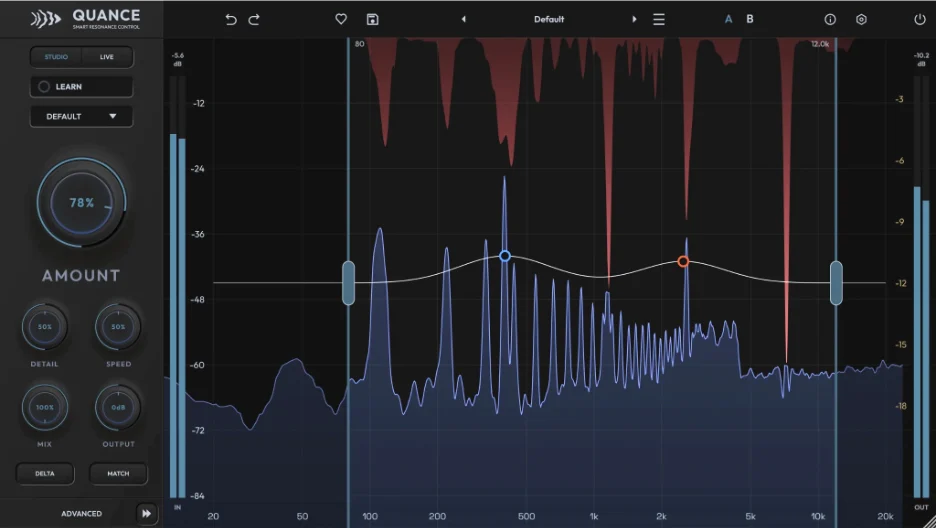
At its core, Quance is an intelligent resonance suppression plugin engineered to identify and attenuate problematic frequencies in real time. While many dynamic EQ and resonance-suppression tools on the market struggle with over-processing—often leaving audio sounding thin, phase-distorted, or lifeless—Quance takes a multi-dimensional approach to protecting the integrity of the source material.
Key Technical Specifications and Features:
- Automated Learn Function: Automatically scans audio material to identify prominent resonances and dynamically adapts detection ranges to suit the source.
- Granular Customization: Users can configure up to eight distinct focus points and four independent detection ranges, allowing for hyper-targeted frequency attenuation.
- Independent Protections: Features dedicated controls to safeguard transient responses and tonal content separately, ensuring punch and body remain intact.
- Dual Processing Engines & Five Quality Grades: Spanning from ultra-efficient modes to high-resolution algorithms, Quance adapts to various processing demands.
- Live Zero Mode: Offers zero samples of latency, making it entirely viable for live sound monitoring and tracking environments where delay is unacceptable.
- Studio Ultra Mode: Delivers maximum frequency resolution tailored for critical mixing and mastering applications.
- Automatic Loudness Matching: Facilitates seamless, level-consistent A/B comparisons so engineers can judge processing decisions objectively without being fooled by volume boosts.
- Targeted Operating Modes: Six specialized modes optimized for vocals, specific instruments, drums, and full stereo mixes.
- Advanced Routing & Monitoring: Includes sidechain unmasking, four stereo processing modes (including Mid-Side capabilities), and Delta monitoring to hear precisely what is being removed.
- Preset Library: Ships out of the box with 53 professionally crafted factory presets.
Chronology: From Concept to Commercial Launch
The journey of Quance spans years of iterative prototyping, rigorous field testing, and direct collaboration with high-profile audio professionals.
Phase 1: Identifying the Industry Gap
The project originated from a fundamental question posed by founder Gustavo Castelo: What if working audio engineers helped design resonance control tools from the ground up? Recognizing that many existing plugins were built entirely from a software developer’s perspective without enough real-world studio input, Castelo and the CodWaves team set out to rethink dynamic resonance suppression.
Phase 2: The Prototyping and Testing Loop
Instead of developing the plugin in isolation, CodWaves took an empirical, community-driven approach. Early prototypes were distributed directly to top-tier recording engineers, mix specialists, and producers. Every iteration of the plugin focused heavily on workflow efficiency and DSP performance. Feedback gathered during these testing rounds directly dictated feature updates, UI tweaks, and algorithmic enhancements.

Phase 3: Field Trials with Industry Elite
Before its public debut, Quance underwent months of stress-testing in professional production environments. Grammy-winning mixers and veteran sound engineers integrated the plugin into active sessions across various genres—ranging from heavy rock guitar busses to delicate vocal tracks. The overwhelmingly positive reception from these beta testers ultimately validated the software for commercial release.
Supporting Data and Technical Architecture
To understand why Quance performs differently than legacy suppressors, one must examine its underlying architecture. Traditional dynamic suppressors often rely on broad-stroke multi-band compression or static dynamic EQ bands that can introduce phase smearing or robotic artifacts when pushed hard.
Quance approaches frequency management through a dual-engine framework. By separating its workload across Live Zero and Studio Ultra engines, CodWaves has solved the classic dilemma of choosing between low-latency tracking performance and high-resolution mastering precision.
Furthermore, the implementation of Delta monitoring allows engineers to solo the exact audio being removed by the plugin. This transparency ensures that the processing is working only where needed, preventing unnecessary pumping or dulling of the audio signal. Coupled with Mid-Side processing capabilities, spatial imaging remains pristine, even when heavy resonance suppression is applied to the center channel of a crowded mix.
Official Responses and Producer Testimonials
The audio engineering community has responded to Quance with rare enthusiasm. CodWaves’ decision to involve elite producers early in the development cycle has clearly paid off, as evidenced by glowing endorsements from industry leaders.
Dom Morley, a Grammy-winning producer and mixer known for his work with legendary acts, praised the plugin’s musicality:

"Straight away it sounds better to me — it dealt with the harshness completely and the vocal is now warmer and rounder. […] It’s the best version of this technology I’ve heard."
Audio engineer Michael Costa highlighted the plugin’s ability to enhance source material naturally:
"Quance is one of those processors that does its cool thing but doesn’t make your audio suffer because of it. It makes tracks sound like they were recorded better than they were."
For instrumental and bus applications, sound engineer Ashton Parsons found the plugin indispensable:
"Quance is now permanently on my guitar bus, I can’t believe how it so precisely cleans up the signal without any hassle or needing to do a second learn pass, it’s right from the start! A+ tool!"
Reflecting on the collaborative development process, founder Gustavo Castelo noted:

"We looked at current tools and set out to improve them. Then we did what every developer should do: we shared our prototypes with top recording engineers and producers and asked how we could improve them. Every conversation focused on workflow and performance, and each round of feedback shaped the plugin. Quance is the result."
Implications for the Audio Industry
The release of Quance by CodWaves marks a significant milestone in the evolution of intelligent mixing assistants. As digital audio workspaces (DAWs) become increasingly crowded with AI-powered tools, engineers are frequently skeptical of "magic button" solutions that take control away from the user.
By striking a balance between automated intelligence (such as the Learn function and multi-point focus detection) and deep manual control (separate transient/tonal protections and multiple stereo routing modes), Quance avoids the trap of homogenization. Instead of dictating how a mix should sound, it acts as a high-precision scalpel, removing digital harshness and acoustic anomalies while empowering the engineer’s artistic vision.
For live sound engineers, the inclusion of a zero-latency mode opens up new possibilities for handling difficult vocal resonances and stage bleed in real time without sacrificing monitoring fidelity. Meanwhile, studio engineers gain a reliable, time-saving processor that cuts down session preparation time significantly.
As CodWaves establishes its footprint in the competitive audio plugin market with Quance, the company has set a high benchmark for developer-engineer collaboration. If Quance is any indication of the company’s future roadmap, CodWaves is well-positioned to become a major force in the advancement of professional audio signal processing tools.