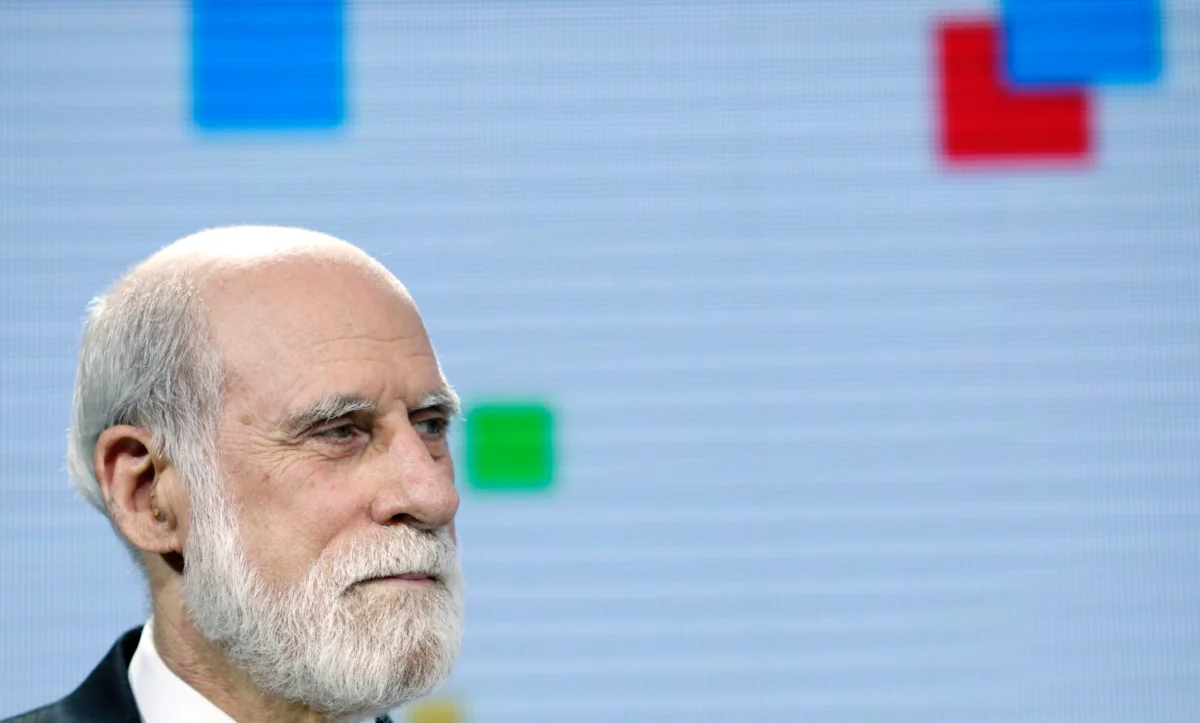
In the annals of modern technological history, few figures loom as large as Vinton “Vint” Cerf. Often heralded as one of the "fathers of the internet," Cerf has spent the better part of two decades as Google’s chief internet evangelist. Next week, that storied tenure will conclude, marking the retirement of an industry titan whose fingerprints are on the very infrastructure that defines 21st-century civilization.
The announcement was made during a poignant moment at the Open Frontier conference, hosted by the Laude Institute. As Cerf participated via video feed, he was honored by his longtime colleague and contemporary, UC Berkeley professor Dave Patterson.
"Vint has been at Google for more than 20 years, and he is retiring a week from today," Patterson remarked to a room filled with industry luminaries, calling for a round of applause for what he aptly described as a "relatively good career." The audience responded with a standing ovation, acknowledging a career that spanned the transition from experimental packet-switching to the global, omnipresent web. Google, for its part, has yet to issue a formal statement regarding the transition.
The Architect of the Digital Age: A Chronology
Cerf’s journey is not merely a corporate biography; it is the history of the digital revolution itself. Born in 1943, Cerf’s intellectual trajectory was set early. By the 1970s, while working alongside collaborator Robert Kahn, he co-developed the Transmission Control Protocol and the Internet Protocol (TCP/IP). These foundational rules allowed disparate computer networks to communicate, creating a unified “network of networks.”
- 1970s: The development of TCP/IP, the bedrock architecture of the internet.
- 1980s-1990s: Cerf played a critical role in the commercialization and expansion of the internet, working with organizations like MCI to build out early public network infrastructure.
- 2005: Cerf joined Google as vice president and chief internet evangelist, a role he used to advocate for open internet policy, digital inclusion, and the development of the "Interplanetary Internet."
- 2024: After 19 years at the helm of Google’s public-facing technology strategy, Cerf announces his retirement at age 83.
Throughout his life, his contributions have been recognized with the highest honors in science and society, including the Presidential Medal of Freedom, the Turing Award—often referred to as the Nobel Prize of computing—and a long list of honorary doctorates.
A Legacy of Open Infrastructure
At the Open Frontier conference, Cerf was joined by a panel of computer science heavyweights, including François Chollet (creator of the Keras deep-learning library), John Ousterhout (creator of the Tcl programming language), and Matei Zaharia (co-founder of Databricks).
The panel’s focus was on the durability of open-source systems. In an era where artificial intelligence is increasingly characterized by closed, proprietary models held by a handful of massive, well-resourced corporations, the participants discussed the vital importance of open infrastructure. Cerf’s presence served as a reminder that the most resilient technological breakthroughs—the ones that truly change the world—are rarely those kept behind walled gardens.
The Future: AI Agents and the Return of Standardization
While much of the conference dwelled on the centralization of power in AI, Cerf looked toward the horizon. He offered a bold prediction: the rise of "agentic" AI—software programs capable of acting autonomously and coordinating with other agents—will force the industry back toward the very principles of standardized protocols that birthed the internet.
"The agentic model of AI, with multiple agents from multiple sources interacting with each other, is going to force composability and a requirement for interoperability and standardization," Cerf argued.
This assertion carries significant weight. If Cerf’s vision holds, the tech sector is on the precipice of a new set of "protocol wars." Companies that establish the standards for how these AI agents communicate will effectively dictate the rules of the future digital economy.
The Fallacy of Natural Language
During the panel, other experts suggested that large language models (LLMs) might be able to communicate effectively through natural language. Cerf remained skeptical, pointing to the inherent ambiguity of human speech.
"I don’t think English is going to be the best choice," Cerf noted. "There’s a flexibility in it, but there’s ambiguity, and I think precision for inter-agent interaction is going to be very, very important. An agent really needs to be sure the other agent understands what it is that they just agreed to do together."
To illustrate his point, he invoked the classic "telephone game"—the children’s activity where a message becomes distorted as it is passed from person to person. "Imagine a bunch of agents talking to each other in natural language," he mused. "That’s kind of terrifying."
The Man Behind the Suits: A Cultural Icon
Beyond the code and the protocols, Vint Cerf is known for his distinct personal style. In a lighter moment during the conference, Dave Patterson recalled meeting a young, suit-clad Cerf in the 1970s. While his peers were embracing the counter-culture aesthetic of the era, Cerf stood out with his three-piece suits and impeccable grooming.
"He’s always been the best-dressed computer scientist I’ve ever met," Patterson said.
Cerf took the comment in stride, reflecting on his decision to intentionally deviate from the norms of his peers. "I even had a vest," Cerf laughed. "For some reason, I always wanted to stick out. Instead of having long hair and something in my nose, I thought just dressing differently was one way to do it."
Implications: The End of an Evangelist Era
As Cerf steps down from his post at Google, the tech industry faces a transition. His role as "chief internet evangelist" was unique; he functioned as a moral and technical compass for the company, keeping Google aligned with the ethos of an open, global, and accessible internet.
The primary implication of his departure is the loss of a foundational voice in the ongoing debate over the control of AI. As the industry moves from the "web era" to the "agentic AI era," the lessons Cerf provided—that open protocols and standardized interoperability are essential for growth—remain as relevant as ever.
Whether the next generation of technologists will follow his lead in prioritizing open systems over closed, proprietary ecosystems remains to be seen. However, as the industry grapples with the complexities of AI, the ghost of Vint Cerf’s philosophy will undoubtedly continue to influence the architectural decisions of the future.
Vint Cerf’s retirement is not just the end of a long, distinguished career at a major corporation; it is a moment to reflect on how one individual’s commitment to connectivity changed the human experience forever. As he departs the stage, he leaves behind a digital world that is, by his own definition, "fully evangelized"—now, it is up to the rest of the world to ensure that the infrastructure he helped build remains robust, open, and capable of fostering the next wave of human innovation.