Perched 1,700 meters above the historic town of Kitzbühel, Austria, the restaurant Hochkitzbühel bei Tomschy offers more than just a culinary experience; it provides a panoramic immersion into the heart of the Austrian Alps. As the sun sets behind the jagged peaks and the atmosphere shifts from the serene calm of high-altitude dining to the rhythmic intensity of an après-ski hub, the venue relies on a sophisticated, invisible backbone: a state-of-the-art K-array audio installation.
Designed and deployed by the integration firm LiveWire, this project stands as a benchmark in acoustic engineering, proving that high-energy DJ performances and background ambiance can coexist within the stringent environmental and regulatory constraints of a pristine mountain sanctuary.
The Challenge: Physics and Regulations in the Clouds
The installation at Hochkitzbühel presented a trifecta of challenges that would test the limits of any standard audio configuration. First, the interior architecture—characterized by a complex interplay of wood flooring and expansive glass partitions—created a nightmare scenario for sound engineers, where reflections and standing waves threatened to turn high-fidelity audio into a muddled acoustic echo.
Second, the venue’s location necessitates absolute compliance with local noise ordinances. In the quiet solitude of the Austrian Alps, sound travel is amplified, and the risk of noise pollution leaking into the surrounding environment is significant. The system needed to provide "punchy", clear audio for guests while effectively "locking" that sound within the venue’s four walls.
Finally, the environmental factor was paramount. Mountain venues are subject to extreme weather: heavy snow, high-velocity winds, intense UV radiation, and rapid, drastic temperature fluctuations. The hardware had to be as rugged as it was refined.
A Technical Symphony: The K-array Architecture
To solve these multifaceted challenges, LiveWire turned to the Italian manufacturer K-array, known for its unique approach to slim-profile, high-output line arrays. The resulting system is a masterclass in controlled dispersion.
Mastering the Interior Acoustics
Inside the main lounge, the design team avoided bulky, traditional speaker cabinets that would have disrupted the venue’s aesthetic. Instead, they deployed multiple Python KP52 discreet line array loudspeakers. The strength of the KP52 lies in its ability to offer controlled vertical dispersion. By narrowing the vertical output, the system effectively reduces the energy directed toward the ceiling and floor, significantly minimizing the reflections that plague glass-heavy environments. This ensures that the audio remains crisp, intelligible, and punchy, even when the venue hits maximum capacity.
To provide the necessary headroom for DJ sets, Dragon KX12 loudspeakers were strategically placed near the DJ booth. These units provide the "impact" required for modern music, while a combination of Thunder KS1 and KS3 subwoofers provides the low-frequency reinforcement that anchors the musical experience. Crucially, the system includes dedicated monitoring for the DJs, allowing them to perform at their best without the need for excessive stage volume—a vital balance for maintaining control over the room’s sound pressure levels.
The Terrace: Precision in the Open Air
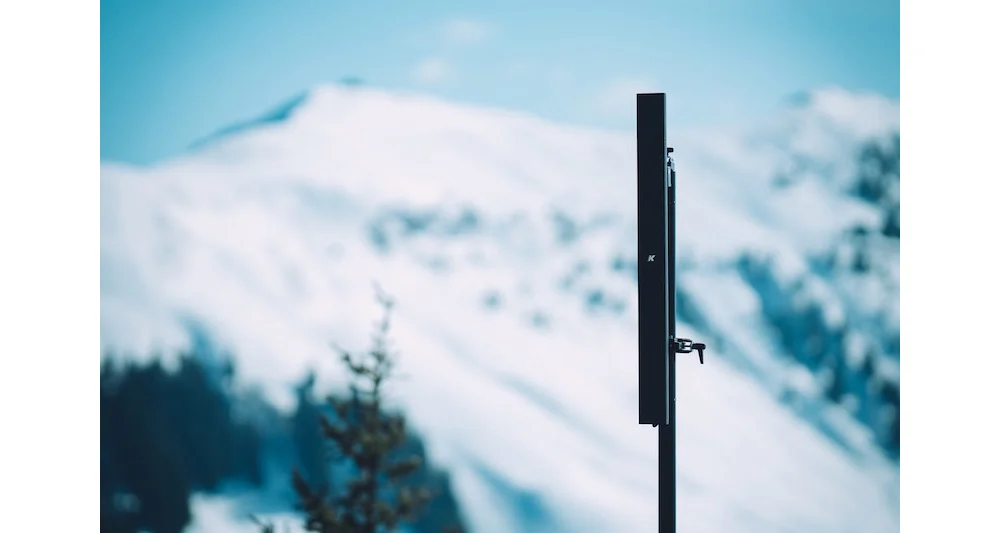
The outdoor terrace presented the most significant regulatory hurdle. With an unobstructed view of the Alpine landscape, sound easily travels for miles. To address this, the team utilized Python KP102 column loudspeakers. These units are celebrated for their ability to provide tight horizontal coverage with narrow, directed vertical dispersion. By "aiming" the sound strictly at the terrace area, the system minimizes spill, ensuring the music stays where the guests are and doesn’t drift into the surrounding Alpine valleys. The low-frequency footprint is managed by Rumble KU315 subwoofers, which are tucked away to provide bass reinforcement that remains within the defined venue boundaries.
Environmental Resilience
Durability was not an afterthought; it was a foundational requirement. Because the equipment is exposed to the harsh realities of a 1,700-meter elevation, all components underwent K-array’s proprietary marine-grade treatment. This specialized coating protects the internal drivers and circuitry from moisture, corrosion, and the extreme thermal cycling common in the Austrian Alps, ensuring that the system remains reliable regardless of the season.
Chronology: From Concept to Après-Ski Reality
The project began with a comprehensive acoustic modeling phase, where LiveWire mapped the restaurant’s layout to predict how sound would interact with the specific materials of the building.
- Phase I (Site Assessment): Analysis of the acoustic reflective indices of the wood and glass. Defining the "sound leakage" perimeter to comply with local authorities.
- Phase II (Hardware Selection): The decision to prioritize K-array’s line array technology to maximize "throw" while maintaining narrow dispersion patterns.
- Phase III (Integration): The installation of the Kommander KA68 amplifier and Q-SYS control platform. This phase was critical for enabling the "one-touch" transition between dining and party modes.
- Phase IV (Calibration): On-site tuning of the DSP (Digital Signal Processing) to align delays and crossover points, ensuring that the sound from the terrace and the lounge would be phase-coherent.
- Phase V (Commissioning): Testing under various occupancy loads to ensure the system behaved as expected when the room was full of guests.
Intelligence at the Core: Control and Processing
The hardware is only as good as the brain driving it. At the center of the Hochkitzbühel system is the Kommander KA68 amplifier, which features integrated DSP. This unit serves as the nerve center for the entire installation, managing complex crossover points, time-delay alignments, and individual zone levels.
Integration with a Q-SYS platform provides the staff with a seamless user interface. With a simple touch, the venue staff can toggle between distinct "scenarios." During the day, the system is calibrated for soft, ambient background music that facilitates conversation. As the afternoon progresses toward the après-ski hour, the system shifts into a high-fidelity performance mode, boosting the low-end frequencies and increasing volume in specific zones to create an energetic, club-like environment.
Official Perspectives: The Philosophy of Sound
Trevor Davison, Company Director at LiveWire, emphasizes the precision required for such a project. "Mountain venues like bei Tomschy demand a very precise approach to sound design," Davison notes. "You are dealing with high expectations from guests who want to be immersed, and high expectations from the local community who want to preserve the tranquility of the Alps. Using K-array’s controlled dispersion technology, we were able to thread that needle—delivering an energetic DJ environment that stays focused exactly where we need it to be."
For owner Christoph Tomschy, the audio system is not merely an accessory; it is an essential part of the guest experience. "Bei Tomschy is a truly special place," Tomschy says. "At 1,700 meters, we offer guests an experience like no other. During the day, people dine and take in the breathtaking views, then by night the DJ takes the stage and the whole place comes alive. The K-array system is at the heart of it all. It gives us the precise, powerful audio we wanted while respecting the beautiful environment we are so proud to be part of."
Implications: The Future of High-Altitude Audio
The Hochkitzbühel bei Tomschy installation serves as a case study for the future of hospitality sound design in sensitive locations. It demonstrates that the conflict between high-energy entertainment and noise control can be resolved through high-end engineering rather than through compromised, low-volume systems.
As Alpine destinations continue to evolve into year-round luxury hubs, the ability to provide high-quality audio that respects the environment will become a competitive advantage. By investing in controlled-dispersion technology and robust, weather-resistant hardware, venue owners can ensure that their businesses remain compliant with regulations while consistently exceeding the sonic expectations of their clientele.
In the case of bei Tomschy, the result is a seamless fusion of nature and technology—a place where the bass drops, the views soar, and the sound remains perfectly, and remarkably, contained.