In the high-stakes world of professional audio, the difference between a world-class sonic experience and a flawed installation often comes down to a single, critical variable: the accuracy of the room model. Recognizing that traditional architectural blueprints frequently fail to capture the nuances of a finished venue, L-Acoustics has officially launched "Digital Construction," a sophisticated new LiDAR-based service designed to provide a verified geometric foundation for Soundvision modeling and system design.
The service, set to be a focal point of the L-Acoustics presence at InfoComm 2026 in Las Vegas (Booth N6336), promises to eliminate the "guesswork" that has long plagued audio engineers and venue owners alike. By marrying advanced laser scanning technology with the company’s proprietary acoustic simulation software, Digital Construction aims to set a new industry benchmark for precision.
The Problem: The Disconnect Between Paper and Reality
For decades, the standard workflow for designing a sound system has relied on architectural CAD drawings or PDF floor plans. While these documents are essential for construction, they are rarely updated to reflect the reality of a space after years of renovations, retrofits, and minor modifications.
"Every sound system design starts with a model of the space," notes the engineering team at L-Acoustics. "That model is only as accurate as the information behind it."
When a design rests on inaccurate geometry, the consequences are rarely immediate but often devastating. Discrepancies between the virtual model and the physical space frequently lead to:
- Acoustic Disparity: Coverage patterns that behave differently than predicted in simulation.
- Rigging Conflicts: Loudspeaker arrays that physically fail to fit into the intended structural gaps or conflict with existing lighting and HVAC infrastructure.
- Installation Delays: Costly, last-minute changes that occur on-site, requiring emergency re-engineering and logistical pivots.
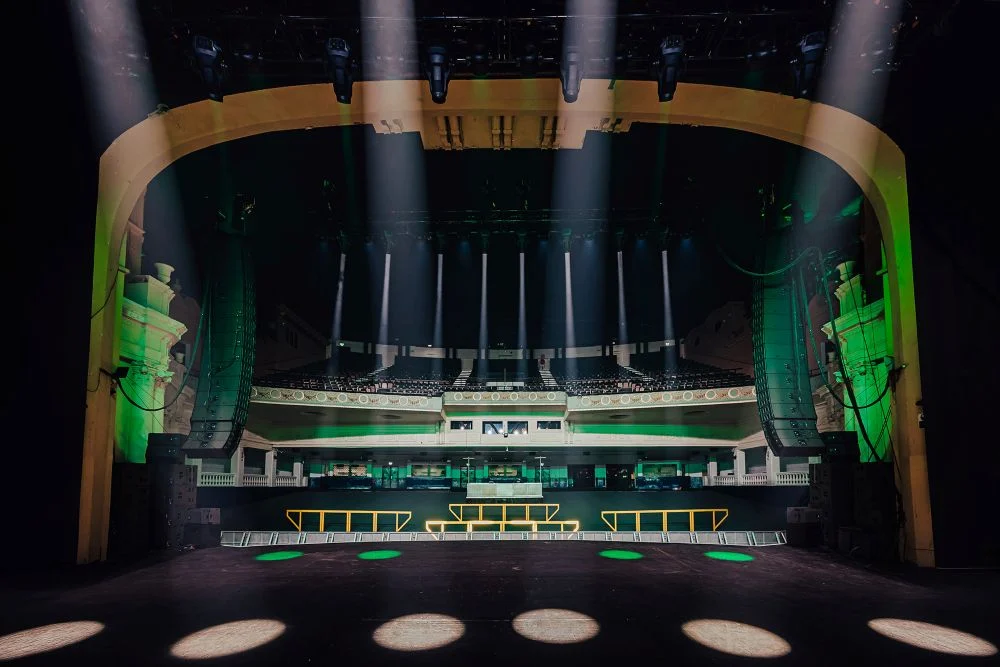
These challenges are particularly acute in historic venues or buildings that have undergone multiple refurbishments, where "as-built" documentation is either non-existent or dangerously outdated.
How It Works: The LiDAR Advantage
Digital Construction is not merely a data-capture service; it is a systematic, high-resolution approach to venue mapping. The process begins with an on-site visit by an L-Acoustics application engineer.
Unlike consumer-grade LiDAR tools—which are often limited to a five-meter range and struggle to capture the scale of concert halls or stadium bowls—L-Acoustics employs professional-grade handheld scanners capable of mapping large-scale environments with sub-centimeter precision. The process records the entire room, including complex geometries such as stage areas, multi-tiered balconies, and the intricate spaces that connect them.
The workflow is structured into a rigorous, standardized process:
- On-Site Scanning: Engineers capture high-density point-cloud data of the venue’s entire interior.
- Standardized Processing: The raw scan data is run through a proprietary workflow that incorporates quality checks at every stage, ensuring consistency regardless of whether the site is an intimate club or a 50,000-seat stadium.
- Dual-Deliverable Generation: Clients receive two distinct files: a detailed point-cloud file for their own archival reference, and a simplified, "Soundvision-ready" model optimized for immediate acoustic simulation.
This approach effectively bypasses the limitations of manual measurement, which is prone to human error, and P2P (point-to-point) laser methods, which often miss the fine architectural details that can influence sound propagation.
Chronology of Development: From Concept to InfoComm 2026
The development of Digital Construction follows years of internal observation within L-Acoustics. Seeing their Certified Providers and AV consultants struggle with "dirty" data, the company began piloting remote and on-site scanning solutions to support high-profile installs.
- Early 2024: L-Acoustics begins internal testing of handheld LiDAR scanning in European venues to refine the translation of point-cloud data into Soundvision-compatible geometry.
- Late 2024: The "Digital Construction" service model is formalized, focusing on streamlining the handoff between scan data and acoustic software.
- Mid-2025: Beta testing with select global partners reveals a marked reduction in site-visit revisions and installation-day conflicts.
- June 2026 (InfoComm): Official public launch of the service, positioning it as an essential component of the modern AV design lifecycle.
Official Perspective: The Impact on Acoustic Integrity
According to Asher Dowson, Director of Product Management, Services at L-Acoustics, the importance of this service extends beyond simple structural alignment—it fundamentally changes the performance of the audio system itself.
"In addition to pure design problems, the issues caused by inaccurate drawings also mean that the Autofilter algorithm takes into account those inaccuracies," Dowson explains. "This can result in suboptimal front-to-back tonal and level balance. Digital Construction brings total accuracy to the foundational geometry for which a system design is produced, ensuring each client receives the absolute best result possible."
Dowson emphasizes that by providing an "as-built" reference, the service allows the Soundvision software to operate at its peak potential. When the software understands the room exactly as it exists, the resulting calibration, filtering, and deployment are inherently more accurate, leading to a more consistent experience for every listener in the venue.
Implications for the Future of AV Design
The introduction of Digital Construction has significant implications for the wider AV industry.
Reducing Risk for Stakeholders
For AV consultants and system integrators, the service serves as an insurance policy. By verifying the geometry before the first loudspeaker is specified, the risk of "late surprises"—such as unexpected ceiling structures or unforeseen sightline conflicts—is significantly mitigated. This predictability allows for more accurate budgeting and tighter timelines.
Creating a Living Venue Database
An accurate model of a venue does not merely serve a single project; it becomes a long-term asset. As these venues grow their digital archives, future upgrades become easier to plan. Communication between architects, venue owners, and sound designers becomes clearer, as all parties are referencing the same "source of truth." Furthermore, this data contributes to the expanding global L-Acoustics venue database, providing a growing wealth of knowledge for designers worldwide.
Integration with Existing Workflows
L-Acoustics has taken care to ensure that Digital Construction integrates seamlessly with existing tools. It is designed to work in tandem with the current Soundvision ecosystem and the company’s existing Architectural Drafting services. Whether a firm is using a Certified Provider or an in-house design team, the Digital Construction service acts as a "pre-design" layer, ensuring the starting point is as solid as the foundation of the building itself.
Conclusion: A New Standard for Professional Venues
As venues become increasingly complex and production requirements more demanding, the need for precision has never been higher. By professionalizing the process of venue scanning, L-Acoustics is moving the industry away from reliance on legacy documents toward a future defined by data-driven accuracy.
The Digital Construction service is officially available as of the opening of InfoComm 2026. For venue owners, consultants, and integration partners, this represents a significant shift in how space is perceived, measured, and ultimately transformed into a high-performance audio environment.
For those attending InfoComm 2026, the L-Acoustics team will be providing live demonstrations of the scanning workflow and the resulting models at booth N6336, offering a firsthand look at the next evolution in sound system design. For those unable to attend, detailed service information is available through the official L-Acoustics website.