By Marcelo
Published by Headfonics
Main Facts: The FiiO QX11 at a Glance
The portable audio market has long been saturated with compact dongle DACs that trade performance for convenience, or power for portability. FiiO, a brand renowned for pushing the envelope of personal audio engineering, has entered the fray with a device that challenges these compromises. Priced at an accessible $159.99, the FiiO QX11 is a USB-powered portable DAC and headphone amplifier designed to bridge the gap between pocket-friendly mobile audio and heavy-duty desktop amplification.

At its technical core, the QX11 leverages a sophisticated internal architecture featuring dual ES9069Q DAC chips working in tandem with dual OPA1692 and quad OPA1622 Texas Instruments operational amplifiers. This parallel layout enables true balanced conversion and amplification, supporting high-resolution audio formats up to 32-bit/768kHz PCM and native DSD512 decoding.
What truly sets the QX11 apart from its predecessors—such as the popular KA11, JIEZI, and Melody models—is its hybrid operational philosophy. In standard portable mode, it pushes a robust 360mW + 360mW per channel, which is more than enough to drive 99% of in-ear monitors (IEMs) on the market to punishingly loud volumes. However, by engaging its dedicated Desktop Mode and connecting an external USB-C power source supporting up to 45W Power Delivery (PD) fast charging, the output surges to a staggering 800mW + 800mW.

Combined with a vibrant 1.14-inch IPS LCD screen, a multi-function physical volume knob, dual USB-C ports, an integrated microphone with AI ENC (Environmental Noise Cancellation), and specialized UAC 1.0/2.0 gaming modes, the QX11 presents an overwhelmingly comprehensive feature set for audiophiles and gamers alike.
Chronology of Innovation: FiiO’s Evolution in Portable Audio
To understand the engineering leap represented by the QX11, it is essential to trace FiiO’s recent trajectory in the portable DAC space.

- The Early Form-Factor Pioneer: Years ago, FiiO established its dominance in the ultra-portable category with devices like the KA11. Touted as one of the most powerful small-form-factor 3.5mm adapters available at the time, it proved that high-output audio could fit inside a thumb-sized chassis.
- Expanding the Lineup: Over subsequent release cycles, FiiO experimented with various form factors, sound signatures, and price points. Models like the JIEZI and the Melody explored warmer sonic colorations and minimalist designs, catering to listeners who favored analog-like smoothness over clinical precision.
- The Convergence Era (Present Day): With the QX11, FiiO seeks to synthesize its learnings. Rather than forcing users to choose between a dedicated desktop stack and an on-the-go dongle, the company engineered a modular power delivery system. By incorporating a secondary USB-C port dedicated solely to power injection, FiiO solved the historical thermal and electrical limitations that plagued high-power dongle DACs. The review sample arrived running firmware version V1.5, showcasing an already mature software environment that integrates seamlessly with the FiiO Control App.
Supporting Data: Hardware, Design, and Audio Performance
Hardware Architecture and I/O Layout
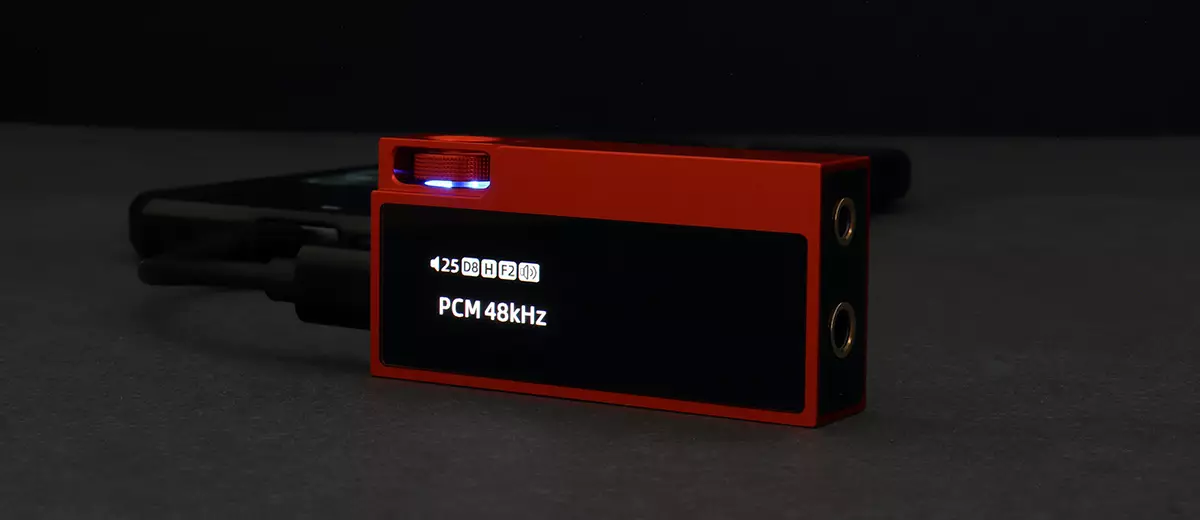
The physical layout of the QX11 reflects an industrial, futuristic design language characterized by clean straight lines and an angular, multifaceted rectangular chassis. Constructed from anodized metal—available in sophisticated finishes such as green and silver—the device balances rugged durability with aesthetic appeal. A subtle carbon-fiber pattern adorns the rear panel, while the front is dominated by a crisp, high-contrast 1.14-inch IPS LCD screen (135 x 240 pixels).
The display provides vital telemetry, including current volume levels, signal types, sampling rates, and active EQ modes. While not touch-sensitive, its brightness is adjustable and remains legible even under harsh outdoor lighting.

The I/O arrangement is cleverly bifurcated:
- Top USB-C Port: Handles data transmission from the host device (smartphone, laptop, or digital audio player).
- Left USB-C Port: Dedicated to power input, enabling 45W PD fast charging to both fuel the QX11’s desktop mode and simultaneously charge the connected host phone.
- Bottom Outputs: Traditional 3.5mm single-ended and 4.4mm balanced headphone jacks.
- Right-Side Controls: A tactile, knurled rotary volume knob that also acts as a clickable menu navigator, accompanied by a slide switch for desktop mode and a programmable push-button switch.
Sound Impressions and Sonic Signature
Initial expectations for an ESS-based DAC often lean toward a bright, analytically cold, or overly forward upper-midrange presentation. However, the QX11 breaks this mold.

- Bass Response: Reminiscent of FiiO’s flagship high-end digital audio players (such as the M15S, M17, and M33 R2R), the QX11 delivers a tight, punchy, and impeccably clean low-end. The bass adds organic presence and physical energy without resorting to artificial warmth. It possesses the authoritative control typically associated with dedicated desktop gear rather than budget dongles.
- Midrange and Treble: Both registers maintain a high degree of neutrality. There is no fatiguing upper-midrange shoutiness. Instead, the QX11 exhibits a minute elevation in upper-treble energy that enhances the transient bite and micro-detail retrieval of complex instrumentation. Timbral accuracy remains intact, offering transparent insights into complex mixes without sounding sterile.
- Soundstage and Dynamics: Rivaling devices well above its price class, the QX11 projects a wide, clean, and transparent soundstage. Paired with its muscular output architecture, dynamic swings are handled with effortless authority. Whether driving sensitive IEMs or demanding planar and dynamic over-ear headphones, the device maintains composure, avoiding congestion during dense orchestral or electronic passages.
Official Responses and Ecosystem Integration
FiiO’s software ecosystem plays a vital role in unlocking the QX11’s full potential. The device is fully compatible with the FiiO Control App, available on both iOS and Android platforms, alongside web-based Auto EQ utilities.
According to FiiO’s product documentation and user feedback compiled during testing:

- Fuss-Free Pairing: The QX11 registers immediately within the FiiO Control App upon device addition, eliminating the pairing frustrations common with third-party Bluetooth or Wi-Fi audio accessories.
- Granular Customization: Users can deploy custom parametric and graphic equalization profiles directly to the device’s onboard memory, adjusting filters, gain structures, and display themes without needing third-party digital signal processing apps on the host device.
- Firmware Stability: Out-of-the-box performance on firmware V1.5 proved entirely stable, requiring no emergency patches during extended evaluation periods across multiple operating systems (Windows, macOS, Android).
Implications for the Portable Audio Market
The launch of the FiiO QX11 at a competitive $159.99 price point carries significant implications for the personal audio industry.
- Blurring the Lines Between Portable and Desktop: For years, consumers required a dedicated desktop amplifier to drive power-hungry planar magnetic or high-impedance dynamic headphones. The QX11’s dual-USB-C architecture proves that a pocket-sized dongle can deliver desktop-tier muscle (800mW per channel) when tethered to a wall charger, effectively replacing two distinct audio chains for mobile professionals and hybrid desk workers.
- The Rise of Feature-Rich Multifunctional DACs: Beyond pure music consumption, the inclusion of hardware gaming modes (with UAC 1.0 compatibility for legacy consoles and PCs), an onboard microphone with AI ENC, and granular Auto EQ app support transforms the QX11 from a passive DAC into an active communication and gaming hub.
- Consumer Value Realization: At $159.99—inclusive of a high-quality leather carrying case, robust multi-impedance drive capability, and dual-DAC fidelity—the QX11 sets a new benchmark for what budget-conscious audiophiles should expect from portable source gear. It successfully democratizes high-end architectural design elements, proving that flagship-inspired sound quality is no longer exclusive to four-figure audio gear.