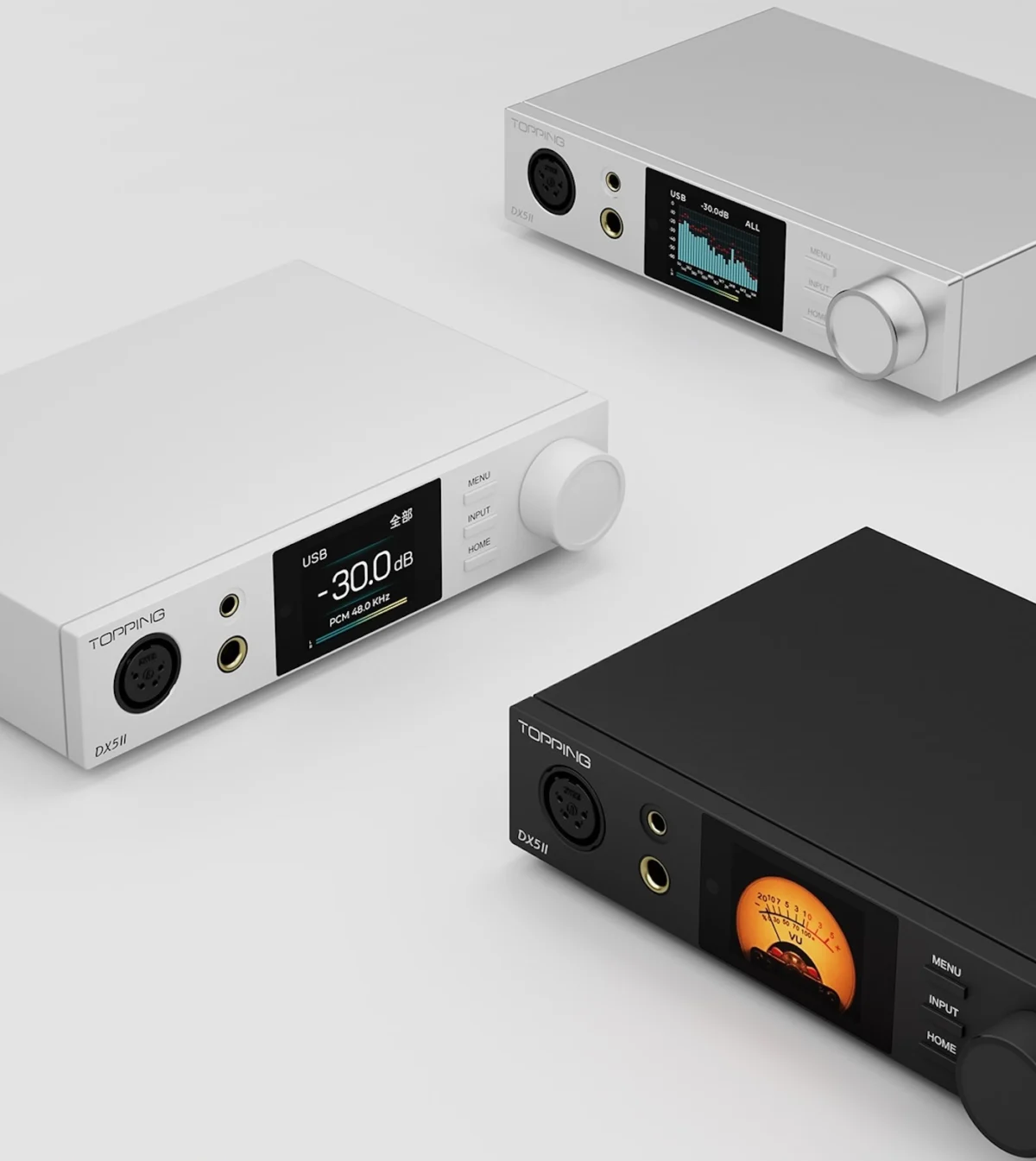
In the rapidly evolving landscape of high-fidelity audio, the "law of diminishing returns" is a concept that often haunts audiophiles. We are conditioned to believe that to achieve state-of-the-art transparency, pinpoint imaging, and sub-threshold distortion levels, one must invest thousands of dollars into boutique, heavy-chassis components. However, for years, the Chinese manufacturer Topping has been systematically dismantling this narrative. Their latest offering, the DX5 II, serves as a masterclass in modern engineering, proving that elite-level digital-to-analog conversion and robust amplification can be delivered at a sub-$300 price point without compromising on build quality or feature sets.
Main Facts: The Evolution of Value
The Topping DX5 II is a compact, multifaceted DAC and balanced headphone amplifier that stands as the latest iteration of the company’s relentless pursuit of ESS Sabre perfection. At its core, the device utilizes dual ESS Sabre ES9039Q2M DAC chips, a choice that underscores its commitment to technical precision.
Beyond its silicon, the DX5 II is designed for the modern listener. It features a 10-band parametric equalizer (PEQ), Bluetooth 5.1 connectivity with the high-resolution LDAC codec, and a proprietary "Aurora" user interface displayed on a crisp, 2-inch full-color screen. Perhaps most notably, it manages these feats while maintaining THD+N levels of <0.00008% (RCA) and <0.00006% (XLR), figures that place it among the most linear and clean-sounding devices in its class. With a robust internal power supply—eschewing the common "wall-wart" approach—it is a device that feels as substantial as it sounds.

A Chronological Perspective: The Topping Trajectory
To understand the significance of the DX5 II, one must look at the decade-long history of Topping’s presence in the enthusiast market. Ten years ago, the brand was a niche player, known primarily for budget-conscious entry-level amplifiers. Over the subsequent years, their rapid cycle of R&D and implementation of ESS technology allowed them to iterate at a pace that left traditional legacy audio brands struggling to keep up.
The release of the original DX5 set a high bar for the "all-in-one" category, but the DX5 II represents a refinement of that philosophy. Throughout the development cycle, Topping has moved from focusing solely on "measured performance" to integrating a more holistic user experience. The inclusion of the "Aurora" UI, the move to an integrated IEC power supply, and the implementation of user-configurable filters and PEQ functions reflect a manufacturer that has graduated from merely "crunching numbers" to solving the practical needs of the end user. The DX5 II is not just a revision; it is the culmination of years of feedback from the audiophile community, refined into a chassis that fits on a desktop but performs like a centerpiece.
Supporting Data: Technical Prowess
The DX5 II is not just about features; it is a performance beast. The headphone output stage is particularly impressive, delivering 7600mW x 2 at 16Ω and 990mW x 2 at 300Ω. This versatility ensures that the unit can drive everything from sensitive In-Ear Monitors (IEMs) to power-hungry, high-impedance planar magnetic headphones without breaking a sweat.

Key Specifications Table
| Feature | Specification |
|---|---|
| DAC Chipset | Dual ESS Sabre ES9039Q2M |
| Output Power (32Ω) | 6400mW x 2 |
| Dynamic Range (XLR) | 132dB |
| EQ Capability | 10-Band Parametric |
| Connectivity | USB, Optical, Coaxial, Bluetooth 5.1 |
| Outputs | 6.35mm SE, 4.4mm Bal, 4-pin XLR Bal |
The inclusion of eight distinct digital filters—spanning various roll-off characteristics—allows the listener to subtly tailor the high-frequency response to their preference. While the default "minimum phase" filter proved to be the most balanced for general use, the ability to switch these via the included remote control highlights the unit’s flexibility.
In Use: The Auditory Experience
The real test of any audio component is how it interacts with source material. Testing the DX5 II involved two distinct environments: high-resolution streaming via a Bluesound Node Nano and home theater integration via a Sony Bravia OLED.
When listening to the complex, microtonal arrangements of Quebecois duo Angine de Poitrine (ADP), the DX5 II showcased its ability to handle "chaotic" music with poise. Tracks like "Utzp" require a DAC that can maintain the integrity of rapid-fire drum transients while keeping the discordant, microtonal guitar textures distinct. The DX5 II managed this effortlessly, creating a soundstage that felt both expansive and intimate. It is rare for a device at this price to render the "volcanic energy" of prog-rock without sounding clinical or fatiguing, yet the DX5 II achieved a rare balance of technical surgicality and musical engagement.

In a cinematic context, the DAC proved equally adept. Watching the suspense-driven series Your Friends and Neighbors, the DX5 II excelled in micro-dynamic shifts. The device handled the subtle nuances of hushed dialogue—where clarity often gets buried by ambient background noise—with startling realism. It created a phantom center channel so precise that one could easily track the movement of a whisper as it shifted across the soundstage.
Official Perspectives and Industry Implications
While Topping has not issued a formal "manifesto," their product trajectory speaks volumes. By aggressively pushing the boundaries of what is possible at a sub-$300 price point, they are forcing the industry to reconsider the value proposition of high-end audio.
Industry analysts suggest that the DX5 II poses a significant challenge to mid-tier audio manufacturers. When a $300 unit can offer balanced circuitry, high-end ESS conversion, and the power to drive almost any headphone on the market, the justification for $1,000+ DACs becomes increasingly reliant on brand cachet or aesthetic luxury rather than pure sonic performance. The implication for the consumer is clear: we are living in a "Golden Age" of audio accessibility.

Final Analysis: The Verdict
The Topping DX5 II is, by any metric, a monumental achievement in audio engineering. It is rare to encounter a product that leaves so little room for criticism.
Strengths:
- Unrivaled Value: It offers features and performance usually reserved for units costing three to four times as much.
- Build Quality: The anodized aluminum chassis and integrated power supply provide a sense of durability and reliability.
- Versatility: With its diverse headphone outputs and comprehensive I/O, it functions as the perfect hub for both desktop and living room systems.
- Precision: The sonic transparency is beyond reproach, providing a clean, "wire with gain" experience that allows the music to dictate the character of the playback.
Areas for Consideration:
While the device is nearly flawless, power users might eventually desire even deeper DSP control or perhaps a more robust mobile app interface for the PEQ settings. However, for 99% of the target audience, the current feature set is more than sufficient.

In an economic climate where the cost of living continues to rise, the Topping DX5 II stands as a beacon of reason. It is a device that does not demand a sacrifice in quality for the sake of affordability. It is not merely a "good budget option"—it is a premier audio component that happens to be priced for the masses. For anyone looking to elevate their digital listening experience, the DX5 II is, unequivocally, a no-brainer. It dissolves the barriers between the listener and the artist, proving that state-of-the-art performance is no longer a luxury, but an expectation.