By Audiophile Review Staff
Published August 2026
Main Facts: The Anatomy of the Nagra Compact Player
For decades, Swiss manufacturer Nagra has been synonymous with the absolute pinnacle of audio engineering. From their legendary portable analog tape recorders used by field recordists and broadcast journalists worldwide, to their ultra-luxurious, no-compromise reference-grade home audio components, the brand has commanded a mythical status among audiophiles. Now, Nagra is pushing the boundaries of what is possible in a micro-form-factor chassis with the introduction of the Nagra Compact Player.
Measuring a remarkably diminutive 7.2 x 6.5 x 1.6 inches, the Compact Player is precision-engineered to match the exact physical dimensions of its sibling, the Nagra Compact Phono stage. Despite its featherweight footprint, this single-purpose digital streaming DAC punches vastly above its weight class, delivering reference-grade sonic performance that rivals—and in some cases surpasses—digital front-ends many times its size and cost.
Key features and specifications of the Nagra Compact Player include:
- Form Factor: Ultra-compact aluminum chassis matching the Nagra Compact Phono (7.2 x 6.5 x 1.6 inches).
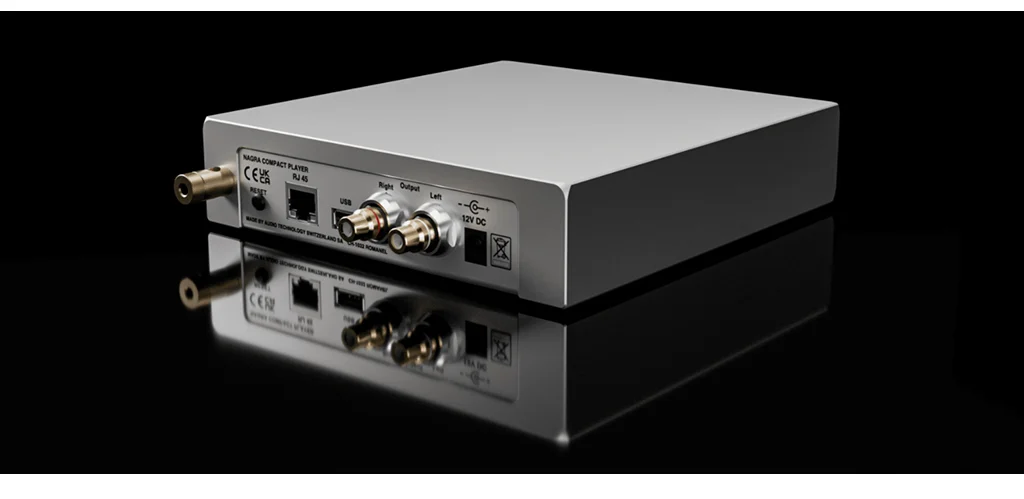
- Connectivity: RJ-45 Ethernet port for network streaming and a USB input designated for external hard drives or USB memory sticks.
- Ecosystem Compatibility: Fully Roon Ready, supporting fast, seamless integration into existing network environments.
- Resolution Support: Full native DSD capability alongside high-resolution PCM playback (ranging from standard 16-bit/44.1kHz up to 24-bit/192kHz).
- Power Supply Integration: Ships with a high-performance external power supply, with clear upgrade paths to the Nagra Compact PSU, MPS, or Classic PSU units.
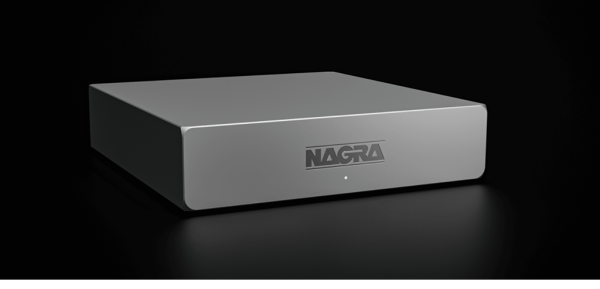
- Minimalist Design Philosophy: Completely switchless design. The unit remains powered on permanently once connected, indicated only by a single, subtle status LED.
Chronology: From Field Recorders to Micro-High-End Digital
To understand the engineering achievement behind the Compact Player, it is vital to look at the historical trajectory of Nagra (Nagra-Kudelski), a company founded in 1951 by Stefan Kudelski.
The Analog Legacy (1951–1990s)
Nagra’s early fame was built entirely on miniaturization and uncompromising reliability. The original Nagra III recorder revolutionized film and broadcast audio by fitting studio-quality reel-to-reel performance into a portable, battery-powered leather bag. Kudelski’s obsessive dedication to mechanical precision, ultra-low noise floors, and modular circuit topologies set a gold standard that lasted for decades.
The Pivot to High-End Consumer Audio (1990s–2020s)
As the professional market shifted, Nagra brought its formidable engineering talent into the high-end consumer audio space. Launching iconic products like the PL-P tube preamplifier and later the HD DAC series, the brand proved that high-performance audio did not have to mean massive, unmanageable chassis sizes—though many of their reference monoblocks certainly gravitated toward the heavier end of the scale.
The Birth of the Compact Series (2025–2026)
Recognizing a growing segment of audiophiles who desire uncompromising sound quality without dedicating an entire room or massive equipment racks to a sound system, Nagra conceptualized the "Compact" line. Following the success of the Compact Phono stage, engineers faced the ultimate digital challenge: Could they distill Nagra’s proprietary digital-to-analog conversion architecture and streaming algorithms into a chassis smaller than a hardcover book without introducing digital noise, jitter, or power supply compromises?
The result is the Nagra Compact Player, which made its debut in mid-2026, instantly capturing the attention of minimalist audiophiles and space-conscious high-end enthusiasts.
Supporting Data and Technical Analysis
In high-end audio, the phrase "less is more" is frequently tossed around as marketing hyperbole. With the Nagra Compact Player, however, the philosophy is baked into the very physical architecture of the hardware.
Stripping Away the Non-Essential
How did Nagra achieve such staggering performance in such a small enclosure? The secret lies in brutal, surgical simplification. Nagra’s engineers distilled the digital playback pipeline down to its absolute bare minimum.
- No Power Switch: In a move that challenges traditional consumer electronics conventions, the Compact Player features no physical power switch. Users simply plug it in and leave it energized.
- Streamlined Signal Path: By eliminating complex front-panel displays, multi-source switching relays, and extensive internal wiring, the internal signal path is kept vanishingly short. This dramatically reduces potential electromagnetic interference (EMI) and radio frequency interference (RFI) within the chassis.
Digital Architecture and Roon Integration
During initial evaluations, critics and early reviewers noted the astonishingly frictionless setup process. Utilizing its Roon Ready certification, the Compact Player initializes and connects to a home network in approximately 25 seconds:
- Connect the external power supply.
- Attach an Ethernet cable to the RJ-45 port.
- Open the Roon application, navigate to settings, and click "Enable" on the newly discovered Nagra endpoint.
While the unit boasts native DSD processing capabilities, extensive evaluation has demonstrated breathtaking results playing standard 16-bit/44.1kHz Redbook audio up to heavy 24-bit/192kHz high-resolution files via Roon.
Connectivity Trade-Offs
To maintain its microscopic footprint and circuit purity, certain compromises had to be made. Notably, the unit lacks an S/PDIF (coaxial or optical) digital input or an AES/EBU balanced digital connection.
- The Limitation: Users cannot plug a dedicated external CD transport or legacy digital streamer directly into the Compact Player’s DAC.
- The Rationale: Adding multiple digital receiver chips, multiplexers, and physical input ports would have exponentially increased internal circuit complexity, degraded the signal path, and necessitated a larger power supply footprint. For its intended application as a pure network player and local USB storage host, the RJ-45 and USB layout is deliberately focused.
Power Supply Scalability
Out of the box, the Compact Player’s stock external power supply delivers a remarkably black background and dynamic punch. However, Nagra’s modular design philosophy shines through its power upgrade path. Owners can upgrade their setup by integrating the dedicated Nagra Compact PSU. Furthermore, audiophiles who have already invested in Nagra’s high-end MPS or Classic PSU external power supply units can directly plug the Compact Player into these massive, heavily regulated power stations, unlocking an entirely new tier of micro-dynamics, soundstage depth, and textural realism.
Official Responses and Expert Impressions
Early critical response from industry veterans has been overwhelmingly enthusiastic. Jeff Dorgay of TONEAudio, who spent extensive preliminary time with the unit, noted the unique positioning of the device within the luxury audio market:
"If you’re thinking ‘how can Nagra get so much performance out of such a small box?’ The reason is simple. They have distilled the functionality down to the absolute minimum… The sound is pure Nagra, honed by decades of building some of the world’s finest gear including analog and digital recorders. Lightning fast, tonally correct, musical and involving — yet without embellishment or coloration."
Dorgay went on to offer a compelling analogy for prospective buyers trying to understand the product’s market positioning:
"Think of the Compact Player as the Tudor Black Bay of digital players."
This comparison is fitting; much like Tudor’s approach to Swiss watchmaking—delivering the rugged durability, heritage, and uncompromising timekeeping precision of its parent company (Rolex) in a focused, no-nonsense package—the Nagra Compact Player strips away superfluous bells and whistles to deliver pure, unadulterated acoustic engineering.
Nagra’s engineering team emphasizes that the Compact series is in no way a "watered-down" entry-level product. Instead, it represents a lateral movement in design: a product built for individuals who demand reference-level sound quality but refuse to clutter their living spaces with massive multi-box component stacks.
Implications for the High-End Audio Market
The release of the Nagra Compact Player signals several broader trends and potential shifts within the ultra-high-end audio industry:
1. The Rise of "Micro-High-End" Systems
For decades, high-end audio was governed by the "bigger is better" rule. Massive Class-A amplifiers, towering multi-tier racks, and thick interconnect cables were viewed as physical proof of performance. The success of the Nagra Compact line proves that advanced surface-mount technology, superior power supply design, and intelligent circuit layout allow manufacturers to deliver world-class sound from pocket-sized chassis. This opens the door for high-end audio in urban apartments, executive offices, and minimalist modern homes where traditional gear is aesthetically or spatially unviable.
2. The Dominance of Network-Centric Streaming
By omitting legacy digital inputs like S/PDIF and AES/EBU, Nagra is making a definitive statement about the current state of consumer listening habits. The modern audiophile front-end is no longer physical transport-dependent; it is network-driven. By optimizing the Compact Player exclusively for Ethernet streaming and local USB drive playback, Nagra has channeled 100% of the digital processing budget into making those two specific pathways as pristine as humanly possible.
3. The Modular Upgrade Ecosystem
By ensuring compatibility with existing power supply upgrades like the MPS and Classic PSU, Nagra has created an intelligent upgrade path for existing brand loyalists while providing a scalable entry point for new customers. An owner can start with the stock setup, experience benchmark-level streaming, and later elevate the performance exponentially simply by introducing an upgraded outboard power supply.
Conclusion
The Nagra Compact Player is not trying to be a Swiss Army knife of digital audio. It does not feature HDMI ARC, Bluetooth, multiple digital inputs, or headphone amplifiers. Instead, it is a laser-focused, unapologetically purist digital stream-and-convert engine built to the highest possible manufacturing standards.
For listeners seeking a single-purpose digital player that delivers the authentic, lightning-fast, tonally immaculate "Nagra sound" without occupying half a room, the Compact Player stands peerless. While full, extended reviews are slated to roll out across enthusiast publications in the coming months, early consensus confirms that Nagra has successfully shrunk its legendary sonic signature into a palm-sized chassis—proving once and for all that true high-end performance has nothing to do with size.