In the heart of London’s bustling Strand, beneath the historic architecture of 180 Studios, a quiet revolution in digital art is currently unfolding. Ryoji Ikeda, the Japanese electronic composer and visual artist renowned for his minimalist, high-precision aesthetic, has returned with his monumental installation, data-cosm [n°1]. Following a rapturous reception during its initial premiere in 2025, the work has been brought back by popular demand, reaffirming its status as one of the most significant sensory experiences of the decade.
By synthesizing vast scientific datasets into a singular, overwhelming audiovisual tapestry, Ikeda invites audiences to recalibrate their relationship with the universe. From the subatomic fluctuations of particle physics to the celestial mechanics governing the furthest reaches of the cosmos, data-cosm [n°1] serves as a meditation on the invisible structures that dictate our existence.
The Genesis of a Digital Universe: Main Facts
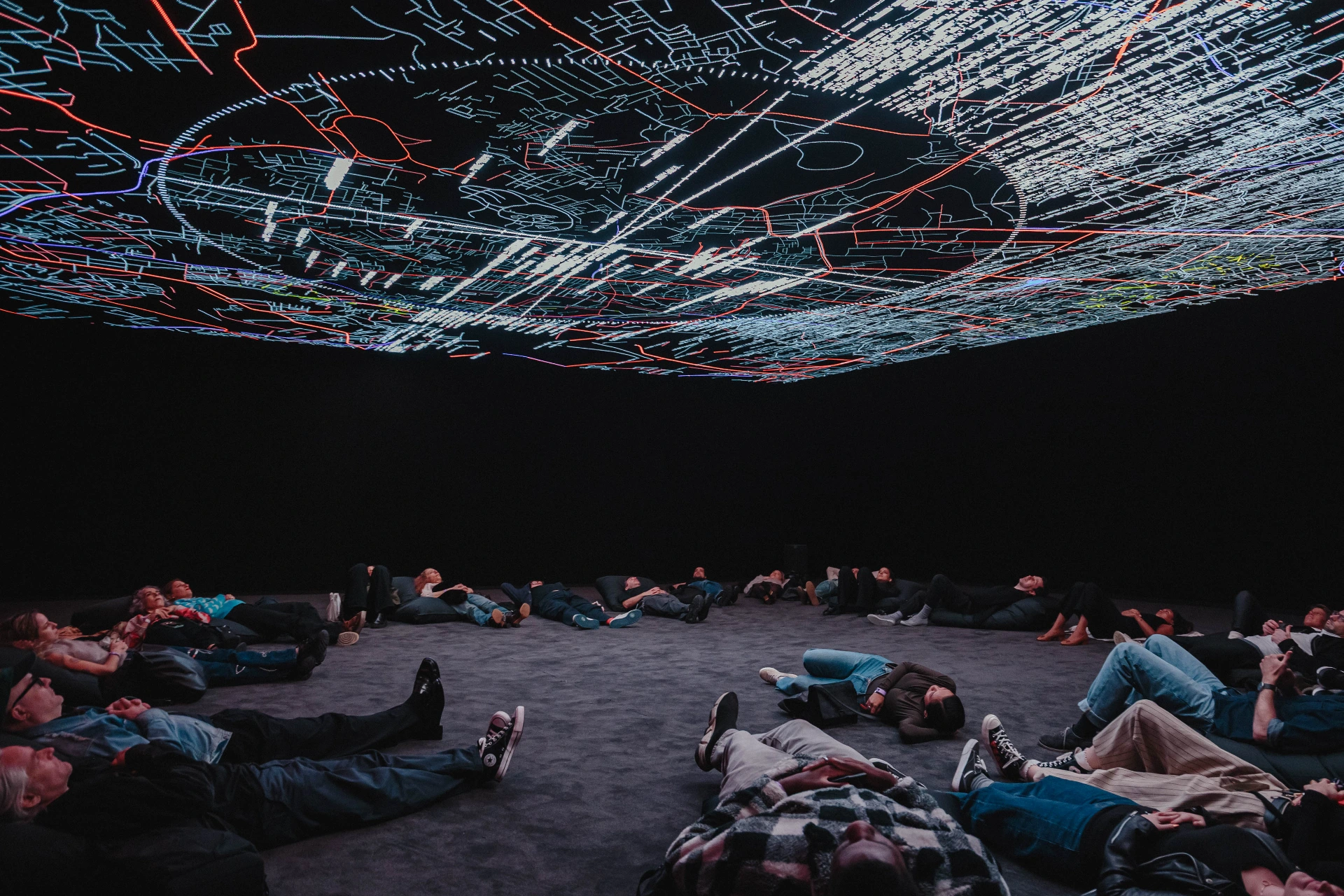
data-cosm [n°1] is not merely an exhibition; it is an environment. Commissioned specifically for the cavernous, subterranean spaces of 180 Studios, the piece utilizes a massive, high-resolution LED ceiling that hangs like an artificial sky above the viewer.
The core premise of the installation is the translation of "raw data" into aesthetic experience. Ikeda, working in collaboration with scientific institutions, harvests datasets—ranging from the atmospheric pressure readings of our planet to the light-curves of distant stars. These numbers, usually relegated to dry academic spreadsheets, are transformed into flickering pulses of light and complex, glitch-inflected soundscapes.
The installation is explicitly designed for immersion. Visitors are encouraged to abandon the traditional verticality of gallery-going, instead lying prone on the floor. This architectural choice is intentional: it mimics the posture of an astronomer gazing upward, physically placing the viewer beneath the weight of the digital universe Ikeda has constructed.
A Chronological Evolution: From data-verse to data-cosm
To understand the gravity of data-cosm [n°1], one must look at the artistic trajectory of Ryoji Ikeda. For over two decades, Ikeda has been the preeminent architect of the "digital sublime." His work often centers on the tension between the infinite complexity of the universe and the binary simplicity of computer code.
The data-verse Trilogy (2019–2021)
The direct ancestor of the current installation is the acclaimed data-verse trilogy. Premiering at the Audemars Piguet commission for Art Basel, data-verse was an ambitious three-part project that interrogated the intersections of art, physics, and biology. It utilized publicly available datasets from organizations like NASA and CERN to visualize the scale of human existence within the larger context of the physical world.
Where data-verse was an exploration of mapping, data-cosm [n°1] acts as a distillation. While the former sought to encompass the sheer breadth of human and cosmic knowledge, the latter focuses on the fluid nature of "cosmological" data—the patterns that repeat across every scale of reality.
The 2025 Premiere and the 2026 Return
data-cosm [n°1] first opened its doors to the public in 2025. The immediate critical response focused on the "physicality" of the sound—a signature Ikeda element where low-frequency oscillations are felt in the chest cavity as much as they are heard. Due to the rapid sell-out of the 2025 run and sustained public discourse surrounding the installation, 180 Studios confirmed the return of the piece for a limited engagement running from 14 October to 20 December, 2026.
Supporting Data: The Science Behind the Art
The power of Ikeda’s work lies in its authenticity. Unlike generative art that relies on randomized noise, data-cosm [n°1] is rooted in empirical science. The datasets employed in the installation include:
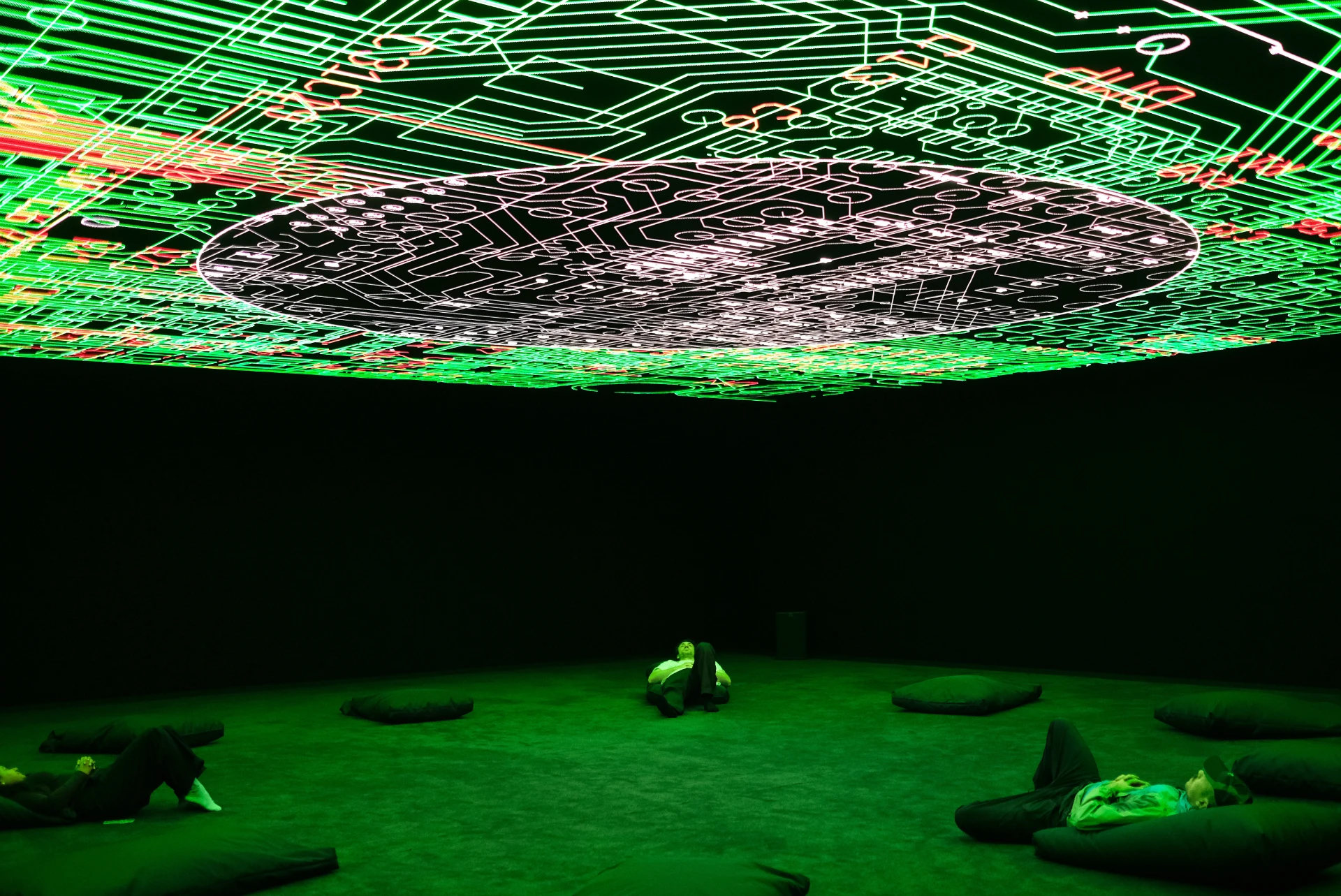
- Particle Physics Data: Utilizing high-energy physics models to visualize the behavior of fundamental particles. This provides the "micro" texture of the visual output, manifesting as rapid-fire white noise and geometric fragmentation.
- Astrophysical Observations: Utilizing telemetry from satellite arrays to map the movement of celestial bodies. This informs the "macro" scale, providing the slower, rhythmic pulses that ground the viewer in the installation’s temporal flow.
- Environmental Monitoring: Integrating real-time (or near-real-time) climate and atmospheric data, which creates a bridge between the abstract cosmic data and the immediate, lived reality of the Earth’s biosphere.
By forcing these disparate scales—the microscopic and the macroscopic—to collide, Ikeda creates a "data-cosmology." The mathematical rigor of the installation serves as a reminder that the same physical laws governing a quark also govern a galaxy.
Perspectives and Official Responses
The reception of Ikeda’s work has been characterized by both critical acclaim and a sense of existential wonder.
"Ikeda manages to strip away the noise of our daily lives and reveal the underlying code of existence," notes one contemporary art critic. "You don’t watch his work; you inhabit it. It is a terrifying and beautiful reminder of how small we are, and yet, how integral we are to the data stream."
The management at 180 Studios has emphasized the importance of bringing such high-concept work to a wider public audience. "Our mission has always been to provide a platform for artists who push the boundaries of technology and space," a spokesperson stated. "The return of data-cosm [n°1] is a testament to the fact that audiences are hungry for experiences that challenge their perceptions of the universe, rather than simply offering a passive aesthetic experience."
The Implications: Where Art Meets the Digital Age
The existence and success of data-cosm [n°1] raise profound questions regarding the future of the museum space and the role of the artist in the age of Big Data.
The De-Humanization of the Viewer
Ikeda’s work is famously devoid of human figures. There are no faces, no narratives of struggle or joy, and no traditional storytelling. By removing the human element, he forces the viewer to confront the "inhuman" scale of the universe. This is a critical pivot in contemporary art: as we move deeper into the era of artificial intelligence and automated systems, artists like Ikeda are exploring what it means to be human in a world defined by machine-readable data.
Technology as the New Canvas
For generations, the canvas was defined by pigment and fabric. For Ikeda, the canvas is the high-fidelity LED display and the multichannel sound system. This shift has significant implications for how we define "fine art." data-cosm [n°1] validates the idea that code—when curated with the precision of a master composer—is as capable of evoking "the sublime" as an oil painting or a marble sculpture.
The Longevity of Digital Installations
The logistical challenges of mounting an installation of this scale are immense. The power requirements, the synchronization of massive LED arrays, and the precision of the audio engineering require a team of specialists akin to a film production crew. The fact that 180 Studios has successfully maintained this installation for a second run highlights the growing trend of "destination exhibitions"—works so technically sophisticated that they function as pilgrimage sites for global audiences.
Visiting Information
For those planning to witness the spectacle, data-cosm [n°1] is open at 180 Studios, 6 Surrey Street, London, WC2R 2ND.
- Schedule:
- Wednesdays: 12:00 – 17:00
- Thursday – Sunday: 12:00 – 21:00
- Booking: Given the high demand experienced during the 2025 premiere, prospective visitors are strongly advised to book in advance via the 180 Studios official website.
As the digital age continues to accelerate, our ability to comprehend the vastness of the information we generate becomes increasingly fractured. Ryoji Ikeda offers a rare reprieve from this confusion. By turning the raw, chaotic data of the universe into a synchronized, pulsating light show, he provides a rare moment of clarity. In the dark, cavernous depths of 180 Studios, we are given the chance to stop, look up, and realize that we are all part of the same, grand, mathematical design. data-cosm [n°1] is not just an exhibition; it is a necessary confrontation with the infinite.