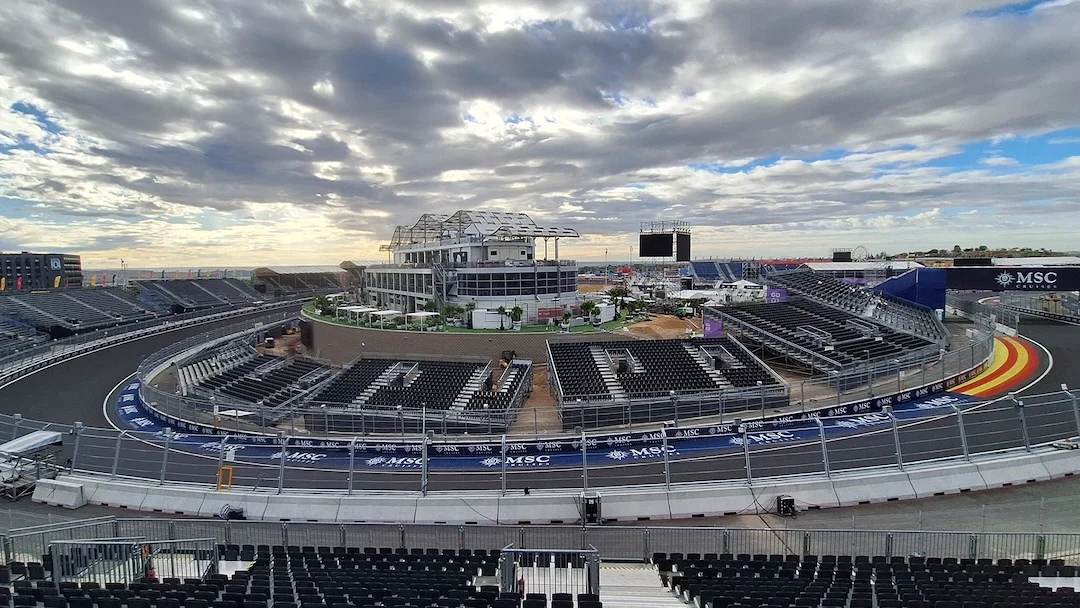
MADRID, Spain – When the engines roared to life at the inaugural Spanish Grand Prix held at the newly minted "Madring" circuit this past August, the spectacle was not merely one of high-octane automotive engineering. Behind the scenes, a different kind of technological marvel was operating—one designed not for speed, but for the absolute safety of 120,000 spectators.
As Madrid cements its status as the new epicenter of Formula 1 in Spain, the infrastructure supporting the circuit—built at a staggering cost of €83.2 million—represents a new benchmark in venue safety. Central to this achievement is a massive, unified public address and voice evacuation (PA/VA) system designed and commissioned by Spanish audio specialists LDA Audio Tech.
The Magnitude of the Challenge: Integrating a City-Scale Venue
The Madring is not a traditional standalone circuit; it is a sprawling, hybrid complex that encircles the IFEMA Exhibition Centre. By integrating racing infrastructure with existing exhibition pavilions, expansive Fan Zones, and high-end hospitality areas, the project developers created a logistical puzzle for safety engineers.
The primary challenge was scale. With a capacity of 120,000 visitors, the venue requires a communication architecture that can segment the crowd during normal operations while providing a centralized, authoritative voice in the event of an emergency. Furthermore, the system had to be fully compatible with the pre-existing audio infrastructure of the various pavilions while remaining subservient to the high-priority race audio managed by the FIA.
"The objective was to create a seamless safety umbrella that covers everything from the pit lane to the furthest grandstand, without interfering with the broadcast-quality audio required for the race itself," says an engineer close to the project.
Chronology of the Build: A Two-Month Race Against Time
The timeline for the Madring project was as aggressive as the cars that would eventually compete on its asphalt. With the August inaugural race date set as an immovable deadline, the integration phase—spearheaded by LDA Audio Tech in collaboration with integrators Ruybesa and DZ Engineering—had to be executed with surgical precision.
Phase 1: The Design Sprint (Early Summer 2026)
Following the finalization of the circuit layout, the audio engineering teams began mapping the acoustics of the IFEMA surroundings. Unlike a permanent, purpose-built circuit in a remote location, the Madring operates within a dense, multi-use environment. This required a distributed rack system that could withstand the environmental variables of a Spanish summer while maintaining fiber-optic connectivity across kilometers of track.
Phase 2: The Integration and Commissioning (July 2026)
Working under a non-negotiable deadline, the teams began the massive task of linking disparate existing systems into a unified architecture. The project involved the installation of hundreds of speaker units and the configuration of a digital backbone that could handle complex routing and synchronization.
Phase 3: The Inaugural Test (August 2026)
The system underwent rigorous "live-stress" testing during the inaugural race weekend. The success of the commissioning was measured by the system’s ability to override local zone audio for emergency announcements while maintaining the integrity of the FIA’s race-day audio feeds.
Technical Specifications: The Power of NEO+ Architecture
The backbone of the Madring’s safety network is built on LDA Audio Tech’s proprietary NEO+ technology. This platform is designed specifically for large-scale, mission-critical environments where latency and intelligibility are non-negotiable.
The Nexo Hub Synchronization
The venue is organized into 15 distinct sites, all of which are connected via a centralized "Nexo Hub." This hub acts as the brain of the operation, utilizing AES67 standards to ensure digital audio synchronization across the entire facility. The use of AES67 is particularly notable, as it allows for the high-fidelity transmission of audio over standard network infrastructures, reducing the need for proprietary cabling across such a large footprint.
Distributed Rack Infrastructure
The scale of the hardware deployment is immense. The primary circuit site, which serves as the hub for the track itself, utilizes 59 NEO-4500E+ extensions. These are organized into 20 strategic racks distributed at intervals along the perimeter of the circuit. This distributed approach ensures that if a local failure occurs in one section of the track, the remainder of the venue’s safety system remains entirely functional.
Acoustic Coverage: The Biamp Community Integration
To ensure that voice evacuation messages are audible above the roar of Formula 1 engines, the project utilized 456 Biamp Community loudspeakers. These were strategically arrayed to cover the grandstands, where the crowd density is at its highest. The choice of hardware was driven by the need for high-frequency dispersion and weather resistance, ensuring that safety messages are as clear during a sudden downpour as they are on a scorching afternoon.
Official Perspectives on the Integration
The collaboration between LDA Audio Tech, Ruybesa, and DZ Engineering is being hailed as a triumph of Spanish engineering. For the venue operators at the IFEMA Exhibition Centre, the system represents more than just regulatory compliance.
"Safety at this scale is not just about having speakers; it is about the intelligence of the system," noted a spokesperson for the project. "By integrating the voice evacuation architecture with our pre-existing systems, we have created a ‘smart’ venue. We can provide targeted information to specific zones—such as the hospitality areas or the Fan Zones—without disrupting the entire facility, unless a total emergency requires it."
The integration with FIA protocols was a point of particular tension during the design phase. Formula 1 race audio requires extreme precision for broadcast, while PA/VA systems require high SPL (Sound Pressure Level) and absolute priority. The resulting configuration allows for a "priority ducking" system, where the race audio is automatically attenuated the moment an emergency broadcast signal is triggered, ensuring that the voice of the safety controller is always the loudest and most intelligible signal on site.
Implications for Future Sporting Venues
The Madring circuit serves as a blueprint for the future of "urban circuit" design. As Formula 1 continues to push for city-center races—often in complex environments like Miami, Las Vegas, and now Madrid—the need for robust, flexible, and integrated safety systems will only grow.
1. The Death of Siloed Infrastructure
The Madring project proves that venues no longer need to rip out existing infrastructure to install modern safety systems. By using IP-based networking (AES67) and flexible hardware like the NEO+ platform, engineers can "wrap" new safety requirements around existing, disparate sound systems.
2. The Shift Toward "Mission-Critical" Audio
The high cost of the project—€83.2 million—underscores the shifting priority of safety in modern sports. Spectator expectations for safety and clear communication have risen in tandem with the complexity of these events. The Madring demonstrates that the audio system is no longer a secondary consideration; it is a primary piece of safety infrastructure, equivalent in importance to the track’s crash barriers or the medical response team.
3. Sustainability and Reusability
Because the system is based on modular rack extensions, it is highly scalable. Should the Madring circuit expand in future years to accommodate larger spectator numbers or additional entertainment facilities, the current audio backbone can be extended simply by adding more nodes to the Nexo Hub.
Conclusion
As the dust settles on the inaugural 2026 Spanish Grand Prix, the legacy of the Madring’s audio engineering is already being felt. By combining advanced digital signal processing with a massive, distributed loudspeaker array, the venue has set a new standard for how large-scale sporting events should protect their visitors.
The Madring is more than just a place to watch cars drive in circles; it is a sophisticated, interconnected machine. With the safety of 120,000 fans secured by the silent, vigilant monitoring of the LDA Audio Tech system, the circuit stands as a testament to the fact that, even in a sport defined by speed, the most important technology on the track is the one that brings everyone home safely.
As the industry looks toward future builds, the lessons learned in Madrid—about rapid deployment, seamless integration, and the necessity of high-fidelity emergency communications—will undoubtedly become the standard for the next generation of global sporting infrastructure.