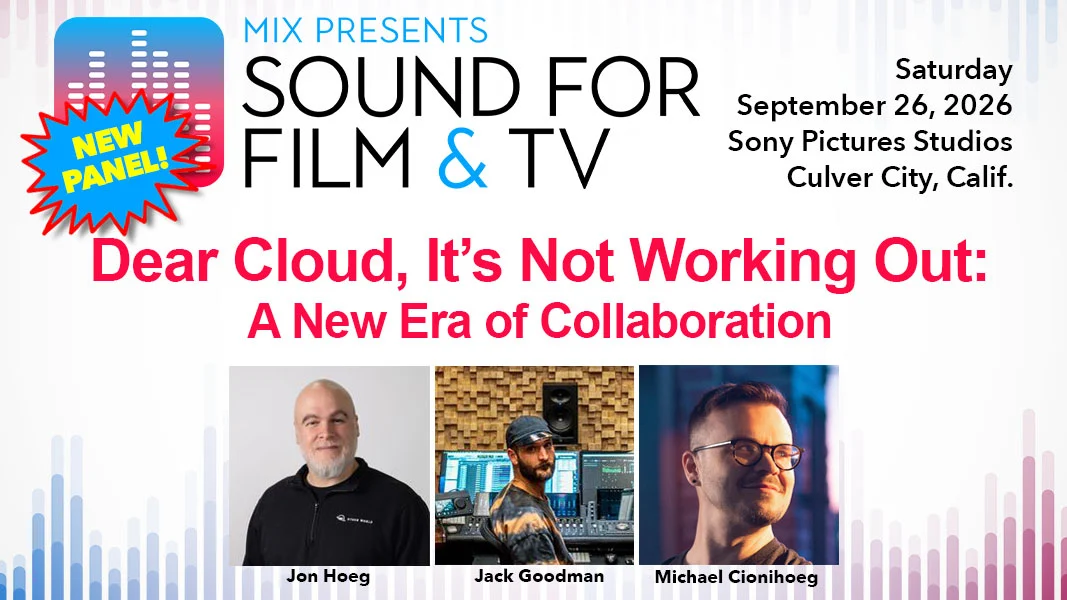
Culver City, CA (September 24, 2026) — For nearly a decade, the audio post-production industry has been swept up in the "Cloud Revolution." The promise was seductive: infinite scalability, seamless remote collaboration, and the ability to work from anywhere. However, as 2026 rolls on, a growing number of industry veterans are beginning to ask a difficult question: Is the cloud actually serving the creative process, or is it creating new bottlenecks?
This Saturday, September 26, 2026, the 13th annual Mix Presents Sound for Film & Television event returns to the historic Sony Pictures Studios in Culver City. While the event will showcase a wide array of technological advancements, one panel in particular is generating significant industry buzz: "Dear Cloud, It’s Not Working Out: A New Era of Collaboration." Presented by Other World Computing (OWC), this session aims to challenge the industry’s reliance on cloud-centric workflows, proposing a return to local storage and high-speed, direct-access media management.
The Core Conflict: Latency vs. Logistics
The shift toward cloud-based audio production was largely accelerated by the necessity of the early 2020s, but as project files grow in size—driven by high-resolution immersive audio and complex 4K/8K video assets—the physics of internet bandwidth are hitting a hard ceiling.
"We are seeing a paradigm shift," says an industry insider close to the event organizers. "The cloud is fantastic for archiving and light-duty collaboration, but when you are working on a high-stakes theatrical mix, the latency involved in cloud syncing is the enemy of the creative flow. We are reaching a point where the friction of the cloud is outweighing its convenience."
The upcoming panel aims to address this head-on. By moving away from a cloud-only mentality, studios are exploring "hybrid-local" workflows that prioritize the speed of on-site NVMe storage while maintaining the collaborative benefits of modern software platforms.
Chronology of the Cloud Shift
To understand why this conversation is happening now, one must look at the trajectory of the last five years:
- 2020–2022 (The Great Remote Migration): Driven by necessity, post-production teams moved en masse to cloud-based storage and virtualized environments. Reliability was sacrificed for accessibility.
- 2023–2024 (The Optimization Phase): As bandwidth costs climbed and file sizes ballooned, firms began to experience "subscription fatigue" and performance degradation.
- 2025 (The Stability Crisis): Reports of sync errors, data bottlenecks, and the high cost of egress fees led many boutique studios to re-evaluate their infrastructure.
- 2026 (The Hybrid Evolution): The current climate represents a "return to sanity." Professionals are now seeking a middle ground—retaining the flexibility of remote access without tethering their primary production timeline to a slow, distant server.
Expert Perspectives: The Panelists
The panel, hosted by Other World Computing, features a powerhouse lineup of industry experts who have spent their careers at the intersection of creative sound and technical infrastructure.
Jon Hoeg (Other World Computing): Representing the hardware side, Hoeg is a vocal proponent of the "Local First" architecture. His work focuses on how high-performance solid-state storage can eliminate the "waiting" periods that plague modern editors and mixers.
Jack Goodman (Jack Goodman Sound): A seasoned audio engineer, Goodman has been at the forefront of the debate regarding how technology impacts the creative output of a sound designer. He has long advocated for workflows that keep the media "close" to the engineer, ensuring that real-time decisions are not buffered by server responsiveness.
Michael Cioni (Strada): Known for his visionary work in post-production technology, Cioni brings a nuanced perspective. His work at Strada focuses on solving the "transportation" problem of large files. Cioni’s participation is expected to center on the idea that "collaboration" should not necessarily mean "all data in the cloud," but rather "all data accessible where it is needed."
Data-Driven Decision Making: Why Local Storage Wins
While cloud proponents argue for the ease of off-site management, the technical data suggests that for high-bitrate audio and video, local storage remains the gold standard.
Current benchmarks indicate that high-end Thunderbolt 4 or USB4 storage arrays can achieve read/write speeds exceeding 2,500–3,000 MB/s. In contrast, even the fastest commercial fiber-optic connections struggle to maintain consistent, sustained throughput for massive multi-track sessions.
For the sound mixer working on a blockbuster film, this speed differential is not just a convenience—it is a requirement for meeting tight deadlines. As budgets shrink and delivery timelines accelerate, the time wasted waiting for a cloud sync to resolve is a direct hit to a studio’s bottom line.
Implications for the Future of Sound for Film
The implications of this shift are profound for the post-production community. If the industry pivots back toward robust, localized hardware, we can expect a few key trends in the coming year:
- Investment in On-Premise Servers: Expect to see a rise in the adoption of professional-grade NAS and SAN solutions within small-to-medium-sized sound houses.
- Refinement of Remote Desktop Solutions: Rather than pushing files to the cloud, more teams will likely adopt high-fidelity remote desktop protocols (like Teradici or Parsec) to control powerful local machines from afar.
- The "Hybrid" Standard: The industry will likely settle on a workflow where the cloud acts as a distribution and "cold" archive layer, while the "hot" work is performed exclusively on local, high-speed drives.
Join the Conversation at Sony Pictures Studios
Mix Presents Sound for Film & Television remains the premier gathering place for these critical conversations. As a cornerstone of the California post-production community, the event serves as a barometer for the health and direction of the industry.
"It’s not just about the gear," says the event coordinator. "It’s about the mindset. We want to ensure that the next generation of sound designers and mixers isn’t just following the crowd into the cloud because it’s the trend, but because they understand the technical and creative consequences of where their data lives."
The conference on September 26 will feature an exhaustive look at these workflows. From the intricacies of immersive audio mixing to the logistics of global, remote team management, the day-long event offers a rare opportunity to engage with the pioneers who are currently writing the rulebook for the next decade of film production.
Final Call for Participation
Registration is currently open for those who wish to witness this debate in person. Given the high attendance expected at the Sony Pictures Studio Lot, organizers strongly encourage early registration to guarantee a seat for the "Dear Cloud" panel and the broader conference sessions.
Whether you are a seasoned veteran navigating the complexities of modern post-production or an emerging professional looking to build a career on a solid technical foundation, the 13th annual Mix Presents Sound for Film & Television is an essential experience.
By challenging the status quo and examining the intersection of technology and creativity, this year’s event promises to be a watershed moment for the industry. Join us in Culver City this Saturday to ensure you aren’t just watching the future of audio unfold—but actively shaping it.
For full event details, speaker bios, and registration information, visit the official Mix Presents Sound for Film & Television website.