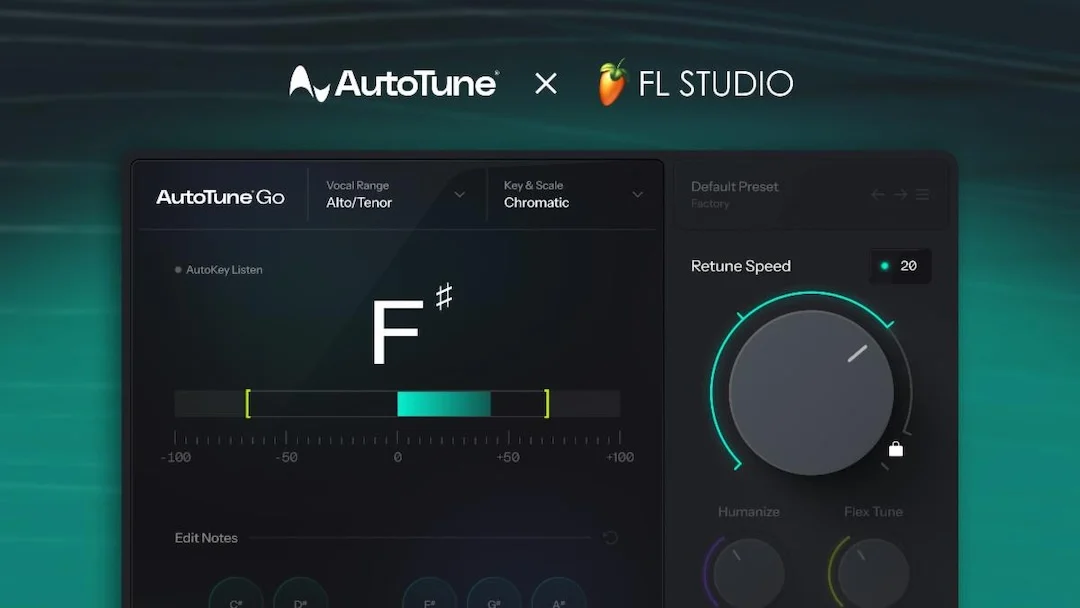
The landscape of modern music production has shifted dramatically over the last three decades, and at the heart of this sonic revolution lies one singular innovation: Auto-Tune. Today, that narrative takes a significant turn as Antares Audio Technologies, in partnership with Image-Line, announces the release of "Auto-Tune Go." Available exclusively within the FL Studio ecosystem via the FL Cloud platform, this new iteration marks the first time Antares has engineered a version of their industry-standard software specifically tailored for a singular Digital Audio Workstation (DAW).
For producers and vocalists worldwide, this development represents more than just a software update; it is the democratization of professional-grade vocal processing. By placing this technology on the free tier of FL Cloud, Antares and Image-Line are effectively removing the financial barrier to entry for the most recognizable vocal sound in the history of recorded music.
The Genesis of a Sonic Standard: A Chronology of Auto-Tune
To understand the magnitude of the Auto-Tune Go release, one must first appreciate the history of the technology.
1997: The Emergence of the "Impossible" Correction
In 1997, Dr. Andy Hildebrand, a geophysicist who had previously developed technology for detecting oil deposits using sound waves, turned his attention to the music industry. He realized that the mathematical principles used to interpret seismic data could be applied to audio pitch detection. The result was the original Auto-Tune hardware, which promised to subtly correct off-key vocal performances. It was intended as a "behind-the-scenes" utility, designed to save time in the studio by eliminating the need for tedious re-takes.
1998: The "Cher Effect"
The cultural pivot point arrived in 1998 with Cher’s hit single, "Believe." By pushing the software’s retune speed to its absolute limit, producers Mark Taylor and Brian Rawling created the now-iconic "robotic" vocal effect. This moment transformed Auto-Tune from a corrective tool into a creative instrument, forever changing the trajectory of pop, hip-hop, and electronic music.
2000s–2020s: Global Proliferation
Over the next twenty-five years, Auto-Tune became ubiquitous. From T-Pain’s chart-topping innovations in the mid-2000s to the mumble rap and trap movements of the 2010s, the software became a defining characteristic of contemporary vocal production. However, as the software grew in sophistication—incorporating real-time pitch correction, formant shifting, and throat modeling—the cost of entry remained relatively high for independent bedroom producers.
2026: The Integration Era
The release of Auto-Tune Go on September 15, 2026, represents the latest chapter in this timeline. By embedding the technology directly into FL Studio’s cloud ecosystem, the industry has moved away from the "standalone plugin" model toward a "native integrated service" model, ensuring that the tool is always at the user’s fingertips.
Anatomy of the Plug-in: Technical Specifications and Features
Auto-Tune Go is not merely a stripped-down version of the professional suite; it is a precision-engineered tool optimized for the FL Studio workflow. Building upon thirty years of proprietary algorithms, the software focuses on the core requirements of modern vocal production.
Essential Tuning Controls
The interface is designed for speed and efficiency. It centers on three primary pillars of vocal management:
- Key and Scale Selection: Users can lock their vocal performances to Major, Minor, or Chromatic scales. This ensures that every note is musically tethered to the underlying instrumental track.
- Vocal Range Controls: To ensure accuracy, the plug-in allows for manual range selection, or users can employ the "Auto Detect" feature, which intelligently analyzes the singer’s pitch profile to determine whether they are a soprano, alto, tenor, or bass.
- Retune Speed Dynamics: Perhaps the most vital feature, the four Retune Speed settings allow for a spectrum of sound. At the slower end of the dial, the plug-in provides natural, transparent pitch correction. At the fastest setting, users can achieve the classic, aggressive, pitch-perfect aesthetic that has defined the sound of modern radio.
The integration is seamless. Because Auto-Tune Go is hosted within FL Cloud, users do not need to manage external licenses or complex iLok-style authorization processes. It functions as a native element of the DAW, allowing for real-time tracking with near-zero latency—a critical requirement for vocalists monitoring themselves while recording.
The Strategic Partnership: Antares and Image-Line
The collaboration between Antares and Image-Line is a testament to the changing power dynamics in audio software. Image-Line’s FL Studio has long been the DAW of choice for independent beatmakers and electronic music producers, largely due to its unique pattern-based sequencing and user-friendly interface.
By partnering with Image-Line, Antares is positioning itself at the center of the largest community of independent creators in the world. This is not just a software deal; it is a distribution strategy that guarantees massive adoption.
Official Response from Antares Leadership
Jeff Wright, CEO of Antares, articulated the vision behind this partnership in a recent statement:
"Bringing Auto-Tune Go directly into FL Studio puts the sound and technology that have helped define modern music into the hands of millions of creators, right where they’re already making music. We’re excited to make Auto-Tune more accessible than ever."
This sentiment underscores a broader trend in the pro-audio industry: the shift from premium, high-cost software suites toward accessible, subscription-integrated models. By offering Auto-Tune Go on the free tier of FL Cloud, Antares is effectively signaling that their value proposition is no longer about gating the technology, but about being the standard platform for the next generation of global music production.
Implications for the Future of Music Production
The availability of professional-grade vocal tuning to every FL Studio user will have profound implications for the music industry.
1. The Levelling of the Playing Field
Historically, the "pro sound" was reserved for artists with access to high-end studios equipped with top-tier hardware. With the release of Auto-Tune Go, the distinction between a "bedroom" recording and a "professional" recording becomes increasingly blurred. A producer in a home studio now has access to the exact same pitch-correction technology used by A-list pop stars.
2. The Standardization of Vocal Aesthetics
As Auto-Tune becomes more accessible, we may see an even greater reliance on pitch correction as a stylistic choice. If the barrier to entry is zero, the incentive to record "perfect" raw takes decreases. This could lead to a future where pitch correction is no longer an optional effect, but a fundamental, baked-in layer of every vocal recording, much like compression or EQ.
3. A New Model for Software Distribution
The "DAW-integrated cloud model" could become the new standard for software developers. If this partnership proves successful, we may see other industry titans—such as Universal Audio, Waves, or FabFilter—seeking similar integrations with major DAWs like Ableton Live, Logic Pro, or Studio One. The era of the fragmented, external plugin may eventually give way to the era of the integrated, ecosystem-based toolkit.
Conclusion: A New Standard for the Modern Vocalist
The release of Auto-Tune Go is a milestone that marks the end of an era where professional pitch correction was a luxury. By integrating this technology into the free tier of FL Cloud, Antares and Image-Line have ensured that the sonic signature of the 21st century remains available to everyone, regardless of their budget or technical background.
As we look toward the future of music, it is clear that the tools of creation are becoming more powerful, more accessible, and more deeply integrated than ever before. Whether used to gently nudge a performance into tune or to create the stylized, hyper-rhythmic vocals that dominate the charts, Auto-Tune Go is poised to become an essential component of the producer’s toolkit. In the hands of the millions of creators who use FL Studio, this software will undoubtedly help write the next thirty years of musical history.